Using a Kmap to reduce a function to its min SOP

Thread Starter

wesqeek

Joined Jun 28, 2017
6
I am studying mechanical engineering and finding it hard to wrap my head around electronics overall...
If someone could please check if my logic (pardon the pun) is correct..

the question is:
(a) Use a Karnaugh map to reduce the following function to its minimum ‘sum of products’ form:

Capture.PNG

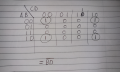
What I have done so far is a Kmap for the 4terms ABCD and left out the ACD

From which I got not(BD) so does this mean that simplified the function becomes
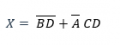
Capture.PNG?

Thanks for the help in advance.

 

Thread Starter

wesqeek

Joined Jun 28, 2017
6
I guess I haven't grasped the concept at all and that's what is confusing me.
How would I map the 4th term out of the five?
I am not simply after the final answer so a resource to read would greatly help me out.

cheers
 

MrChips

Joined Oct 2, 2009
34,807
You map one term at a time into the single Karnaugh map.

For example, map the first term into the map. This is one entry.


The 4th term will be two entries.

If there are no overlaps (repeats), that expression should provide six 1s on the map.
 

Thread Starter

wesqeek

Joined Jun 28, 2017
6
Sadly I am not following, I guess I will need to re read the notes on this site as I seem to be missing fundamentals.
 

WBahn

Joined Mar 31, 2012
32,823
You are almost correct, but you are falling into a common trap.

\(
\bar{BD} \; \neq \; \bar{B} \; \bar{D}
\)

Using the ' for logical NOT of the term immediately to it's left, this is the same as

(BD)' != B'D'

The left expression is true whenever the AND of B and D is not true, meaning that, of the four possible combinations, it is true for ALL EXCEPT when both B and D are true. The right expression is true ONLY when both B and D are false.

Do you understand why you can cover exactly the four corner cells with the term B'D'?
 
Top