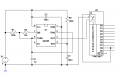
using 555 and 4017 to cycle 7 LED's

Thread Starter

Tony Spence

Joined Dec 20, 2013
64
Second order...have you determined how many amps you need? In Post #71 Bernard calculated that this coil would take "@ 9 V,
I = 6.4 A, 5 V = 3.6 A." That is a whole lot of amps, the BC108 cannot do that without serious loss of power.

If you were driving your current coils with a BC108, you were not getting the full voltage across your coils, so the current (also because of the BC108 saturation characteristics) would not be even near 3 amps or you would have observed some very hot parts, even at a low duty cycle.

You wrote that you need to boost the output of your coils. The output of the coil is proportional to the (current x turns)/ (average distance from one end of the coil through to the other end taking into account all possible paths in space). A magnetic core would help concentrate this magnetic energy -notice that in the elementry school electromagnet experiment the wire is wrapped around a nail?

You need to design your magnetic circuit using the principles above. I suspect that you will want to use many more turns so you can get more of a field with lower current. Once you get something working, measure the current with a steady voltage applied to it, then measure the resistance. We have some people here who are very good at designing driver circuits, but they need to know the coil resistance and the voltage across the coil. Reporting the number of turns can be useful to obtain suggestions at improving your coil design.
In order to find the original current I will need to obtain another bread board and build my first circuit with the 7LEDs and and include the bc108 as that gave me enough power to move the magnet several inches
 

Thread Starter

Tony Spence

Joined Dec 20, 2013
64
There are a number of current pinching points in your circuit. The first one that jumps out at me is the breadboard. They're not intended for large currents.

But there may be many other, starting with the battery and including the hookup wires and active components (ie. transistors). It's tough to make a judgement without details. Length and gauge of the coils, for instance. (Sorry if you've already provided this.)

And as Dick has noted, you'll get a lot more bang for the buck – magnetic field per amp – if you use a core in the coil and provide a return path for the magnetic field.
I need to find a power supply that will generate 9v constantly
 

Thread Starter

Tony Spence

Joined Dec 20, 2013
64
With a input of 9v with the coil on its own I got a reading on my multi-meter was 1.4 ohms with a ten ohm resistor in series I get a reading of 12.1 ohms this is with no other circuit connected
 

Thread Starter

Tony Spence

Joined Dec 20, 2013
64
I have measured the wire it is 720cm long I have some components a blue resistor has near to the same thickness as my copper wire for my coils if that helps on thickness
 

wayneh

Joined Sep 9, 2010
18,124
With a input of 9v with the coil on its own I got a reading on my multi-meter was 1.4 ohms with a ten ohm resistor in series I get a reading of 12.1 ohms this is with no other circuit connected
I'm not sure what you mean about the measurement but assuming your coil is ~2Ω, a 9V battery cannot hold its voltage into that big a load. It would need to put out 4.5A but most of those little rectangular 9V batteries would struggle at 1/10th that current. A sturdy 6V source may be a better choice. 3A may be about all you want to put through that wire.
 

Thread Starter

Tony Spence

Joined Dec 20, 2013
64
I'm not sure what you mean about the measurement but assuming your coil is ~2Ω, a 9V battery cannot hold its voltage into that big a load. It would need to put out 4.5A but most of those little rectangular 9V batteries would struggle at 1/10th that current. A sturdy 6V source may be a better choice. 3A may be about all you want to put through that wire.
Would it be better if the wire of the coils is thinners and would that mean I'd need more windings to produce the desired effect
 

wayneh

Joined Sep 9, 2010
18,124
Would it be better if the wire of the coils is thinners and would that mean I'd need more windings to produce the desired effect
That's a difficult question and the answer depends partly on the load on your rotor and its properties. But ignoring that for a minute, you want to match your coils to your power supply so that you maximize amp•turns.

If the wire is too thin, you'll have lots of turns but current will be reduced by the resistance. A fat wire might take more current than your supply can handle but you can't fit in as many turns.

You can model your system and calculate the ideal wire gauge but it's fairly complex to set up. Most folks just use whatever wire they have on hand and hope for the best. :p

Or try this: Specify a voltage and current that suits your power supply. For instance maybe you want each coil to draw 100mA at 9V. That means it has to, by Ohms law, have a resistance of R = V/I = 9/0.1 = 90Ω. Now look over the table of magnet wire specifications, such as this one from Essex. For every gauge, you can calculate how long a piece of that wire you would need to make a 90Ω coil. Then it's "just" a matter of choosing the gauge that, when you consider the length and wire width, can be formed into the most turns (thus giving the most field) while still fitting within the space you have. A thin wire will take less room per turn, but if you have the room, a fatter wire will be longer (while hitting the Ω target) and might give more total turns.
 
Last edited:

Thread Starter

Tony Spence

Joined Dec 20, 2013
64
That's a difficult question and the answer depends partly on the load on your rotor and its properties. But ignoring that for a minute, you want to match your coils to your power supply so that you maximize amp•turns.

If the wire is too thin, you'll have lots of turns but current will be reduced by the resistance. A fat wire might take more current than your supply can handle but you can't fit in as many turns.

You can model your system and calculate the ideal wire gauge but it's fairly complex to set up. Most folks just use whatever wire they have on hand and hope for the best. :p

Or try this: Specify a voltage and current that suits your power supply. For instance maybe you want each coil to draw 100mA at 9V. That means it has to, by Ohms law, have a resistance of R = V/I = 9/0.1 = 90Ω. Now look over the table of magnet wire specifications, such as this one from Essex. For every gauge, you can calculate how long a piece of that wire you would need to make a 90Ω coil. Then it's "just" a matter of choosing the gauge that, when you consider the length and wire width, can be formed into the most turns (thus giving the most field) while still fitting within the space you have. A thin wire will take less room per turn, but if you have the room, a fatter wire will be longer (while hitting the Ω target) and might give more total turns.
I did what most do and I grabbed the best wire I could for the job which was the copper wire that is wrapped in electrical tape inside a 17 inch or so television set. Then I went by trial and error till I found a suitable amount of turns but I forgot and I do apologise that I did double the power supply to 18v and I also think I added a Darlington pair after each output pin of the 4017 but after a while I think I blew something. Maybe the feed back from the coil hopefully with the added FETs and diodes everything will run well.

I haven't had much time to my self but I have almost constructed my old circuit so that I may get the reading for the power that was used originally.
 
Hi guys, i am new here, so found this thread today and i am wondering what you all are doing. Istopped reading from page 3. Why?
There is nothing wrong with the schematic on the first page.
If it does not work like you expect it to work, then there is something wrong.
And there is something wrong i think.
First, unless you are using a battery, you have to decouple the power supply with capacitors
Second, you need a capacitor on pin 5 of the 555.
If this is not correct, the 4017 can get the wrong signal at the right moment.
More important: read the data sheet of the 4017!
You will find the text: Unused inputs must be connected to VDD, VSS or another input.
If you let them unused, the IC can do things that is not in the data sheet and can produce 5 pages of good ideas that won't work on this forum.
I hope you understand me, i had this problem some years ago, and someone helped me
Peter (from the Netherlands)
 

AnalogKid

Joined Aug 1, 2013
12,169
Hi guys, i am new here, so found this thread today and i am wondering what you all are doing. Istopped reading from page 3. Why?
There is nothing wrong with the schematic on the first page.
Except that it did not do what the TS wanted.
First, unless you are using a battery, you have to decouple the power supply with capacitors
No, you don't. You should, but both of these parts function well with "bad" power. Also, if the circuit is powered by an AC supply with a low output impedance (at the highest frequency of interest, like the 5th harmonic of the narrowest pulse width), and connected with low inductance planes or other wiring technology, local decoupling probably isn't required.
Second, you need a capacitor on pin 5 of the 555.
No, you don't.

ak
 

DickCappels

Joined Aug 21, 2008
10,661
If you stopped reading at page 3 then you probably missed reading that the Thread Starter is satisfied with the results of the thread.

What is the purpose of your questions?
 

ScottWang

Joined Aug 23, 2012
7,501
According the photo that you showed in #74, are you trying to make the magnet motor like the video below?


You can refer to the circuit in post #53.

I'm not sure have you decide the frequency and duty cycle of ne555?
According to the values calculated the frequency and duty cycle below:
R1 : 100K
VR1 : 1M (0~1M), F = 6.87 Hz ~ 144 Hz
C1 : 0.1uF

Frequency : 144 Hz (VR1 = 0Ω)
Duty cycle : 100%
Time high : 6.93 mS
Time low : 0 mS

Frequency : 6.87 Hz (VR1 = 1MΩ)
Duty cycle : 52.38%
Time high : 76.23 mS
Time low : 69.3 mS

555 Astable Circuit Calculator

The current of coil the I = 9V/1.4Ω = 6.4A
The Ids better choose at lest 3 times of 6.4A, Ids = 6.4*3 = 19.2A
So choose the N mosfet the Ids = 20A or more.
The Vcc voltage only 9V, so choose the logic level Vgs<= 5V.
Choose the Vds at least greater than 50% of Vcc, Vds = 9V*1.5 = 13.5V
Choose the Rds around 20 mΩ and less.

Here are four numbers of n mosfet.
BUK9507-30B, N ch,Vds=30V, Ids=75A, Vgs=5V, Rds=7mΩ, Logic level.
CSD16325Q5C, N ch, Vds=25V, Ids=33A, Vgs = 3V, Rds=2.1~2.9mΩ, Logic level.
IRLU8721, N ch, Vds=30V, Ids=45A, Rds=11.8mΩ, Logic level.
PSMN017-30PL, N ch, Vds=30V, Ids=32A, Vgs = 4.5V, Rds=23.4mΩ, Logic level.

Maybe you or our members could provide some others.
I think still something that you should tell us or through the experiments.
 
Top