Completed Project USB Filter

Thread Starter

Wendy

Joined Mar 24, 2008
23,798
#1a.jpg
I was getting objectionable noise on my computer speakers, so I threw this together. Then printed a 3D box to hold it . The top and the bottom of the box slid together only requiring a piece of black duct tape to hold them together. I have attached the dot STL files if someone wants to make their own , also have a bag of used red LED's that when I measured them were the old style (1.6Vf). I took a 1 foot USB extension cable cut it in half identify the power wires and inserted the filter between them

I used a modified dead bug style of wiring. The two large caps were glued on the bottom of the box along with the LED. The 3D printed box had the holes as part of the print.Here are some mid project pictures:


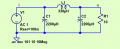
Schematic.png
Schematic

#1.jpg


Attachments

Last edited:

Thread Starter

Wendy

Joined Mar 24, 2008
23,798
Nope I bought them many years ago and just been kicking around in my junk box until I needed them.
 

Thread Starter

Wendy

Joined Mar 24, 2008
23,798
In the not too distant future I will be winding my own coils and measuring their inductance old school. Other than using the 3D printer of course to help with the bobbin.
 

Papabravo

Joined Feb 24, 2006
22,082
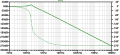
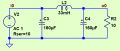
The one you made has a very ugly resonance and a wicked phase shift near the resonance. This would be a better one using the capacitors you have.
1660796780735.png
With this response
1660796844068.png
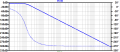
A 3-pole Butterworth with a corner at 100 Hz would be even better. I assume you really want to solve the noise problem, and not give it a 30 dB boost at the resonance peak.
1660797127873.png
1660797198969.png
It will be helpful to know the actual source and load impedances, but this may indicate there are better ways to design things than throwing components on a breadboard.
 
Last edited:

Papabravo

Joined Feb 24, 2006
22,082
Since you plan on making your own inductors, you might want to investigate the design and usage of differential mode and common mode chokes. They are bidirectional and keep noise from getting into your sensitive circuits as well as preventing your circuits from polluting the rest of the system. They are well worth the time you will invest in studying them.
 

DickCappels

Joined Aug 21, 2008
10,661
Gosh, when I read "USB Filter" I assumed it to be something that suppressed the lower sideband was surprised that you are working with RF. : -)

Your attachments have the extension .stl which makes the files difficult or maybe impossible for me to view on my system, and I am pretty sure my cell phone won't be able to open any files with this extension. You might want to consider reposting them in a more common format such as .gif or even 'jpg files.
 

Thread Starter

Wendy

Joined Mar 24, 2008
23,798
Windows 10 and beyond have a viewer built in, LINUX will probably follow (if they haven't already).
 
Top