Unregulated, Isolated, Low-Parts Count?

Thread Starter

johnyradio

Joined Oct 26, 2012
615
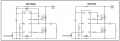
Inspired by @ronsimpson 's LT3439 suggestion, I pulled up some ideas on Digikey. Due to my ignorance, no idea if any of these could do the job. I notice some of the datasheets show a reference design including a transformer. i think some of these require an external oscillator, but i think an osc can be done with very few parts, such as a Schmitt inverter, 1 R, and 1 C.

MP2696A
MPQ8039 (see Figure 7: CCFL Driver Circuit)
MP8040 (see Figure 7—CCFL Driver Circuit)
NCV7721
 
Last edited:

ronsimpson

Joined Oct 7, 2019
4,712
If PCB size is the most important thing; then look for a part that runs fast. (switches at 1mhz) This will reduce the transformer and capacitor size. The LT3999 uses a transformer in 'forward' mode that also reduces size. Switching frequency may be more important then number of parts.

You might put parts under a transformer or on the other side of the PCB.
--edited--
"Isolation" How many volts? Power line isolation or 50 volts?
 
Last edited:

Thread Starter

johnyradio

Joined Oct 26, 2012
615
"Isolation" How many volts? Power line isolation or 50 volts?
Not sure. i assume the isolation need only be higher than the highest expected input V, correct? The input is coming from a typical laptop wall wart, max 24V. Therefor, 50V isolation should suffice.
 
Last edited:

ronsimpson

Joined Oct 7, 2019
4,712
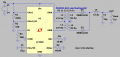
Using LT3999 and a standard transformer from Coil Craft. 12 to 24V input, 6.6V out. Note this transformer was designed for this job but I switched the primary and secondary to get the output I wanted. This IC only guesses at the output voltage. It can not see the actual output voltage.
1600979828709.png
 

Attachments

Ian0

Joined Aug 7, 2020
13,158
Self-oscillating half-bridge driver on the input such as the IR2153, two MOSFETs, series capacitor, transformer, split-phase rectifier using a double-diode, inductor and capacitor on the output. That's 10 components (including the R and C to set the IR2153 frequency).
 

Thread Starter

johnyradio

Joined Oct 26, 2012
615
@ronsimpson , @Ian0 The competition is heating up :) Two strong contenders! It will take me some time to evaluate the pros/cons. Hoping for a short-height inductor (9mm is a bit taller than hoping). i can be more flexible on inductor footprint (length, width).
Ian, i like the no-IC design. The bare metal approach seems feasible for this requirement. Not sure i am capable to make a schematic from your description, but i'll attempt it. Does your topology have a name? Self-oscillating half-bridge?

Here's another i just found:
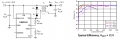
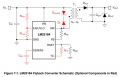
TI LM25184, under $5 from various suppliers
 
Last edited:

Thread Starter

johnyradio

Joined Oct 26, 2012
615
Two interesting bits:

"Optional components in red" . Down to 7 external parts. That's great.
1601014121151.png

Coilcraft offers a Flyback Transformer designed for LM25184. Problem, it's too tall and too expensive for our need. Not so great :)
Curiously, the TI schematic above shows a simple 2-winding inductor, but the coilcraft inductor "designed for LM25184" shows 2 double coils. Maybe for sensing? I wonder if we can get away with a 2-winding inductor.

1601016877258.png
 
Last edited:

Thread Starter

johnyradio

Joined Oct 26, 2012
615
That input will almost certainly be isolated from the mains, so why do you want any further isolation?
This isn't for mains isolation. Some particular internal DC circuitry needs to be galvanically isolated from the rest of the DC circuitry.
 

ericgibbs

Joined Jan 29, 2010
21,466
hi Johnny.
Interesting Thread, but it is becoming a Classic example on how not to design a product, in that it does not have a clear specification.

I would suggest you sit down and take a few minutes in writing out and posting, a detailed specification of the project, so that we as helpers have a clear idea of what you are trying to do.

E
 

Thread Starter

johnyradio

Joined Oct 26, 2012
615
This thread isn't about the design of a product. It's about design of a single circuit, which i've clearly specified at the top of the thread. Reminder, this website isn't called "All About Products." It's called "All About Circuits."

Your complaint is a classic example of someone in a thread demanding information beyond the scope set out in the thread.

This thread is about a circuit with a very specific function, with clearly defined constraints. As such, this thread is progressing very well toward a solution, or set of options. Sorry if that's unsatisfying for you. You needn't participate in the thread if you find that disappointing.

RonSimpson, Ian0, and others are happily participating constructively and creatively in working toward an answer to the question. If you aren't interested (or not able) to help in that effort, that's your choice. But it's not appropriate for you to try and stop other people from doing so.
 
Last edited:

ericgibbs

Joined Jan 29, 2010
21,466
hi,
You are missing the point, I am trying to be helpful, by pointing out you need a clear specification, so that others can help you.

BTW: A Product is something that is produced ,whether it be circuit design or a physical item, after all when you finalise your design, I expect you are going to turn the circuit design into an actual physical module.??

To suggest I am trying stop others from helping, is absolute nonsense.

E
 

ronsimpson

Joined Oct 7, 2019
4,712
Down to 7 external parts. That's great.
Almost all the circuits I showed have the option of no Rt which temperature compensates for the output diodes.
Almost all the circuits I showed have the option of no Css which reduces the turn on current at start up.
Almost all the circuits I showed have the option of no resistors on En pin but that kills the regulation. For the cost of two resistors do you really want a output of 11 to 25 volts?
Almost all the circuits I showed have the option of no clamping on the transformer primary. Build the circuit with the transformer and see if the output will ring above "max voltage". Test at max load and during startup. No one knows how your transformer will ring.
I wonder if we can get away with a 2-winding inductor.
Coil craft uses the same transformer in many different designs. Depending on how you connect the windings you can do different jobs. With increased volume comes lower price. You you can find a different transformer or a different company.
 
Last edited:

Thread Starter

johnyradio

Joined Oct 26, 2012
615
Almost all the circuit I showed have the option of no Rt which temperature compensates for the output diodes.
You mean temperature drift? As long as our Vout stays between 4V and 9V.

Almost all the circuit I showed have the option of no Css which reduces the turn on current at start up.
Is that soft-start? Would that be a big spike?
Almost all the circuit I showed have the option of no resistors on En pin but that kills the regulation. For the cost of two resistors do you really want a output of 11 to 25 volts?
As long as our Vout stays between 4V and 9V.
Almost all the circuit I showed have the option of no clamping on the transformer primary. Build the circuit with the transformer and see if the output will ring above "max voltage". Test at max load and during startup. No one knows how your transformer will ring.
Many thanks for that procedure!

Coilcraft support told me:
This looks like it could work, even though it’s not designed specifically for the LM5180:
https://www.coilcraft.com/en-us/products/transformers/power-transformers/no-opto/ya9280/
This is a shorter inductor, which is great.
 

Attachments

Thread Starter

johnyradio

Joined Oct 26, 2012
615
Self-oscillating half-bridge driver on the input such as the IR2153, two MOSFETs, series capacitor, transformer, split-phase rectifier using a double-diode, inductor and capacitor on the output. That's 10 components (including the R and C to set the IR2153 frequency).
@Ian0 Thanks for telling me about Self-oscillating half-bridge drivers!

Benefits: i like that your driver design gives me the freedom to independently select preferred mosfets for speed, power-handling, on-resistance, etc. I also like that it's unregulated, which helps keep things simple. i like that, unlike the converter chips we've been talking about, it can switch into the MHz range, which can shrink our inductor. Infineon recommends IR2153D for new designs, which needs one fewer external parts.

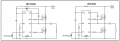
Schematic: To turn your description into a schematic, my starting place is the driver datasheet reference design. Not isolated, but good to know the minimal configuration.

1601069467449.png

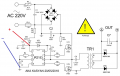
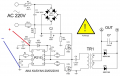
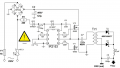
AC/DC: I discovered the IR2153 is a popular choice for mains AC-to-DC converters. Since isolation must be designed into such circuits for safety, and isolation is my goal, seems like a great starting place. Here are some AC/DC circuits based on IR2153.

Input DC connection indicated in red. I'm guessing VD3 can be eliminated with IR2153D. For my application we are only interested in the DC/DC portion.

1601069485075.png


Another one:
1601069156621.png


Driver type: Need to think about which is best for my application: half-bridge, full-bridge (does a full-bridge driver even exist?), high-side, low-side, etc. I'm not sure if this applies to my application.
"- The low-side switch is switching ground while the high-side switch is connecting the voltage supply.
- High-side switch Typically use P-Channel MOSFET.
- P-Type generally have more resistance (or lower current capability) than N-type.
- When you have a load that requires ground, you NEED to use a high-side switch.
- Rule of thumb, if you are turning a device on and off, a low-side switch is a simple solution.
- However, if you are delivering power to an entire circuit or a voltage sensitive device, then you want to use a high-side switch."
https://www.baldengineer.com/low-side-vs-high-side-transistor-switch.html

IR2153 is a half-bridge driver. It looks like the reference design uses N-channel enhancement-mode mosfets for both high-side and low-side switches.

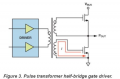
Chip transformer: This article from analog describes a tiny chip-based transformer, surprisingly cheap. Might be the next option to consider for my application.)
 
Last edited:

ronsimpson

Joined Oct 7, 2019
4,712
Soft Start:
Is that soft-start? Would that be a big spike?
At power up, non-soft start power supplies, go to current limit and push as hard as they can to get the output capacitor charged up. This power supply will be at max current while the supply before it is also at max current.
A soft start supply will hold off for some mS to let another supply get up and running well. Then the supply will go to 10% power then 20%, 30% .......80% and hopefully reach full voltage with out stressing out the parts.
Soft start also will not pop the fuse.
I would put the traces for these parts on the PCB and then not populate them. This way you can change your mind later, with out stress.
This is a good part. Some where there is/was a part like the (IR2153+ two 600V MOSFETs). Could not find it last night. SIP with heatsink if I remember right.
 
Top