unknown circuit for me

Thread Starter

abdelazez

Joined Jul 3, 2016
5
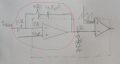
what is this part of circuit ? is it integrator or something else
and what is the expected output in case of Vrf is DC voltage and Isens is sawtooth like signal.
 

Attachments

ci139

Joined Jul 11, 2016
1,989
the 470Ω in series with 4700pF is just to damp the feedback -and/or- delay the response -and/or- protect the inverting input . . . the differential input impedance of an op amp is usually the way higher than this . . . the part looks like a comparator without hysteresis . . . but the shunting bi-polar zener expects the op-amp that can withstand continuous output short
 

Thread Starter

abdelazez

Joined Jul 3, 2016
5
the 470Ω in series with 4700pF is just to damp the feedback -and/or- delay the response -and/or- protect the inverting input . . . the differential input impedance of an op amp is usually the way higher than this . . . the part looks like a comparator without hysteresis . . . but the shunting bi-polar zener expects the op-amp that can withstand continuous output short
Thank you for your reply, so its not an integrator. and its gust error amplifier with non-linear feedback ?
 

MrAl

Joined Jun 17, 2014
13,702
what is this part of circuit ? is it integrator or something else
and what is the expected output in case of Vrf is DC voltage and Isens is sawtooth like signal.
The transfer function of that circuit in the ideal case is:
Vout/Vin=1/(s*Rin*C)+Rf/Rin

and by inspection we can see that the first term is an integrator and the second term is a constant gain. With Rf=470 and Rin=51k that constant gain is less than 1 percent though.
This causes there to be a DC offset in addition to the ramp when a square wave is applied at the input. In the time domain the response to a step input looks like this:
Vout/Vin=t/(Rin*C)+Rf/Rin

and this is a ramp plus a DC offset. The DC offset is very small compared to the ramp.
 

Thread Starter

abdelazez

Joined Jul 3, 2016
5
The transfer function of that circuit in the ideal case is:
Vout/Vin=1/(s*Rin*C)+Rf/Rin

and by inspection we can see that the first term is an integrator and the second term is a constant gain. With Rf=470 and Rin=51k that constant gain is less than 1 percent though.
This causes there to be a DC offset in addition to the ramp when a square wave is applied at the input. In the time domain the response to a step input looks like this:
Vout/Vin=t/(Rin*C)+Rf/Rin

and this is a ramp plus a DC offset. The DC offset is very small compared to the ramp.
Hello MrAl,
Thank you, but i tried to drive the TF for the mentioned circuit and it was Vo/Vi = Rf*(1/SC)/Rin and it can be written in the following formula: Vo/Vin = (Rf*S*C + 1) /( SCRin)
So its different.
 

MrAl

Joined Jun 17, 2014
13,702
Yes and that last form you have is the same i gave, and your first form is not correct.
This is a fairly simple circuit.
The impedance in the feedback is:
Rf+1/(s*C)

and the impedance in the input is:
Rin

So the gain is:
(Rf+1/(s*C))/Rin

and expanded that is:
1/(Rin*s*C)+Rf/Rin

and you can write it differently if you like but expanded it must match that.
 
Top