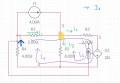
Find unknown current from CCVS circuit.

Thread Starter

kgw5911

Joined Apr 16, 2023
4
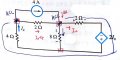
3_스크린샷 2023-04-16 144729.pnge8678428d41471b4c9e3.jpg
- My Goal ; find Ix from given Cicuit
- What I've tried ; Use KVL (at Loop1 )and KCL (at Yellow Node) to express arbitrary current with Ix

* I use KCL at right above blue arrow, then got \(i_1 = I_x -4\)
This is the equation what I've set up \[ 4I_x + 2(I_x -4) + 2i_2 - 2I_x = 0\ \rightarrow (1) \\ i_2 + i_3 = i_1 + 4 = I_x \ \rightarrow (2) \]
from (1) and (2) I derived following , \( i_2 = 4 - 2I_x \ \ \ , i_3 = 3I_x -4 \)
then, use KVL in Loop(2) I marked, I got \(-2Ix -8i_3 + 2i_2 = 0\)

- What I've want to know ; Where did I make mistake? , What am I missing ?
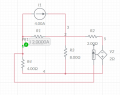
Since Ix turned out 2[A] from Multisim(SPICE), I guess exp(1) is wrong, but.. WHY? I think there's no logical error there..
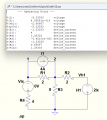
Can any clue please ? ammeter.png
 

Jony130

Joined Feb 17, 2009
5,593
Why do you think that the simulation result is correct? From what I see you did not use the CCVS properly in Multisim. And this is why the simulation answer is wrong.
Ix = 4/3 A ≈ 1.333A
 

WBahn

Joined Mar 31, 2012
32,703
View attachment 292260View attachment 292262
- My Goal ; find Ix from given Cicuit
- What I've tried ; Use KVL (at Loop1 )and KCL (at Yellow Node) to express arbitrary current with Ix

* I use KCL at right above blue arrow, then got \(i_1 = I_x -4\)
This is the equation what I've set up \[ 4I_x + 2(I_x -4) + 2i_2 - 2I_x = 0\ \rightarrow (1) \\ i_2 + i_3 = i_1 + 4 = I_x \ \rightarrow (2) \]
from (1) and (2) I derived following , \( i_2 = 4 - 2I_x \ \ \ , i_3 = 3I_x -4 \)
then, use KVL in Loop(2) I marked, I got \(-2Ix -8i_3 + 2i_2 = 0\)

- What I've want to know ; Where did I make mistake? , What am I missing ?
Since Ix turned out 2[A] from Multisim(SPICE), I guess exp(1) is wrong, but.. WHY? I think there's no logical error there..
Can any clue please ? View attachment 292263
So what did YOU get for Ix? I'm not seeing a result anywhere. Why do you think you made a mistake (I'm not saying whether you did or didn't) since you don't have an answer to even compare to the simulation results?

Speaking of your simulation results, I'm unfamiliar with that symbol for V2 in your simulation schematic, but if it is supposed to be a current controlled voltage source, then you almost certainly need the control current (Ix) to flow THROUGH the port on the left side of the symbol. Since one side of the port is unconnected, the control current through it will be zero, meaning that the output of V2 will be 0 V.

I don't use Multisim, but I'm guessing that there is no actual connection between the vertical and the horizontal wires at your yellow node since there is no connection dot -- they are just two wires that happen to cross.

That means that R1 and R2 (making 4 Ω) are in series and that these are in parallel with R4 (making 2 Ω). Since all of the current from I1 has to split between these two equal paths, the current through R4 (which is Ix) will be 2 A.

So I would say that you have two major mistakes in your simulation schematic.
 

crutschow

Joined Mar 14, 2008
38,316
My LTspice simulation gives an Ix [ I(Vix) ] current of 1.33A also, as Jony130 posted.

In LTspice the H1 voltage here is a function of the current through the dummy 0V voltage source Vix, whose sole function here is to detect the current flowing through it.
The current from + to - through Vix generates a positive output H1 voltage.

1681671502783.png
 
Last edited:

Thread Starter

kgw5911

Joined Apr 16, 2023
4
Why do you think that the simulation result is correct? From what I see you did not use the CCVS properly in Multisim. And this is why the simulation answer is wrong.
Ix = 4/3 A ≈ 1.333A
Thanks Jony ! I didn't even think to doubt the simulation Haha.. Really appreciate for point it out :D
 

Thread Starter

kgw5911

Joined Apr 16, 2023
4
My LTspice simulation gives an Ix [ I(Vix) ] current of 1.33A also, as Jony130 posted.

In LTspice the H1 voltage here is a function of the current through the dummy 0V voltage source Vix, whose sole function here is to detect the current flowing through it.
The current from + to - through Vix generates a positive output H1 voltage.

View attachment 292302
Thanks for kind verification ! Now I know that where I made mistake :D I owe you one!
 

Thread Starter

kgw5911

Joined Apr 16, 2023
4
So what did YOU get for Ix? I'm not seeing a result anywhere. Why do you think you made a mistake (I'm not saying whether you did or didn't) since you don't have an answer to even compare to the simulation results?

Speaking of your simulation results, I'm unfamiliar with that symbol for V2 in your simulation schematic, but if it is supposed to be a current controlled voltage source, then you almost certainly need the control current (Ix) to flow THROUGH the port on the left side of the symbol. Since one side of the port is unconnected, the control current through it will be zero, meaning that the output of V2 will be 0 V.

I don't use Multisim, but I'm guessing that there is no actual connection between the vertical and the horizontal wires at your yellow node since there is no connection dot -- they are just two wires that happen to cross.

That means that R1 and R2 (making 4 Ω) are in series and that these are in parallel with R4 (making 2 Ω). Since all of the current from I1 has to split between these two equal paths, the current through R4 (which is Ix) will be 2 A.

So I would say that you have two major mistakes in your simulation schematic.
--
Sorry, I omitted Ix . I got (Ix was 4/3 [A] from derived linear equation), I think I made a mistake not long after I learned Multisim. Thanks for detail and neat explanation, Really helps me a lot ! Have a good day;)
 
Top