Yes I see I now, thanks.
So for example C9 and R15, form a HPF you say. fc=1/(2PiRC). That's about 1 Hz? R8 and C5 would be about .1 Hz. What frequencies should be eliminated?
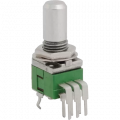
The standard potentiometers that I have (3/4" dia) are 0.2 watts. I've been looking at the Alpha 9mm square pots because they would fit in a smaller enclosure. They are rated at 0.05W. Looking at the simulations, the voltage across either the single or dual pots at any value seems to be negligible, with the absolute value being between 4 - 4.5V. P = I^2*R = V^2/R. Should I be concerned about the lower power rating?
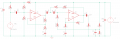
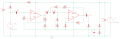
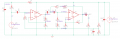
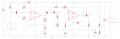
Here is the most recent schematic, based on some minor tweaks and corrections. I changed the HPF dual pot to a 100k so I can use the 9mm above, which reduced the caps from 47n to 22n.
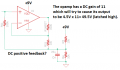
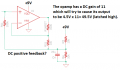
You don't need C5 and C9 if you return the resistors to the mid-supply bias at R3, R4, C4. I demonstrated this in my simulation.
Similarly you can eliminate R10 and return R11 to the mid-supply bias.
I agree. I don't think I'd be too happy about that arrangement. TL072 isn't great for offset voltage. Luckily it is good for input bias current, but that 0V reference is not stiff enough for my liking. I'd keep both C9 and C5 to roll off the DC gain to unity.
I agree. I don't think I'd be too happy about that arrangement. TL072 isn't great for offset voltage. Luckily it is good for input bias current, but that 0V reference is not stiff enough for my liking. I'd keep both C9 and C5 to roll off the DC gain to unity.
So leaving C5 and C9, the question is can R10, R11 be eliminated in lue of the R3, R4 voltage divider if the input to X1 is connected there? Then the DC path to ground for X1 would be through R4, C4. Or is it best for X1 to have it's own separate voltage divider?
Of you delete the very low cost of R10 and connect R11 to the R3 and R4 divider then you will still have some positive feedback (through R2POT) even with C5 and C9 connected. The result might be motor boat (put, put, put) sounds.
I am puzzled because I see 3 resistors marked a s "Rpot" and that implies a 3 section device that is rather rare, and not small.
A separate concern is with connectors soldered to the PCB and mounted to the box. Any vibration will certainly stress that solder connection and lead to failures that will cause problems, and be difficult to see when trying to fix. Even thru-hole attachments may fail from vibration.
R2 and R6 are a dual pot for HPF. R14 is the preamp.
It is common, and in recent years preferred, to solder as much as possible to the board. Most pedals designed in last 5-10 years are this way and have very little point to point wiring.
R2 and R6 are a dual pot for HPF. R14 is the preamp.
It is common, and in recent years preferred, to solder as much as possible to the board. Most pedals designed in last 5-10 years are this way and have very little point to point wiring.
I am aware of the current method, which allows much lower assembly costs. And it will work for a while. But just because it is often done does not mean that it is a good choice for product long term operation. Consider that if the PCB is not adequately supported by other means, those solder connections will be all that is supporting the board, and subject to all of the forces from vibration of that board.
So just because it is done as a cost reduction does not make it a quality improvement. Please understand that!
If the PCB is otherwise supported so that it can not vibrate or move relative t the enclosure, then it might be OK.
So once again, the failure of that solder connection will not be immediate, but probably happen in a few months during the setup for an important gig. And it will be intermittent at first.

 Facebook
 Google
 GitHub
 Linkedin