Universal Motor powering rotor and stator from different triac curcuits ?

Thread Starter

psoke0

Joined Mar 31, 2017
205
Adsız.png


hi. i have powered 220v 550 w Universal motor with triac and arduino it works okay. And also i have powered it with triac and bridge rectifier to power it with DC . i want to power the stator and rotor from different triac curcuits. for example. the stator will get a triac curcuit and rectifed to power it with dc. but rotor will get just triac curcuit and this way the motor will behave like normal DC motor with magnets. its just more stable when i run normal DC motor with triac and rectifier. so i thought what if i convert Universal motor to resemble DC motor with magnets.
what i want to ask is that

1- how can i calculate triac based rectified dc voltage for stator ? like what voltage would be fine because stator winding have much lower resistance then rotor winding.

2- can i power rotor only by itself with triac un rectified but stator is powered with triac rectified voltage ? im asking this because rotor have higher resistance so maybe i wont get problems ?

can you guys help please
 

Ian0

Joined Aug 7, 2020
13,097
View attachment 344006


hi. i have powered 220v 550 w Universal motor with triac and arduino it works okay. And also i have powered it with triac and bridge rectifier to power it with DC . i want to power the stator and rotor from different triac curcuits. for example. the stator will get a triac curcuit and rectifed to power it with dc. but rotor will get just triac curcuit and this way the motor will behave like normal DC motor with magnets. its just more stable when i run normal DC motor with triac and rectifier. so i thought what if i convert Universal motor to resemble DC motor with magnets.
what i want to ask is that

1- how can i calculate triac based rectified dc voltage for stator ? like what voltage would be fine because stator winding have much lower resistance then rotor winding.

2- can i power rotor only by itself with triac un rectified but stator is powered with triac rectified voltage ? im asking this because rotor have higher resistance so maybe i wont get problems ?

can you guys help please
1. Integrate V from the trigger angle to the end of the cycle.
2. No. The direction of the motor depends on the relative polarities of the stator and rotor voltages. If one is AC and the other is DC it won't know where to go.
 

Thread Starter

psoke0

Joined Mar 31, 2017
205
1. Integrate V from the trigger angle to the end of the cycle.
2. No. The direction of the motor depends on the relative polarities of the stator and rotor voltages. If one is AC and the other is DC it won't know where to go.
1- i mean i can set the voltage just fine but how much voltage will be safe for stator. how to calculate that.
2 - im sorry i dont know why i have thinked that way ofcourse we cant make one of them dc and other ac. i want to power it from two rectified triac curcuits. what i was actually asking was. like the first question is there any problem running rotor by itself with another rectified triac ?
 

Thread Starter

psoke0

Joined Mar 31, 2017
205
What is the purpose?
It sounds like you are using a Universal type in the wrong application??
well i have alot of washing machine universal motors. and i will like to put them in good use. like the machines i will operate. Drill , belt sander etc.
 

Thread Starter

psoke0

Joined Mar 31, 2017
205
Essentially you are turning it in to a Shunt field motor, the characteristics are different.
yes that is what im trying to do. some what like shunt motor. but the difference will be that stator voltage will be fixed and i can control the voltage of the rotor so that i will have speed control. what i want to know is how can i calculate the max safe voltage needed for the stator and rotor. i can measure inductance and resistance of windings. but when motor runing how back emf will effect it ?
 

schmitt trigger

Joined Jul 12, 2010
2,027
What you are intending to do is operate the universal motor as a shunt-wound DC motor.
You can do that, but definitely require a large DC supply to provide current to the stator field. The DC supply must have a DC ammeter or you require to provide an external one. The DC supply must have a current sourcing capacity equal to the motor’s original full load current. For starters, do you know the motor’s FLA?

Now and WITHOUT THE ROTOR CONNECTED, apply the DC supply to the stator, and increase its voltage until you reach the FLA current.

Then and only then, you apply voltage to rotor. Failure to do that, or with a weaker field than required, the motor will both overspeed and go into overcurrent. For the simple reason that without a magnetic field, there is no back-EMF generated to regulate either. Write down the rotor’s voltage required for full speed. Do you have the means to measure RPM?

Of course, you may barrel ahead to figure out the electric motor’s principles by trial and error, which is also a good way of learning things.
 

Thread Starter

psoke0

Joined Mar 31, 2017
205
What you are intending to do is operate the universal motor as a shunt-wound DC motor.
You can do that, but definitely require a large DC supply to provide current to the stator field. The DC supply must have a DC ammeter or you require to provide an external one. The DC supply must have a current sourcing capacity equal to the motor’s original full load current. For starters, do you know the motor’s FLA?

Now and WITHOUT THE ROTOR CONNECTED, apply the DC supply to the stator, and increase its voltage until you reach the FLA current.

Then and only then, you apply voltage to rotor. Failure to do that, or with a weaker field than required, the motor will both overspeed and go into overcurrent. For the simple reason that without a magnetic field, there is no back-EMF generated to regulate either. Write down the rotor’s voltage required for full speed. Do you have the means to measure RPM?

Of course, you may barrel ahead to figure out the electric motor’s principles by trial and error, which is also a good way of learning things.
omg. that is exactly type of answer i wanted. thankyou.
first of all i have rpm meter also i can measure amps.
couple of questions :)

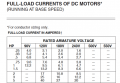
1- When you talking about FLA is it motor stall current or what ?
2- when you said "weaker field than required" will it go crazy even if its lets say half of the FLA current ? because eventually if im going to power the stator with rectified triac its not going to be very smooth current its will have ripples. but i guess i can give more voltage untilthat triac also gives same amount of current so that average current of the triac will be the same of normal dc supply. but is that also can go crazy if its 120 hz ripple even when there is the same FLA current applied like DC supply ?
 

Thread Starter

psoke0

Joined Mar 31, 2017
205
Last thing: the stator field must be continuous if you plan to use phase-control DC (full bridge rectifier with a Triac) on the rotor.
yes otherwise remaining magnetic field in stator will couse the motor go faster and faster if only rotor is powered or power of the stator is removed before the rotors power removed. is that what you are saying
 

MaxHeadRoom

Joined Jul 18, 2013
30,559
yes that is what im trying to do. some what like shunt motor. but the difference will be that stator voltage will be fixed and i can control the voltage of the rotor so that i will have speed control. what i want to know is how can i calculate the max safe voltage needed for the stator and rotor. i can measure inductance and resistance of windings. but when motor runing how back emf will effect it ?
That is essentially how a shunt motor works, the field is usually fixed, in most applications, very large motors in machine control etc, if the drive experiences field loss the consequence is unlimited runaway often to destruction. :(
IOW, the lower the field the higher the possible RPM, use a field voltage that will give you the RPM required at the max load.
 

Thread Starter

psoke0

Joined Mar 31, 2017
205
That is essentially how a shunt motor works, the field is usually fixed, in most applications, very large motors in machine control etc, if the drive experiences field loss the consequence is unlimited runaway often to destruction. :(
IOW, the lower the field the higher the possible RPM, use a field voltage that will give you the RPM required at the max load.
i see. okay so how can i determine the original max load capacity FLA of this 550w 220v universal motor ? is there a way ?. by the way i am very carefull when doing high voltage work. i respect the electricty power and act accordingly. and also i always clamp these motors to the table or screw them to the table when testing. so that if anything happens its will not jump or anything. i also have kill switch ready. sometimes at first i use 2400W incandescent lamp that i build by connecting 100w bulbs in parallel an connecting that to the curcuit im testing in series. incase if there is short curcuit happens its will only light the light bulbs.
 

schmitt trigger

Joined Jul 12, 2010
2,027
FLA means full load amps.
Indeed a FW bridge will provide pulsating voltage to the stator, bur the motor’s own inductance and magnetic remanence will smooth the torque. But still, I would only use the Triac to control the applied voltage to the rotor.
Be free to experiment though, after you have got the motor running correctly with full field current.
Lastly, be aware that field weakening operates the motor at constant power, meaning that as the speed increases the torque will decrease.
 

MaxHeadRoom

Joined Jul 18, 2013
30,559
Series field motors essentially operate in a run away condition where the RPM is basically controlled by load, the high RPM is also one reason they are used for vacuum applications
Another app is in the older starter motors as they are also capable of very high torque loads. Starting at zero RPM.
 

MaxHeadRoom

Joined Jul 18, 2013
30,559
In shunt mode, you will have the field current which is dependent on its resistance and supply voltage, the armature will depend on load.
The AC/DC universal motor is not a good candidate for becoming a shunt field type.
 
Top