Universal Active Filter IC's

Thread Starter

rpschultz

Joined Nov 23, 2022
838
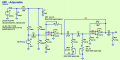
Are the wipers of R10 & R11 adjusted separately or are they mechanically connected (2-gang potentiometer)? Do you or they have a simulation file for this design?
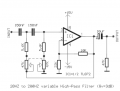
It's a dual gang, single shaft, yes I know the schematic is missing the dashed lines between the 2 pots. No I haven't figured out how to simulate the circuit in Eagle yet. But the HPF is based on this design.
VariableHPF.png
 

MrChips

Joined Oct 2, 2009
34,908
This might be feasible for a low pass application with an analog anti-aliasing filter. This is a high pass application where all the frequencies above the Nyquist limit will be folded back into the baseband.
Agreed. You still need a hardware/analog anti-aliasing filter.
 

Thread Starter

rpschultz

Joined Nov 23, 2022
838
Agreed. You still need a hardware/analog anti-aliasing filter.
I'm afraid this is above my knowledge level. I thought anti-aliasing was only needed in analog-digital conversions and not needed in DC applications.

So is another filter beyond the 2nd order HPF needed in my application?
 

Papabravo

Joined Feb 24, 2006
22,084
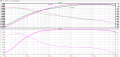
I decided to do an LTspice version of your Adjustable HPF. I may or may not have replicated the circuit accurately. If I did, I don't think it is doing what you want it to do. Rather than moving the corner frequency it is shifting the shape and the attenuation in the passband. IMHO this is NOT what you intend to do. The initial gain stage is fine, but the rest is (fill in your own pejorative term).
1671809857701.png
The following traces show the gain stage V(O1) and the final output V(Vo) at the extremes of adjustment, [0.15,,0.95].
1671809717295.png
 

Attachments

Papabravo

Joined Feb 24, 2006
22,084
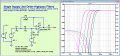
Check out the following Application note from TI:

Filter Design in Thirty Seconds -- SLOA93, December 2001
For additional ideas on filter design, I think this might be closer to what you have in mind. Notice that over the range of interest the passband gain is constant and identical for the simulated settings. Bigger values for resistor RK move the corner lower.
1671811047182.png
 

Thread Starter

rpschultz

Joined Nov 23, 2022
838
Hmmmm, sounds like you're onto something.
So R1=2*R2. I wonder why this is. Is it possible to use the same dual gang pot? If I put a 50k across the 50k pot, that's close to 1/2 of R through most of it's range. It would be fairly accurate at the lower end of the HPF... but then the ratio would get further from 1/2.
I also need to use a voltage divider arrangement to get 4.5V off of one leg of the pot, and it connects back to the opamp a little different. Can I still use the 2nd side of a TL072?
 

Papabravo

Joined Feb 24, 2006
22,084
Hmmmm, sounds like you're onto something.
So R1=2*R2. I wonder why this is. Is it possible to use the same dual gang pot? If I put a 50k across the 50k pot, that's close to 1/2 of R through most of it's range. It would be fairly accurate at the lower end of the HPF... but then the ratio would get further from 1/2.
I also need to use a voltage divider arrangement to get 4.5V off of one leg of the pot, and it connects back to the opamp a little different. Can I still use the 2nd side of a TL072?
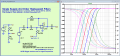
I think you may have drawn the same conclusion that I did from this simulation I did 2.5 years ago. I reworked it to cover your frequency range of interest, used a TL072, and replaced the V+/2 voltage source with a standard voltage divider.
1671821126047.png
 

Attachments

Last edited:

Ian0

Joined Aug 7, 2020
13,158
If you are prepared to accept non-unity gain, then you can achieve a Butterworth filter with R1=R2
A resistor across the pot won't work.
 

Ian0

Joined Aug 7, 2020
13,158
Some amount of non-unity gain could be acceptable. If R1=R2, do you still need the 4.5V?
Yes. Although I'm not a fan of single supply circuits, I'd always use a ±15V supply for audio.
If you use a gain of 1.577, then the frequency setting resistors are equal for a Q of 0.7
 

Audioguru again

Joined Oct 21, 2019
6,826
The 2nd-order Sallen-Key filter has a Butterworth response (flat until a sharp corner) when the opamp gain is 1 and R1=2*R2.
If you make the opamp gain about 1.6 times then R1= R2 for a Butterworth response.

The datasheet for the UAF42 does not show a frequency response for us to see if its highpass is 1st-order or 2nd-order,
Maybe the response of a UAF42 is a 2nd-order highpass.
 

Audioguru again

Joined Oct 21, 2019
6,826
Some amount of non-unity gain could be acceptable. If R1=R2, do you still need the 4.5V?
Of course the 4.5V bias voltage is needed for the opamp with a gain of one and is powered from 9V. The "half the supply voltage" bias allows the output of the opamp to produce a maximum up and down output voltage swing.

Since an opamp input draws a very low current then the 4.5V can be two 22k resistors in series producing 4.5V and a 22uF capacitor to ground making a very low impedance.
 

Audioguru again

Joined Oct 21, 2019
6,826
Why must the filter have an adjustable cutoff frequency?
It would be easy to make a switched 4th-order Butterworth highpass filter but it is not two 2nd-order circuits in series that would produce a droopy Bessel response (not a sharp-corner Butterworth response). You must lookup the resistor ratios for it to be Butterworth..
 

Thread Starter

rpschultz

Joined Nov 23, 2022
838
Why must the filter have an adjustable cutoff frequency?
A variable HPF is an extremely useful knob for acoustic guitarists to have. Low end feedback is always a concern, so depending on the stage conditions you want more or less low end, more or less roll off.

The Grace Designs Felix I mentioned a few posts up is variable HPF from 40-1000 hz. It is designed for more than just guitar. Practically speaking, most acoustic guitarists would set it between 80-400 hz.
 

Ian0

Joined Aug 7, 2020
13,158
Why must the filter have an adjustable cutoff frequency?
It would be easy to make a switched 4th-order Butterworth highpass filter but it is not two 2nd-order circuits in series that would produce a droopy Bessel response (not a sharp-corner Butterworth response). You must lookup the resistor ratios for it to be Butterworth..
Two cascaded 2nd order Butterworths is a 4th order Linkwitz-Riley response, and it used in professional audio for crossovers, because, for two coherent sources, the outputs of high-pass and low-pass add to form a flat response.
 
Top