Facebook
 Google
 GitHub
 Linkedin

Hi.
I have some fundamental misunderstanding I am hoping you can help me with.
Attached image ckt1.png shows my test circuit.
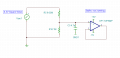
It is a ~10:1 voltage divider (high resistances to look at a large voltage).
It is followed by a non-inverting opamp buffer.
To build the circuit, the source is an AFG set to high output impedance, 5Vpp, 2.5V offset.
For the amplifier I tried three parts: an NE5532, a TL972, and an LM6132. These are all dual chips, and the unused amp is correctly terminated.
The amplifiers are powered with +/- 5V rails.
Because the divider resistances are large, some loading is to be expected, both by the opamp input, and by the scope probe if placed at the divider. In fact, 10M probe on ~1M divider will load a 500mV signal down to 450mV.
I'm trying to come up with an explanation as to why the measurements I made were different for each chip:
1) NE5532: buffer output swings between -172mV and 324mV (delta of 496mV)
2) TL972: buffer output swings between 628mV and 1.120mV (delta of 492mV - measured at tighter 200mV/div because of larger offset)
3) LM6132: buffer output swings between 80mV and 576mV (delta of 496mV)
The output offsets are large, and unexpectedly varied from chip to chip. Does anyone know why this might be?
I have some fundamental misunderstanding I am hoping you can help me with.
Attached image ckt1.png shows my test circuit.
It is a ~10:1 voltage divider (high resistances to look at a large voltage).
It is followed by a non-inverting opamp buffer.
To build the circuit, the source is an AFG set to high output impedance, 5Vpp, 2.5V offset.
For the amplifier I tried three parts: an NE5532, a TL972, and an LM6132. These are all dual chips, and the unused amp is correctly terminated.
The amplifiers are powered with +/- 5V rails.
Because the divider resistances are large, some loading is to be expected, both by the opamp input, and by the scope probe if placed at the divider. In fact, 10M probe on ~1M divider will load a 500mV signal down to 450mV.
I'm trying to come up with an explanation as to why the measurements I made were different for each chip:
1) NE5532: buffer output swings between -172mV and 324mV (delta of 496mV)
2) TL972: buffer output swings between 628mV and 1.120mV (delta of 492mV - measured at tighter 200mV/div because of larger offset)
3) LM6132: buffer output swings between 80mV and 576mV (delta of 496mV)
The output offsets are large, and unexpectedly varied from chip to chip. Does anyone know why this might be?