Understanding Hammond Toroid Power Transformer specifications?

Thread Starter

gatesw

Joined Feb 28, 2011
18
Hello,

I am looking at a Hammond Toroid Power Transformer PN 1182M117 which provides very basic specs on their website and a connection instruction datasheet.

I have never dabbled around with transformers much less with transformers in power supplies and I am trying to understand the provided specification per Hammond. For PN1182M117 the website provides

VAWired in SeriesWired in ParallelDual or Single%Voltage Regulation
300 234V C.T. @ 1.28A 117V @ 2.56A Dual 5.80%

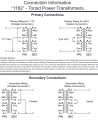
The PN1182M117 is a Dual transformer with a Primary and a Secondary and according to the Connection Datasheet it looks something like this:
1740773815273.png


What I see here is basically two coils on the "left" and two colis on the "right"

My confusion is with the power/current ratings.

1. Is my following understanding correct regarding the basic wiring for a dual toroid transformer?
I think there are other methods here but just focusing on the top level wiring methods for the sake of understanding the specifications and practicalities.

For example:

1. Wire the primary in parallel for 117VAC input and the Secondary in parallel for a 117VAC output (isolated - 1:1)
2. Wire the primary in parallel for 117VAC Input and the Secondary in series for a 234VAC output (isolated - 1:2 )
3. Wire the primary in series for 234VAC Input and the Secondary in parallel for a 117VAC output (isolated - 2:1 )
4. Wire the primary in series for 234VAC Input and the Secondary in series for a 234VAC output (isolated - 1:1 )

So if above is OK would this mean:
1. I could run 117VAC @2.56A on both sides?
2. I could run 117VAC @2.56A on primary side and 234VAC @1.28A on secondary side?
3. I could run 234VAC @1.28A on both side?
4. I could run 234VAC @1.28A on primary side and 117VAC @2.56A on secondary side?

In the spirit that power has to be equal on both sides 300VA primary = 300VA secondary is this correct?

I am also wondering why so many toroid transformers do not provide the number of windings, resistance and inductance specifications?

I am trying to relate this in effort to avoid overheating and not melting the winding enamel i.e shorting etc...

I am trying to replicate this project but with some modifications and the things I am trying to understand are:

1. In chatting with Hammond I was offered the idea of placing the toroid transformer in front of the variable transformer for the sake of the toroid transformer efficiency i.e. the input to the transfomer will be 120VAC and its output will feed into the variable transformer.

2. I do not yet understand why isolation is lost when when the project (switch) is set to 240V. I am still going through the wiring diagram. It seems like the toroid transformer should always be isolated?

3. The most important feature for me is the 350VDC output ~ 3A (Isolated) so I am still working through the power chain calculations but I am starting with the toroid transformer.
 
Last edited:

Ian0

Joined Aug 7, 2020
13,112
So if above is OK would this mean:
1. I could run 117VAC @2.56A on both sides?
2. I could run 117VAC @2.56A on primary side and 234VAC @1.28A on secondary side?
3. I could run 234VAC @1.28A on both side?
4. I could run 234VAC @1.28A on primary side and 117VAC @2.56A on secondary side?
Yes correct.

If you connect a 300VA load to the secondary, the power taken from the supply to which the primary connects will be 300VA*1/η where η is the efficiency.

300VA is a thermal rating. You can exceed it for short periods of time. Power tool transformers are generally rated for about 3x the continuous rating.

Number of windings is not important. Ratio of windings is simply ratio of voltages. Because of the shape of the B-H curve, inductance is very ill-defined, and unless you want to do something clever with the transformer, it won't matter too much.

I don't know why isolation might be lost when the input is 240V.

If it is 300VA, then, if you rectify it , you will get 325V at slightly less than 1A. I don't know where 3A came from.
 

crutschow

Joined Mar 14, 2008
38,407
f it is 300VA, then, if you rectify it , you will get 325V at slightly less than 1A. I don't know where 3A came from.
And since you need to derate a transformer to about 60% of its rating for a full-wave rectified-filter DC output, the allowed output is only about 1/2A at 325V.
 

Thread Starter

gatesw

Joined Feb 28, 2011
18
@Ian0 and @crutschow thank you both.

I was referencing the inscrutables project. Perhaps I misunderstood its BOM?

The project BOM calls out for "2 separate 120VAC coils 280VA" and claims to achieve 350VDC ~3A. Proved difficult for me to find something like this as his part was salvaged from a centrifuge I think he said.

It even shows that in the video. The odd thing is in the video it shows a single part - not 2 separate coils - but then shows a single toroid coil and then a variable transformer but the block diagram show to units.

Is there any concern with having the toroid transformer in front of the variable transformer?
 

crutschow

Joined Mar 14, 2008
38,407
What drives the need to derate the transformer ?
The high, short peak current pulses from the transformer due to the diode-capacitor supply for a DC output, generates an RMS current value much higher than the average DC current (since the RMS heating is proportional to the square of the current).
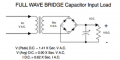
As shown below, from a Hammond Transformer design guide for a full-wave bridge rectifier, the Idc output is 0.62 of the secondary Iac(RMS).

1740794394006.png

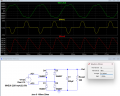
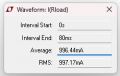
As an example in the sim below, you can see that the current of the transformer source, I(Vtran) is 1.77Arms, whereas the DC load current, I(Rload) is only 1A.
(The actual derating factor is affected by the resistance of the transformer windings.)

1740796318823.png1740796347391.png
 
Last edited:

Ramussons

Joined May 3, 2013
1,567
[/QUOTE]
2. I do not yet understand why isolation is lost when when the project (switch) is set to 240V. I am still going through the wiring diagram. It seems like the toroid transformer should always be isolated?
[/QUOTE]
An Autotransformer is a 3 terminal device, and so there is no Isolation between the input and Output.
 

MaxHeadRoom

Joined Jul 18, 2013
30,595
Hello,
I have never dabbled around with transformers much less with transformers in power supplies and I am trying to understand the provided specification
The majority of concerns are identical whether I,E. or Toroidal style transformer.
One thing to watch for though is to never enable the centre mounting bolt and retainer to complete a path to chassis-ground the outside of the unit, as this will constitute a shorted turn and overheat the unit.
The Toroidal is much more efficient due to the retention of the magnetic field to within the unit.
Little or no radiated field.!
 

Thread Starter

gatesw

Joined Feb 28, 2011
18
The high, short peak current pulses from the transformer due to the diode-capacitor supply for a DC output, generates an RMS current value, much higher than the average DC current (since the RMS heating is proportional to the square of the current).
As shown below, from a Hammond Transformer design guide for a full-wave bridge rectifier, the Idc output is 0.62 of the secondary Iac(RMS).

View attachment 343481

As an example in the sim below, you can see that the current of the transformer source, I(Vtran) is 1.77Arms, whereas the DC load current, I(Rload) is only 1A.
(The actual derating factor is affected by the resistance of the transformer windings.)

View attachment 343484View attachment 343485
Thank you very much @crutschow.

So helpful and interesting. I have never used LTSpice but I made an effort to replicate what you shared with me and then to add the "transformer" as mutually coupled inductors. I measured the resistance on the actual transformer which I received yesterday. I get about 2.2 Ohm for each of the primary windings and about 2.4 Ohm on the secondary. I added these values to the model as series resistance values for each of the windings/inductors.

I am not really sure what to pick for the Inductance values. The LTSpice tutorials suggest the ratio of the square root of the inductance values but this leads me back to some more questions:

1. No manufacturer spec on inductance and I have no good way to measure. So does it matter from a sim point of view or just pick the ratios correctly similar to the voltage or turn ratios etc.. ?

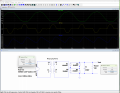
Here is my "copy cat" of the results you shared plus the transformer. Please note the measured resistor values are in the model so these results shown here lump in the resistor values.


Screenshot 2025-03-01 172136.png
 

Ian0

Joined Aug 7, 2020
13,112
There is an easy way to approximate the primary inductance. Just measure the primary current with no load on the secondary. Then Z=V/I and L=Z/(2πf)
It ignores the core losses.
If you can measure the current and voltage on a scope, and get the phase shift, which will be almost 90°, then you can also work out the core losses, which appear as a resistor in parallel to the primary inductance.
If you short out the secondary, and measure the primary inductance with an inductance meter, then you have an approximation of the leakage inductance. There is a more accurate way, but you need a variac.
 

Thread Starter

gatesw

Joined Feb 28, 2011
18
There is an easy way to approximate the primary inductance. Just measure the primary current with no load on the secondary. Then Z=V/I and L=Z/(2πf)
It ignores the core losses.
If you can measure the current and voltage on a scope, and get the phase shift, which will be almost 90°, then you can also work out the core losses, which appear as a resistor in parallel to the primary inductance.
If you short out the secondary, and measure the primary inductance with an inductance meter, then you have an approximation of the leakage inductance. There is a more accurate way, but you need a variac.
I do have a 0-130VAC 2000VA variac. Would I need a current probe proper for the scope approach or could I get away with a precision shunt or something? I dont have a current probe for my scope.
 

Ian0

Joined Aug 7, 2020
13,112
I do have a 0-130VAC 2000VA variac. Would I need a current probe proper for the scope approach or could I get away with a precision shunt or something? I dont have a current probe for my scope.
As you have a variac, you can measure it with a meter. Start at zero, then slowly increase it to mains voltage. Without a variac the inrush current would probably blow the fuse in the meter.
You could try 10Ω in series and measure the voltage across the resistor with the scope. Watch out for what is earthed! You might end up with your scope connected to neutral.
You might even be able to measure the phase shift, but the current waveform tends not to be a nice sinewaves.
 

crutschow

Joined Mar 14, 2008
38,407
I get about 2.2 Ohm for each of the primary windings and about 2.4 Ohm on the secondary. I added these values to the model as series resistance values for each of the windings/inductors.
Okay, but then you need to remove the 15Ω series impedance for Vtran, since that was to simulate the transformer resistance.
 

MisterBill2

Joined Jan 23, 2018
27,315
A bunch of comments: First, unless you connect the mains to your secondary circuit, there is no loss of isolation. Second, if your VARIAC is only rated for 130 volts AC, you will need to use it to control the input to the transformer, and if you want an output near 350 VDC, the secondary will need to be wired IN SERIES. The maximum voltage may approach 350 volts at no load and at a maximum input from the Variac.
Considering that the diodes will not be conducting until the voltage rises enough to make the diodes conduct, you will have higher current pulses, but the same average power. So there may be more heating. But you may not need to do much derating.
 
Top