Facebook
 Google
 GitHub
 Linkedin

A few years ago, I bought a µCurrent GOLD device for instrumentation purposes and I'm quite happy with it.
Lately, I've been wanting to replicate the circuit on my own, and after some digging I found this video by Dave Jones himself explaining a stability glitch in the design. One of the comments drew my attention:
@ericksonengineering7011
I see the problem in the schematic. The output stage uses a resistor from the output of the op-amp to the output pin. This R, plus a capacitive load adds a high frequency pole which causes excess phase shift and thus oscillation of the output stage. Move that feedback cap to the op-amp output instead of the board output and increase it a bit, I'd guess 100-1000pF. This was a latent design problem. Spice the circuit and you will see the marginal stability of that stage with a C load. A marginal design is like a blind man walking along the edge of a cliff. If he drifts one way, no problem. If he drifts the other way a tiny bit he falls off. The parameter that is changing slightly is the op-amp phase margin, changing slightly from batch to batch. Fix the design, don't select parts. Hope this helps.
Dave Erickson
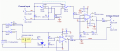
Now, here's Mr Jones' schematic:
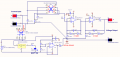
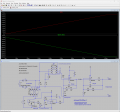
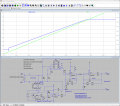
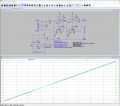
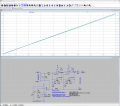
I have redrawn the above schematic myself, but omitting the TPS3809 chip, and the range selector switch. I have drawn the schematic as it would look like if the range selector switch were set at its most sensitive. That is, in the nano-amps range. For convenience, I have replicated the part numbering as well. The schematic includes the suggested correction at the circuit's output, which is to reconnect C4 directly into the output pin of U4. I have also added C5 for the purpose of being consistent regarding the use of bypass caps.
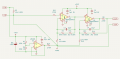
And now for the questions:
If only I had the spice file for the LMV321 I would start exploring the circuit immediately
Lately, I've been wanting to replicate the circuit on my own, and after some digging I found this video by Dave Jones himself explaining a stability glitch in the design. One of the comments drew my attention:
@ericksonengineering7011
I see the problem in the schematic. The output stage uses a resistor from the output of the op-amp to the output pin. This R, plus a capacitive load adds a high frequency pole which causes excess phase shift and thus oscillation of the output stage. Move that feedback cap to the op-amp output instead of the board output and increase it a bit, I'd guess 100-1000pF. This was a latent design problem. Spice the circuit and you will see the marginal stability of that stage with a C load. A marginal design is like a blind man walking along the edge of a cliff. If he drifts one way, no problem. If he drifts the other way a tiny bit he falls off. The parameter that is changing slightly is the op-amp phase margin, changing slightly from batch to batch. Fix the design, don't select parts. Hope this helps.
Dave Erickson
Now, here's Mr Jones' schematic:
I have redrawn the above schematic myself, but omitting the TPS3809 chip, and the range selector switch. I have drawn the schematic as it would look like if the range selector switch were set at its most sensitive. That is, in the nano-amps range. For convenience, I have replicated the part numbering as well. The schematic includes the suggested correction at the circuit's output, which is to reconnect C4 directly into the output pin of U4. I have also added C5 for the purpose of being consistent regarding the use of bypass caps.
And now for the questions:
- Have I reconnected C4 correctly? Or is it necessary to also reconnect the right side of R14 the same way?
- I would like to simulate the circuit in LTSpice, but I cannot find the model for LMV321, which opamp could be used instead?
- I would like to make a cheaper version of this circuit, by replacing the MX4239 with other zero-drift opamp, if possible. For instance, the NCS333 costs only $0.48 whilst the MAX4239 goes for more than $3.00 buks! ... I know that the NCS333 has entirely different characteristics, but what would happen if said opamp is used instead? ... I would expect that its accuracy (and possibly its response time) would be very affected, but what about stability and repeatability?
If only I had the spice file for the LMV321 I would start exploring the circuit immediately
Attachments
-
 290.9 KB Views: 1
 -
593.4 KB Views: 1
-
1.2 MB Views: 1
-
1,012.8 KB Views: 1