Understanding datasheet sink source current How do you read a datasheet?

Thread Starter

paul296

Joined Aug 13, 2016
15
In this case using a 74HC02 at 2V

Simple needs:
Gate 1 > Drive an LED at 2mA @ 2V output
Gate 2 > Drive a Transistor with the 2V output. Saturation is about 3mA.

The datasheet here: http://www.nxp.com/documents/data_sheet/74HC_HCT02.pdf?
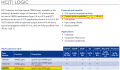
From NXP selection guide in the screenshot it says 8mA. I can't find 8mA anywhere to confirm.
Then:
If you look at something like this- https://gadgetory.com/index.php?route=product/product&product_id=82 it says 5.2mA for 2 to 6v.

So from the datasheet:
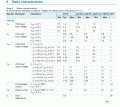
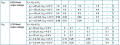
Is it a maximum of -20uA at 2.0V, but then if you look at 6V you also have -20uA and further down -5.2mA or is this the voltage at those currents. But where is the actual source sink currents.


If you look at the 'limiting values'
Io - Output current - -0.5 < Vo <Vcc + 0.5V +- 25mA
Icc - supply current 50mA

I interpret that as It can supply 25mA out of any output pin as long as 50mA is not exceeded. So: 20uA, 25mA, 5.2mA, 8mA ???
 

Attachments

dl324

Joined Mar 30, 2015
18,248
I've found NXP datasheets to be rather sparse when it comes to details.

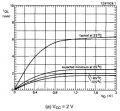
Here's a curve from a Philips Semiconductors HC guide:
upload_2017-1-26_8-35-42.png

Depending on how high you let the output voltage rise, you can't expect more than a mA or two. Conservative designs will use the minimum value so the circuit will work if you don't get a typical part...
 

crutschow

Joined Mar 14, 2008
38,388
So where do the others come into play,
6V has 20uA and 5.2mA.
The data sheet shows the source and sink currents and voltages for normal operating conditions.
The output is a voltage, not at current, and output current is determined by the load resistance it is driving, it doesn't force that current.
Thus at Vcc=6V and a high impedance load that causes a source and sink current of only 20μA, the output voltage will 5.9V and 0.1V respectively, worst-case.
If the load causes a source and sink current of 5.2mA (about 1.1kΩ to either GND or Vcc respectively) then the output voltages will be 5.48V and 0.26V respectively, worst-case.
(All the above are at 25°C.)

The 25mA is the maximum continuous output current you should allow (which may be less than the short-circuit current).
The output voltage at that current is unspecified.
upload_2017-1-26_8-58-42.png
upload_2017-1-26_8-33-58.png
 
Last edited:

Thread Starter

paul296

Joined Aug 13, 2016
15
I've found NXP datasheets to be rather sparse when it comes to details.
I'll never understand the need to by cryptic, I also have a 74HC132 that says 4mA at 5V but the datasheet references all but 5V and it also has 6v at 20uA.

Anyway, if I read the chart correctly, assuming typical 25 deg 'C' it's around 6.25mA which on the 74HC02 D/S Limiting values it has 25mA Io - output current, to me divided by 4 outputs it's 6.25mA per output. Yeah, I'm still nowhere.

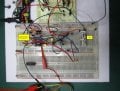
I've added a screen shot of a cct using the 74HC02 drawing 4.25ma at 2.3V that's been running all day.
 

Attachments

Thread Starter

paul296

Joined Aug 13, 2016
15
The data sheet shows the source and sink currents and voltages for normal operating conditions.
The output is a voltage, not at current, and output current is determined by the load resistance it is driving, it doesn't force that current.
Thus at Vcc=6V and a high impedance load that causes a source and sink current of only 20μA, the output voltage will 5.9V and 0.1V respectively, worst-case.
If the load causes a source and sink current of 5.2mA (about 1.1kΩ to either GND or Vcc respectively) then the output voltages will be 5.48V and 0.26V respectively, worst-case.
(All the above are at 25°C.)
That's what I thought.
The 25mA is the maximum continuous output current you should allow (which may be less than the short-circuit current).
The output voltage at that current is unspecified.
So, it can't be 25mA per pin or can it. Assuming it's less than the 50mA total.
Also why the need to be cryptic, they put everything else.
 

crutschow

Joined Mar 14, 2008
38,388
So, it can't be 25mA per pin or can it. Assuming it's less than the 50mA total.
Also why the need to be cryptic, they put everything else.
Yes, it can if you don't exceed the 50mA total.
But that's an abnormal mode of operation (They are not being cryptic. It's an Absolute Maximum Limit which you normally stay well away from), so you are on your own when doing that.
If you need that much current, it's better to add a buffer transistor at the output rather than stressing the IC.
 

Thread Starter

paul296

Joined Aug 13, 2016
15
Yes, it can if you don't exceed the 50mA total.
But that's an abnormal mode of operation (They are not being cryptic. It's an Absolute Maximum Limit which you normally stay well away from), so you are on your own when doing that.
If you need that much current, it's better to add a buffer transistor at the output rather than stressing the IC.
Ok, so let me get this straight/ish.
Absolute extreme : 25mA per pin as long as it's below the to total of 50mA
Typical conditions 5.2mA per output pin at any voltage from 2 to 6V. taking into consideration the voltage and temp effects.

So why cant they just say Operating Voltage 2 to 6V
Io Current per pin 5mA subject to temperature and other limitations.
 

hp1729

Joined Nov 23, 2015
2,304
hi,
The d/s states 20uA for Source and Sink at 2Vsup.
E
Yes, 20 uA ... "and stay within 0.1 V of the rail voltages". If you are not concerned with staying within these limits "Absolute Maximums" says + or - 25 mA for output current.
So ... try it and see if it works. Will it put out enough voltage at the necessary current? What LED?
You can spend a week in theory or get your answer in 5 minutes by trying it.
 

Thread Starter

paul296

Joined Aug 13, 2016
15
Yes, 20 uA ... "and stay within 0.1 V of the rail voltages". If you are not concerned with staying within these limits "Absolute Maximums" says + or - 25 mA for output current.
So ... try it and see if it works. Will it put out enough voltage at the necessary current? What LED?
You can spend a week in theory or get your answer in 5 minutes by trying it.
I actually tried it, with a 2.2V rail - 1.25mA from the output I loose 0.1V. there is a screenshot of it in an above post.

My main concern was understanding the data sheet to what the IC is actually capable of sourcing/sinking.
 

hp1729

Joined Nov 23, 2015
2,304
In this case using a 74HC02 at 2V

Simple needs:
Gate 1 > Drive an LED at 2mA @ 2V output
Gate 2 > Drive a Transistor with the 2V output. Saturation is about 3mA.

The datasheet here: http://www.nxp.com/documents/data_sheet/74HC_HCT02.pdf?
From NXP selection guide in the screenshot it says 8mA. I can't find 8mA anywhere to confirm.
Then:
If you look at something like this- https://gadgetory.com/index.php?route=product/product&product_id=82 it says 5.2mA for 2 to 6v.

So from the datasheet:
Is it a maximum of -20uA at 2.0V, but then if you look at 6V you also have -20uA and further down -5.2mA or is this the voltage at those currents. But where is the actual source sink currents.


If you look at the 'limiting values'
Io - Output current - -0.5 < Vo <Vcc + 0.5V +- 25mA
Icc - supply current 50mA

I interpret that as It can supply 25mA out of any output pin as long as 50mA is not exceeded. So: 20uA, 25mA, 5.2mA, 8mA ???
Theory and data sheets aside. Yes I had no problems diving a red LED from a 74HC86 at 2 V. Driving it directly (10 ohm resistor to measure current) It drew about 40 mA. With a 100 Ohm resistor it drew about 2.5 mA. About 1.88 V out and 1.65 or so across the LED. (No precision intended.)
The answer to the question is, YES.
 

Thread Starter

paul296

Joined Aug 13, 2016
15
Theory and data sheets aside. Yes I had no problems diving a red LED from a 74HC86 at 2 V. Driving it directly (10 ohm resistor to measure current) It drew about 40 mA. With a 100 Ohm resistor it drew about 2.5 mA. About 1.88 V out and 1.65 or so across the LED. (No precision intended.)
The answer to the question is, YES.
Hp1729 :D yes I know I can make the smoke escape, and it will probably run an LED if I also hook it up to my house hold mains. At least for one billionth of a nano second, but it should work;)

I have a greater understanding now of how to interpret that data sheet and the IC's limitations, unless I want to make it smoke.
 

Thread Starter

paul296

Joined Aug 13, 2016
15
Hello,

Perhaps the attatched PDF will tell you more about the parameters of digital chips.

Bertus
Thanks, I'll see about reading through all 68 pages.

For an exercise I loaded the TI 74HC02's data sheet and with the info gained in these posts I understood it.
 
Top