Understanding a particular oscillator

Thread Starter

Antsy electron

Joined Dec 27, 2022
69
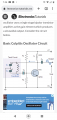
I read the article about the oscillator in the photo but couldn't understand how comes that the output of the oscillator comes out of the collector when is the collector who is feeding power to the entire system. I mean , the voltage is higher at the collector. Current doesn't move from emitter to collector , specially when the collector is at higher potential. Screenshot_20230214-194659.png
 

WBahn

Joined Mar 31, 2012
32,823
It's not a matter of current flowing in one direction or another, it's a matter of changes in current resulting in changes in voltage that are then capacitively coupled to the output.
 

Thread Starter

Antsy electron

Joined Dec 27, 2022
69
It's not a matter of current flowing in one direction or another, it's a matter of changes in current resulting in changes in voltage that are then capacitively coupled to the output.
I got it , since RF is high frequency AC it moves back and forth in both directions changing voltage of course from peak to peak while in the process... Am I right ?.
 

MrAl

Joined Jun 17, 2014
13,702
I got it , since RF is high frequency AC it moves back and forth in both directions changing voltage of course from peak to peak while in the process... Am I right ?.
Hello there,

To better understand the operation of this circuit you should first analyze the path between the collector and the base. That goes through an inductor sort of in parallel with two capacitors, and then another capacitor. Analyze that as if it was a filter. That will help you understand this much better. You can then see how the transistor adds to the circuit functionality.

If you dont know how to do this im sure someone here can help you.
 

Thread Starter

Antsy electron

Joined Dec 27, 2022
69
Hello there,

To better understand the operation of this circuit you should first analyze the path between the collector and the base. That goes through an inductor sort of in parallel with two capacitors, and then another capacitor. Analyze that as if it was a filter. That will help you understand this much better. You can then see how the transistor adds to the circuit functionality.

If you dont know how to do this im sure someone here can help you.
Thanks a lot sir.
 

LvW

Joined Jun 13, 2013
2,026
For each harmonic oscillator the "oscillation condition" (formulated by H. Barkhausen) applies:
There must be one single frequency for which the loop gain LG is unity (in practice: Slightly larger than unity).
That means: Zero phase shift and unity magnitude.
Loop gain: LG=Transfer function of the complete loop when it is opened at a suitable point.

As a consequence, we need a frequency-selective feedback network and an amplifier (to compensate the losses in the filter).
In your case, there is a phase inverting amplifier stage (common emitter configuration, phase shift 180deg).
Therefore, the filter in the feedback path must be able to produce a phase shift of another 180 deg at the desired frequency.
This is realized with a third-order lowpass in ladder topology (ro-C1-L-C2). The resistance ro is the dynamic output resistance at the collector node.
This describes roughly the principle function of the shown circuit.

For finding suitable passive component values you must
* design the 3rd-order lowpass to meet the 180deg criterion at the desired frequency wo,
* find the attenuation at the frequency wo
* design the amplifier for compensating the filter attenuaton at w=wo.
 

Thread Starter

Antsy electron

Joined Dec 27, 2022
69
For each harmonic oscillator the "oscillation condition" (formulated by H. Barkhausen) applies:
There must be one single frequency for which the loop gain LG is unity (in practice: Slightly larger than unity).
That means: Zero phase shift and unity magnitude.
Loop gain: LG=Transfer function of the complete loop when it is opened at a suitable point.

As a consequence, we need a frequency-selective feedback network and an amplifier (to compensate the losses in the filter).
In your case, there is a phase inverting amplifier stage (common emitter configuration, phase shift 180deg).
Therefore, the filter in the feedback path must be able to produce a phase shift of another 180 deg at the desired frequency.
This is realized with a third-order lowpass in ladder topology (ro-C1-L-C2). The resistance ro is the dynamic output resistance at the collector node.
This describes roughly the principle function of the shown circuit.

For finding suitable passive component values you must
* design the 3rd-order lowpass to meet the 180deg criterion at the desired frequency wo,
* find the attenuation at the frequency wo
* design the amplifier for compensating the filter attenuaton at w=wo.
Thanks a lot sir.
 

MrAl

Joined Jun 17, 2014
13,702
Thanks a lot sir.
You are welcome.

BTW do you happen to have any actual values for the components (resistors, capacitors, inductors, transistor, etc.) ?
We could look at this in more detail.

You will probably find that that LCC section passes one frequency only, so it acts like a sharp bandpass filter. That would be the frequency of oscillation.
Probably w=L*C but that's just a guess right now it could be other.
 
Last edited:

LvW

Joined Jun 13, 2013
2,026
You will probably find that that LCC section passes one frequency only, so it acts like a sharp bandpass filter. That would be the frequency of oscillation.
I do not think that this view is correct.
At the center frequency, a bandpass filter has zero deg phase shift.
But we need a phase shift of 180deg at the desired oscillation frequency (see my last contribution).
As I have mentioned already, the LCC section - together with the output resistance at the collector node - forms a 3rd-order lowpass which is able to produce a phase shift of 180deg at one single frequency.
 

Thread Starter

Antsy electron

Joined Dec 27, 2022
69
You are welcome.

BTW do you happen to have any actual values for the components (resistors, capacitors, inductors, transistor, etc.) ?
We could look at this in more detail.

You will probably find that that LCC section passes one frequency only, so it acts like a sharp bandpass filter. That would be the frequency of oscillation.
Probably w=L*C but that's just a guess right now it could be other.
Thanks a lot sir ... Unfortunately no , I found it online.
 

MisterBill2

Joined Jan 23, 2018
27,507
This thread is an excellent example of why it is best to understand basic AC circuit theory prior to trying to figure out how actual circuits with active components function. Understanding DC circuit theory will also be useful in understanding how it works.
an understanding of inductive and capacitive reactance makes it possible to understand how an LC (resonant circuit) oscillator works. Otherwise it is a lot like climbing a ladder with a bunch of rungs missing: Much more difficult, maybe impossible. There is a good reason for building in sequence.
 

Thread Starter

Antsy electron

Joined Dec 27, 2022
69
This thread is an excellent example of why it is best to understand basic AC circuit theory prior to trying to figure out how actual circuits with active components function. Understanding DC circuit theory will also be useful in understanding how it works.
an understanding of inductive and capacitive reactance makes it possible to understand how an LC (resonant circuit) oscillator works. Otherwise it is a lot like climbing a ladder with a bunch of rungs missing: Much more difficult, maybe impossible. There is a good reason for building in sequence.
Thank you sir but is know how an LC tank works , I have seen several times , o just didn't understand why the output was in the collector . Is more about understanding BJTs . A posible explanation to why the output is in the collector is that AC move back and forth. That's my best guess since to the best of my understanding the current move from Collector to Emitter in NPNs .
 

LvW

Joined Jun 13, 2013
2,026
Thank you sir but is know how an LC tank works , I have seen several times , o just didn't understand why the output was in the collector . Is more about understanding BJTs . A posible explanation to why the output is in the collector is that AC move back and forth. That's my best guess since to the best of my understanding the current move from Collector to Emitter in NPNs .
The circuit consists of an amplifier (common emitter gain stage) with a frequency-selective feedback network (3rd-order lowpass).
Such an amplifier has an input and an output.
Antsy electron, don`t you think that it is quite logical to use the amplifiers output node (collector) ?
 

Thread Starter

Antsy electron

Joined Dec 27, 2022
69
The circuit consists of an amplifier (common emitter gain stage) with a frequency-selective feedback network (3rd-order lowpass).
Such an amplifier has an input and an output.
Antsy electron, don`t you think that it is quite logical to use the amplifiers output node (collector) ?
Since AC ( RF ) moves back and forth I guess you can choose emitter or collector , any of them in this case. Just a wild guess.
 

MrAl

Joined Jun 17, 2014
13,702
I do not think that this view is correct.
At the center frequency, a bandpass filter has zero deg phase shift.
But we need a phase shift of 180deg at the desired oscillation frequency (see my last contribution).
As I have mentioned already, the LCC section - together with the output resistance at the collector node - forms a 3rd-order lowpass which is able to produce a phase shift of 180deg at one single frequency.
Hi,

Well the Colpitts proper depends on the resonate frequency of the LC circuit.
Is this a real Colpitts? I'll check that out next.

How did you come to the conclusion that it is something else?
 

MrAl

Joined Jun 17, 2014
13,702
I do not think that this view is correct.
At the center frequency, a bandpass filter has zero deg phase shift.
But we need a phase shift of 180deg at the desired oscillation frequency (see my last contribution).
As I have mentioned already, the LCC section - together with the output resistance at the collector node - forms a 3rd-order lowpass which is able to produce a phase shift of 180deg at one single frequency.
Hello again,

Ok i took another look at it and the frequency appears to be:
f=1/(2*pi*sqrt(L*C))
where
C is the series combination of the two caps across the inductor.
This is a regular Colpitts.
 
Last edited:

MisterBill2

Joined Jan 23, 2018
27,507
Consider that in a parallel LC resonant circuit the voltages at opposite ends of the tuned circuit are always 180 degrees out of phase.Then look at the circuit and observe that the collector and the base are connected to opposite ends of the resonant circuit.
Now I add to my statement that before challenging an active circuit operation it really is important to understand AC circuit theory.
As for why the output is from the collector? That is for a few reasons, first, it is a lower impedance portion with the greatest voltage swing, and so the most power is available there, Being a lower impedance point, the power removed will tend to have less effect on the oscillation frequency, which is useful for frequency stability.
 
Top