Understanding a particular oscillator

LvW

Joined Jun 13, 2013
2,027
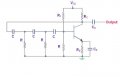
Consider that in a parallel LC resonant circuit the voltages at opposite ends of the tuned circuit are always 180 degrees out of phase.Then look at the circuit and observe that the collector and the base are connected to opposite ends of the resonant circuit.
Yes - I agree. This view leads us to another interpretation of the circuit.
Nevertheless, an analysis of the feedback function (by hand or by simulation) clearly shows that it is 3rd-order lowpass function.
 

MrAl

Joined Jun 17, 2014
13,704
Yes - I agree. This view leads us to another interpretation of the circuit.
Nevertheless, an analysis of the feedback function (by hand or by simulation) clearly shows that it is 3rd-order lowpass function.
Hello again,

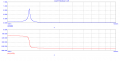
Where are you getting this 3rd order lowpass function from, and what are you using to drive the input when you test the LCC part of the circuit?

Here are some facts:
1. When i do a hand analysis i get a bandpass with fairly sharp response.
2. When i do a simulation i get a bandpass with fairly sharp response.
3. When i do a simulation of the entire circuit the output frequency follows the resonant frequency of the circuit.
4. Articles written on this kind of oscillator show the frequency follows the resonant frequency.
5. The plot in the attachment is clearly a bandpass with a fairly sharp response.

What are you using to drive the input part of the LCC part of the circuit? That's the part from the collector to that third capacitor.
 

Attachments

LvW

Joined Jun 13, 2013
2,027
Hello again,

Where are you getting this 3rd order lowpass function from, and what are you using to drive the input when you test the LCC part of the circuit?

Here are some facts:
1. When i do a hand analysis i get a bandpass with fairly sharp response.
2. When i do a simulation i get a bandpass with fairly sharp response.
3. When i do a simulation of the entire circuit the output frequency follows the resonant frequency of the circuit.
4. Articles written on this kind of oscillator show the frequency follows the resonant frequency.
5. The plot in the attachment is clearly a bandpass with a fairly sharp response.

What are you using to drive the input part of the LCC part of the circuit? That's the part from the collector to that third capacitor.
Its a classical lowpass in ladder topology, see my post 7.
During your simulation - did you ground the node between both caps?
It is lowpass, thats for sure.
A bandpass cannot produce 180 deg phase shift
 

BobTPH

Joined Jun 5, 2013
11,515
@MrAl ,

I am probably totally wrong about this, but I think your graph shows a low pass filter with a sharp resonant peak at the transition frequency. Notice that at low frequencies the response asymptotically approaching a non-zero value whereas at high frequencies it approaches zero.
 

LvW

Joined Jun 13, 2013
2,027
@MrAl ,

I am probably totally wrong about this, but I think your graph shows a low pass filter with a sharp resonant peak at the transition frequency. Notice that at low frequencies the response asymptotically approaching a non-zero value whereas at high frequencies it approaches zero.
Bob, you are right. He has driven the circuit with an IDEAL voltage source.
So C1 plays no role at all. And therefore, he has simulated a lossfree LC lowpass of 2nd orrder only .
This is a wrong view.
But we must use a series resostor between the source and the filter.
This is because the opamp is a source with an internal resistance. In my description, post 7, it was the resistance ro. Therefore, we have a 1st- order lowpass ro-C1 and at the node between both parts there is a 2nd order lowpass connected L-C2.
A classical ladder topology.
 
Last edited:

MrAl

Joined Jun 17, 2014
13,704
@MrAl ,

I am probably totally wrong about this, but I think your graph shows a low pass filter with a sharp resonant peak at the transition frequency. Notice that at low frequencies the response asymptotically approaching a non-zero value whereas at high frequencies it approaches zero.

Hello there,

Oh ok so you want to call it by it's theoretical name. That doesnt bother me, but the resonant peak plays a big part in getting the response to go to just one frequency.
Also, this could easily be used for a bandpass regardless what you prefer to call it.
 

MrAl

Joined Jun 17, 2014
13,704
Bob, you are right. He has driven the circuit with an IDEAL voltage source.
So C1 plays no role at all. And therefore, he has simulated a lossfree LC lowpass of 2nd orrder only .
This is a wrong view.
But we must use a series resostor between the source and the filter.
This is because the opamp is a source with an internal resistance. In my description, post 7, it was the resistance ro. Therefore, we have a 1st- order lowpass ro-C1 and at the node between both parts there is a 2nd order lowpass connected L-C2.
A classical ladder topology.
That's totally incorrect.
I asked you what you were driving it with.
I am not using an ideal voltage source, that's just nuts. That would make C1 ineffective.
If you prefer to call it a low pass filter that's your choice. I go by the response itself, which BTW does depend on C1.
BTW your note about the phase shift is a good one, but oscillation does not occur based on phase shift alone we also have to have the right amplitude.
The operating frequency is as expected also, w=1/sqrt(L*C) with C being the series combo of the two grounded caps.

I simulated the same circuit shown in the first post, but also did a separate analysis of the LCC part we had been talking about. Didnt use an ideal source.
 
Last edited:

LvW

Joined Jun 13, 2013
2,027
MrAl, to answer the question in your 1st sentence - I only spoke about the only function which matters: The loop gain which must have a phase shift of zero deg at w=wo.
And this is the property of a 3rd order lowpass. This property of each Colpitt oscillator is known since many years and can be found in each relevant textbook.
The loop gain has no resonance peak.
Please show us your simulation circuitry, this would clarify things
Thank you
 

MrAl

Joined Jun 17, 2014
13,704
MrAl, to answer the question in your 1st sentence - I only spoke about the only function which matters: The loop gain which must have a phase shift of zero deg at w=wo.
And this is the property of a 3rd order lowpass. This property of each Colpitt oscillator is known since many years and can be found in each relevant textbook.
The loop gain has no resonance peak.
Please show us your simulation circuitry, this would clarify things
Thank you
Hi,

Yes that is what puzzled me when you implied there was no resonance. Not only did i see this behavior in simulation of both the circuit itself and the LCC circuit by itself, i also know that the formula for the frequency is w=1/sqrt(L*C) with C being the series combo of C1 and C2 (in the original schematic in first post) which to me implies some sort of LC resonance.
I'll post the schematic i used, which is the same, but i used a different simulator then we usually use here. I would not mind using LT Spice too though, i could set that up if you think that would help.

Oh BTW, Circuit 1 was used to find the running frequency of the original circuit, Circuit 2 was just to test the LCC section alone.
Values are in units of Henries, Farads, Ohms, Volts.
Outputs were taken at Vo1 and Vo2.
V2 is just a sine source that can vary from 0 to maybe 100 Hertz just to test the frequency response. Amplitude 1 volt peak.
 

Attachments

Last edited:

MisterBill2

Joined Jan 23, 2018
27,523
Its a classical lowpass in ladder topology, see my post 7.
During your simulation - did you ground the node between both caps?
It is lowpass, thats for sure.
A bandpass cannot produce 180 deg phase shift
Well of course, the feedback portion is a ' low-pass filter". But why waste time looking at it that way??
Of course an oscillator has a fundamental order feedback, That is why they oscillate. And the better desigs ARE INDEED much more stable than some of the oscillators that have even been called Tesla coils.
You you are welcome to call it something else, but that doea not make it other than a Colpitts oscillator.
 

LvW

Joined Jun 13, 2013
2,027
Yes that is what puzzled me when you implied there was no resonance. Not only did i see this behavior in simulation of both the circuit itself and the LCC circuit by itself, i also know that the formula for the frequency is w=1/sqrt(L*C) with C being the series combo of C1 and C2 (in the original schematic in first post) which to me implies some sort of LC resonance.
I'll post the schematic i used, which is the same, but i used a different simulator then we usually use here. I would not mind using LT Spice too though, i could set that up if you think that would help.

Oh BTW, Circuit 1 was used to find the running frequency of the original circuit, Circuit 2 was just to test the LCC section alone.
Values are in units of Henries, Farads, Ohms, Volts.
Outputs were taken at Vo1 and Vo2.
V2 is just a sine source that can vary from 0 to maybe 100 Hertz just to test the frequency response. Amplitude 1 volt peak.
I must admit that I do not understand the existence of the 10 Ohm resistor in your simulation profile.
Why this value?
It really seems that you have simulated the feedback path using a (nearly) ideal signal source - because , in reality, the signal source for the feedback path (collector node) must be modelled as a voltage source with a pretty large output resistance (dynamic resistance ro - as I have mentioned in my earlier posts).
More than that, you have assumed a load resistor of 50kOhms. Why such a large value?
The feedback network (lowpass) will be damped by the input resistance at the base node which will be (normally) some kOhms only.
Both effects will drastically reduce the "peaking" of the lowpass function at the frequency where the phase shift is 180deg.

One comment to the term "resonance":
This term is clearly defined as follows:
We say that a frequency-dependent network is in "resonance" when the capacitive phase shift between input and output has exactly the same value as the inductive phase shift (but the opposite sign) with the result that the network has ZERO phase shift.
This is not the case for the network under discussion (since it is not a bandpass).
With other words: A peak in the transfer function magnitude response does not necessarily mean that this is a case of resonance - it is an indication of pole_Q value larger than unity. Hence, it is atways necessary to analyse the phase response to see if there is a bandpass response or not.

* Here are some simulation results:
Source resistance: 30k
Load resistance: 3k
C1=C2=100µF; L=100µH
Magnitude: Third order lowpass with magnitude peaking of app. 20dB (at app. 2.2kHz); DC value of -20dB (as expected)
Phase: Typical lowpass response with a relatively steep phase change at -180deg (at 2.2 kHz).

* Second simulation run (modified L=0.1H and C1=C2=0.1µF)
Results: Same frequency (2.2 kHz) with a smaller magnitude peak of app. 10dB only.

* Additional findings: The quality factor of the complex pole is Q=ro*SQRT(C/L).
This expression shows the following: The peaking in the magnitude response will further reduce for rising L and decreasing C values.
 
Last edited:

LvW

Joined Jun 13, 2013
2,027
Well of course, the feedback portion is a ' low-pass filter". But why waste time looking at it that way??
I must admit that I cannot understand why you are speaking of "wasting time".
To me, it was clear that the questioner (Andy electron) did not know how the oscillator (as shown in his post) could produce an output signal at the collector node.
In this context and to answer his question, it is necessary - I think - to mention the oscillation criterion and to show how and why the circuit under discussion could do this job. Don`t you agree?
 

MrAl

Joined Jun 17, 2014
13,704
I must admit that I do not understand the existence of the 10 Ohm resistor in your simulation profile.
Why this value?
It really seems that you have simulated the feedback path using a (nearly) ideal signal source - because , in reality, the signal source for the feedback path (collector node) must be modelled as a voltage source with a pretty large output resistance (dynamic resistance ro - as I have mentioned in my earlier posts).
More than that, you have assumed a load resistor of 50kOhms. Why such a large value?
The feedback network (lowpass) will be damped by the input resistance at the base node which will be (normally) some kOhms only.
Both effects will drastically reduce the "peaking" of the lowpass function at the frequency where the phase shift is 180deg.

One comment to the term "resonance":
This term is clearly defined as follows:
We say that a frequency-dependent network is in "resonance" when the capacitive phase shift between input and output has exactly the same value as the inductive phase shift (but the opposite sign) with the result that the network has ZERO phase shift.
This is not the case for the network under discussion (since it is not a bandpass).
With other words: A peak in the transfer function magnitude response does not necessarily mean that this is a case of resonance - it is an indication of pole_Q value larger than unity. Hence, it is atways necessary to analyse the phase response to see if there is a bandpass response or not.

* Here are some simulation results:
Source resistance: 30k
Load resistance: 3k
C1=C2=100µF; L=100µH
Magnitude: Third order lowpass with magnitude peaking of app. 20dB (at app. 2.2kHz); DC value of -20dB (as expected)
Phase: Typical lowpass response with a relatively steep phase change at -180deg (at 2.2 kHz).

* Second simulation run (modified L=0.1H and C1=C2=0.1µF)
Results: Same frequency (2.2 kHz) with a smaller magnitude peak of app. 10dB only.

* Additional findings: The quality factor of the complex pole is Q=ro*SQRT(C/L).
This expression shows the following: The peaking in the magnitude response will further reduce for rising L and decreasing C values.
Hello again,

Interesting reply.

I hope this reads ok I had to type offline and paste here. If it is hard to read I'll change the format and edit this.

I seems that in your first reply section you are trying to deny the existence of a peaked response.
It sounds like you are trying to push the low pass filter proper when that's not what it appears to be.
It may be part low pass filter, but to classify it as such alone leaves out the information that there is a
peak in the feedback frequency response, and the peak cannot be eliminated by changing the two resistances
you are referring to, R3 and R4.
In the schematic, R3=10 and R4=50k, but it doesn't matter. Change R4 to 10 Ohms, still the peak appears.
Change R3 to 1000 Ohms with that, and peak still appears.
What confuses me about your note that 10 Ohms for R3 makes it appear as an ideal source, but in reality
if it was an ideal source then we would lose C1 and I think that would make it more of a low pass filter
which you seem to want to call it alone. It doesn't matter though because you can increase R3 and you still
see a peaking. The only way to get rid of the peaking is to add some resistance to L1 or maybe in series
to a cap so that it could eat up that cap and inductor energy exchange.

Also, I am not exactly sure why you are trying to define resonance. It's been defined in the past and there
is more than one type of resonance. There are actually three types of resonance.
But if you want to claim that it is not resonance, then isn't it a coincidence that when we use a formula
usually associated with resonance that we get the same formula for the oscillation frequency. If you have
an explanation for that if there is no resonance then I would be happy to hear about it.

Is it because you see the L and two C's as a low pass filter because of the topology itself? That may be
true, but as I am sure you know low pass filters can have peaking just before the response drops and that
peaking can be used for something useful in a way similar to a bandpass filter. We may not be able to call
it a bandpass filter proper, but it has a response that mimics that in at least part of the spectrum, and
isn't it another coincidence that it just happens to appear at the oscillation frequency.

Maybe you can try to get the peaking to go away completely, because that seems to be what you want to say
happens. However, that peaking does not go away for any values I have tried an I tried many different
values for R3 and R4 including both infinite just to see what would happen.
I guess the million-dollar question then is if the peaking goes away, do we still get an oscillator.
I might add that when we make an RC phase shift oscillator, we have some minimum gain in order to
maintain oscillation.
 

MisterBill2

Joined Jan 23, 2018
27,523
The reality is that if one examines an oscillator circuit with a microscope the resulting impression will be incorrect, unless taken as a whole. There are detailed research reports on the Colpitts oscillator circuit and they are available to read and learn from.
And a small portion of a circuit, taken out of context, is just as likely to be misinterpreted as a small segment of any writing, taken out of context. AND, by the way, in that aspect a drawn circuit is a lot like a complex sentence in a complex paragraph: Examining it with a microscop is likely to convey the incorrect understanding. Which is exactly why my comment about wasting time was correct.
 

LvW

Joined Jun 13, 2013
2,027
I seems that in your first reply section you are trying to deny the existence of a peaked response.
It sounds like you are trying to push the low pass filter proper when that's not what it appears to be.
Sorry to say but this is simply not true. Please, can you quote one sentence in my "first reply section" where I have denied a peaked response? I have written a book about active filters and you can believe me that I am familiar with the fact that each lowpass with chebyshev behaviour has a peaked response.

What confuses me about your note that 10 Ohms for R3 makes it appear as an ideal source, but in reality
if it was an ideal source then we would lose C1 and I think that would make it more of a low pass filter
which you seem to want to call it alone.
I think, I can clarify your confusion.
The feedback network (lowpass) is driven from the collector node with a source resistance of several kOhms (result from Early effect).
In my simulation I have assumed 30kOhms. This value must be compared with a value of 10 Ohms (your simulation).
Do you now see why I spoke about a "nearly ideal source" in your case?
Can you give me any justification for this surprising value?
And the same question for your surprisingly and total unrealistic large load of 50 Kohms.

Also, I am not exactly sure why you are trying to define resonance. It's been defined in the past and there
is more than one type of resonance. There are actually three types of resonance.
Could you, please, give some information about these three types you have found?

Is it because you see the L and two C's as a low pass filter because of the topology itself? That may be
true, but as I am sure you know low pass filters can have peaking just before the response drops and that
peaking can be used for something useful in a way similar to a bandpass filter.
OK - let me repeat again (I have mentioned this several times before):
A bandpass filter cannot produce the necessar phase shift of 180deg at the desired oscillation frequency.
Therefore, when somebody wants to understand the circuits principle function he must know about the lowpass transfer function.
It does not help at all to try to find any relationship/similarity to a bandpass function.

Maybe you can try to get the peaking to go away completely, because that seems to be what you want to say
happens. However, that peaking does not go away for any values I have tried an I tried many different
values for R3 and R4 including both infinite just to see what would happen.
I guess the million-dollar question then is if the peaking goes away, do we still get an oscillator.
I might add that when we make an RC phase shift oscillator, we have some minimum gain in order to
maintain oscillation.
I wonder why you are speaking so intensively about the peaking effect.
And why do you think I would like to "get the peaking go away"? Did I mention this anywhere?
There are many other oscillator topologies based on a lowpass function with or without amplitude peaking (e.g. phase shift oscillator).
This is of no importance as far as the principle function is concered.
Rather, it is the PHASE which must be able to fulfill the oscillation criterion.
The second part of the oscillation criterion - the loop gain requirement - can easily be fulfilled by gain adjustments.

Regards
LvW
 
Last edited:

LvW

Joined Jun 13, 2013
2,027
The reality is that if one examines an oscillator circuit with a microscope the resulting impression will be incorrect, unless taken as a whole.
................................
And a small portion of a circuit, taken out of context, is just as likely to be misinterpreted as a small segment of any writing, taken out of context.
..................................
Which is exactly why my comment about wasting time was correct.
Well, I know what you mean - and, in general, I can agree.
However, in this specific case, I think we are not wasting our time.
This is because the oscillation condition consists of two parts: (1) Loop gain magnitude and (2) Loop gain phase.
Therefore, it is really necessary to realize if a certain system with feedback is able fulfill this condition.

More than that, also the the loop of an oscillator circuit consists of two main parts: (1) Gain stage and (2) Frequency-selective feedback circuit.
For designing/analyzing an oscillator it is, therefore, really necessary to "divide" the whole circuit into two parts:

* When we are using an inverting amplifier, we must select a frequency-selective feedback network which is able to produce 180deg phase shift (lowpass or highpass).
* In case of a non-inverting amplifier we make use of a bandpass or a notch (zero phase at w=wo)

So - it makes no sense to "examine" such a system "with a microscope", but a separate analysis of both parts seems to be necessary and is no "wasting of time".
I am sure that you can agree to this view.
 
Last edited:

BobTPH

Joined Jun 5, 2013
11,515
To illustrate @LvW’s point, lets look at the phase shift oscillator:

7A76E4DF-BF90-4810-A102-1DBC1F94B035.jpeg
The feedback network is clearly a high pass filter without any resonance or peak in the response. The oscillation frequency is the one where the phase shift is 180°.
 

MrAl

Joined Jun 17, 2014
13,704
Sorry to say but this is simply not true. Please, can you quote one sentence in my "first reply section" where I have denied a peaked response? I have written a book about active filters and you can believe me that I am familiar with the fact that each lowpass with chebyshev behaviour has a peaked response.


I think, I can clarify your confusion.
The feedback network (lowpass) is driven from the collector node with a source resistance of several kOhms (result from Early effect).
In my simulation I have assumed 30kOhms. This value must be compared with a value of 10 Ohms (your simulation).
Do you now see why I spoke about a "nearly ideal source" in your case?
Can you give me any justification for this surprising value?
And the same question for your surprisingly and total unrealistic large load of 50 Kohms.


Could you, please, give some information about these three types you have found?


OK - let me repeat again (I have mentioned this several times before):
A bandpass filter cannot produce the necessar phase shift of 180deg at the desired oscillation frequency.
Therefore, when somebody wants to understand the circuits principle function he must know about the lowpass transfer function.
It does not help at all to try to find any relationship/similarity to a bandpass function.


I wonder why you are speaking so intensively about the peaking effect.
And why do you think I would like to "get the peaking go away"? Did I mention this anywhere?
There are many other oscillator topologies based on a lowpass function with or without amplitude peaking (e.g. phase shift oscillator).
This is of no importance as far as the principle function is concered.
Rather, it is the PHASE which must be able to fulfill the oscillation criterion.
The second part of the oscillation criterion - the loop gain requirement - can easily be fulfilled by gain adjustments.

Regards
LvW

I am first repeating the conversation and then with new replies after that...


[1]
MrAl said:
I seems that in your first reply section you are trying to deny the existence of a peaked response.
It sounds like you are trying to push the low pass filter proper when that's not what it appears to be.
LvW:
Sorry to say but this is simply not true. Please, can you quote one sentence in my "first reply section" where I have denied a peaked response? I have written a book about active filters and you can believe me that I am familiar with the fact that each lowpass with chebyshev behaviour has a peaked response.

[2]
MrAl said:
What confuses me about your note that 10 Ohms for R3 makes it appear as an ideal source, but in reality
if it was an ideal source then we would lose C1 and I think that would make it more of a low pass filter
which you seem to want to call it alone.
LvW:
I think, I can clarify your confusion.
The feedback network (lowpass) is driven from the collector node with a source resistance of several kOhms (result from Early effect).
In my simulation I have assumed 30kOhms. This value must be compared with a value of 10 Ohms (your simulation).
Do you now see why I spoke about a "nearly ideal source" in your case?
Can you give me any justification for this surprising value?
And the same question for your surprisingly and total unrealistic large load of 50 Kohms.

[3]
MrAl said:
Also, I am not exactly sure why you are trying to define resonance. It's been defined in the past and there
is more than one type of resonance. There are actually three types of resonance.
LvW:
Could you, please, give some information about these three types you have found?

[4]
MrAl said:
Is it because you see the L and two C's as a low pass filter because of the topology itself? That may be
true, but as I am sure you know low pass filters can have peaking just before the response drops and that
peaking can be used for something useful in a way similar to a bandpass filter.
LvW:
OK - let me repeat again (I have mentioned this several times before):
A bandpass filter cannot produce the necessar phase shift of 180deg at the desired oscillation frequency.
Therefore, when somebody wants to understand the circuits principle function he must know about the lowpass transfer function.
It does not help at all to try to find any relationship/similarity to a bandpass function.

[5]
MrAl said:
Maybe you can try to get the peaking to go away completely, because that seems to be what you want to say
happens. However, that peaking does not go away for any values I have tried an I tried many different
values for R3 and R4 including both infinite just to see what would happen.
I guess the million-dollar question then is if the peaking goes away, do we still get an oscillator.
I might add that when we make an RC phase shift oscillator, we have some minimum gain in order to
maintain oscillation.
LvW:
I wonder why you are speaking so intensively about the peaking effect.
And why do you think I would like to "get the peaking go away"? Did I mention this anywhere?
There are many other oscillator topologies based on a lowpass function with or without amplitude peaking (e.g. phase shift oscillator).
This is of no importance as far as the principle function is concered.
Rather, it is the PHASE which must be able to fulfill the oscillation criterion.
The second part of the oscillation criterion - the loop gain requirement - can easily be fulfilled by gain adjustments.

[6]
LvW:
Regards
LvW

---------------------------------------------------------------------------------------------------------------------

MrAl new replies:

[1]
You kept talking about decreasing the peaked part of the response.

[2]
This 'surprising value' has been cleared up but you didnt seem to read that.
I used other values much higher and i already said that so why go on with this argument.
Once again you can not use an ideal source to test this because that effectively removes C1 from the circuit.
Even 10 Ohms is enough to keep C1 active in the circuit, but higher values are just fine too.
Some circuits do not change much with increased resistance but it depends where you put it. In that
position (R3) it does not make much difference as long as it is not zero, but put a resistance in series
with L1 and you can see massive damping which would turn this into a true low pass filter section
with no peaking.

[3]
The three types of electrical resonance.
I had noticed something like this back in the 1980's but didnt have a clear way of looking at
it yet. Then, i found a paper that explained that the three types were related to the
Cassini Ovals. You probably noticed this also but did not realize it had significance.
I'll have to try to find this paper again or else you can look for it on the web.

[4]
The relationship to a bandpass function that i see is because of the peaked amplitude response.
The phase shift is better understood by the low pass function as you pointed out.
The requirement for oscillation is not fulfilled by phase shift alone, it also has the
requirement of some amplitude, namely unity.
However, the crux of the argument lies in the factorization where we get a 2nd order response
combined with a first order response. The 2nd order part reveals that there are complex
poles. That implies a peaked response. Understanding the peaked response allows us to
see the amplitude requirement.

[5]
As I said, you were looking to reduce the peak of the peaked response.
But also your last sentence is too general:
"The second part of the oscillation criterion - the loop gain requirement - can easily be fulfilled by gain adjustments."
When we are looking into theory we can not state that we simply 'adjust' the circuit. We are looking
to understand the exact nature not introduce an undefined variable. The 'gain adjustment'
could very well be part of the reason for oscillation in the first place. It is also possible that
the circuit has a natural tendency to stabilize on the only combination that works all by itself.
This circuit seems to have that ability, and i believe that part of the cause is because of the
peaked part of the response, which is considered resonance.
But in this regard you have not yet answered my question about resonance and the formula for the
oscillation frequency of this oscillator (in the first post in this thread). The formula for this
is the same as a formula for resonance. Why do you think that is so. Is it just a conincidence.

[6]
Same to you :)
 
Last edited:

MrAl

Joined Jun 17, 2014
13,704
The reality is that if one examines an oscillator circuit with a microscope the resulting impression will be incorrect, unless taken as a whole. There are detailed research reports on the Colpitts oscillator circuit and they are available to read and learn from.
And a small portion of a circuit, taken out of context, is just as likely to be misinterpreted as a small segment of any writing, taken out of context. AND, by the way, in that aspect a drawn circuit is a lot like a complex sentence in a complex paragraph: Examining it with a microscop is likely to convey the incorrect understanding. Which is exactly why my comment about wasting time was correct.
I think i see what you are getting at and it has been emphasized by some of the replies now.
This is a particular oscillator with particular behaviors and has to be taken separately from other oscillators. There is one that may be comparable though, and
that is i think the Hartley oscillator. If that is the one with the two inductors and one cap that is. I haven't actually looked at it in years now though.

But one thing we like to look at in oscillators and other circuits is WHY it works that way. In this case, why it oscillates. What are the main reasons that
it can keep going as it does.

The main point is that the complex pair is located on the jw axis. It MUST satisfy this condition and that's the entire story of an oscillation in a nutshell.
None of the other ideas such as Barkhausen are as complete as that because there will be times when those simply are NOT true or does not work for
one reason or another. If the pair is on the jw axis, we get sustained oscillations, if it is even a tiny bit to the left or right, the response either dies down
or goes to infinity (which means it gets pinned to either power supply rail) so we get no SUSTAINED oscillations.

So now that that is out of the way, we can try to find out HOW this oscillator gets the complex pair to be on the jw axis.
It just so happens that there is a 2nd order response part that can be factored out of the denominator, and it has complex poles. That 2nd order
part is what will put the response on the jw axis, and it MUST be that part because the first order part cannot do that. That implies resonance
and in fact the formula for the oscillation frequency is the same as the formula for resonance w=1/sqrt(LC).
 
Top