Unbranded transistors - important information about datasheet reading

Thread Starter

PaulEngineer

Joined Dec 21, 2016
217
I hear you. Stick to authorized distributors to the extent possible. I have been buying from authorized electronics distributors for nearly 50 years. There will always be bad stuff out there, and sometimes you find flaky distributors. Even at my ripe old age I sometimes buy junk by accident, but I have cut way back on orders from gray market distributors because under the pressure (or opportunity) caused by the parts shortage, many fakes and sub-standard parts have shown up. Don't ever let your guard down.
Thank you sir, i will definitely follow your advice. It is indeed frustrating to buy some unknown parts provided by unknown dealers. And also, im so related to your experiences. I experienced electronic part shortages many times, especially under demanding conditions when owners who own the device, wants their job to be done any time soon. Wish they would understand what electronic components shortage is.. Anyway, i will always buy from branded products, because i know they are at least 99.999% good quality and according to the datasheets, they could fully function on that specific circuit. Anyway, for the second time, thank you for your advice.
 

Thread Starter

PaulEngineer

Joined Dec 21, 2016
217
DMMs with an hFE range are notoriously low quality meters.

But you can get an ATMega328-based LCR/Transistor Tester.

For a little more than $20 you can get a meter that will tell you the pinout, type (NPN, PNP, NMOS, PMOS), and parameters hFE, Vbe, and Ic. It can characterize diodes, including LEDs, and flashes them so you can see the color. It also provides the functionality of an LCR meter, though not with laboratory precision accurate enough for hobbyist and most practical work.
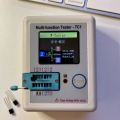
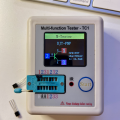
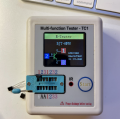
I don't know if i can agree or disagree and I don't know why do you tell that, since my DMM i bought is about 36$ (not the best one i know, but it came in handy for my own use although I use it 6 years) but let me show you some pictures of my multimeter and its hFE result. Of course any opinion after that is a good idea to start with, in order to learn something new. We are people so we often have something new to learn. Anyway, the transistor you see in the picture, is the one unbranded transistor i told previously, and I don't know why, it came with pinouts reversed compared to the original BF199. But even by that, the hFE is surprisingly in the range of the specified datasheets. I tried to put it in reverse with the base pin (the blue cable) untouched, and the result is on the screen. There is no way you can't determine the pinout of the transistor using DMM. Well at least mine one.

This is the correct pinout
IMG_20220914_170409.jpg
And this is the reverse pinout
IMG_20220914_170441.jpg

Beyond that, i will try that kit you suggested because seriously i need something like that that can provide a detailed characteristics of the transistor, but sometimes i don't really rely on these smart kits. I bought a small smart kit of a function generator based on XR2206, and what can i say, i didn't really liked it due to the signal clipping with no load on the output at the maximum amplitude. At least this is what I've seen on my oscilloscope. Anyway, i will try your suggestion. Thank you by the way. Good day sir.

Paul.
 

MrSalts

Joined Apr 2, 2020
2,767
I don't know if i can agree or disagree and I don't know why do you tell that, since my DMM i bought is about 36$ (not the best one i know, but it came in handy for my own use although I use it 6 years) but let me show you some pictures of my multimeter and its hFE result.
First, Most people just push the transistor into the holes in the meter and skip the wires and breadboard. The holes are arranged with two options for emitter because the bigger TO220 size transistors have the collector in the center. Either way, it allows you to orient most transistors into a position that fits directly into the meter.

As for your question I quoted above, it is easy for a manufacturer to build a meter that is accurate to 2 or even three decimal places. 99% if the time, the last decimal place is ignored because that level of accuracy is rarely needed. Expensive meters have temperature compensation and safety features for high voltage measurements with fuses that cost more than $10 each. These expensive meters dypically do not have a transistor Hfe feature like yours and some people apparently want to let you know that you did not "invest" (wildly spend) on a meter for your hobby. What I'm trying to say is, a lower priced meter like you have is quite fine. I'm sure it is very repeatable and serves your purpose just fine for a hobby. Maybe you can ask what "notoriously low quality" means. Does the case break when dropped, is it less safe than other meters, is it somehow imprecise beyond usefulness, is it inaccurate beyond usefulness or what because millions are sold each year and I've heard very few people complain that they output exceedingly incorrect values - I don't understand the comment myself.
 

DickCappels

Joined Aug 21, 2008
10,659
The problem I have with hFE measurements and why I rarely use them other than to see if a transistor is really dead or not is that with many transistors hFE is a strong function of collector current, especially those Darlingtons with an base to emitter resistor on the output transistor, so I don't use that to qualify transistors. If the transistor is bad or has very low hFE it will be obvious when I go to use it in a circuit.

It helps that I try to design circuits that are relatively insensitive to h
FE since wanders a lot.
 

Ya’akov

Joined Jan 27, 2019
10,258
I don't know if i can agree or disagree and I don't know why do you tell that, since my DMM i bought is about 36$ (not the best one i know, but it came in handy for my own use although I use it 6 years) but let me show you some pictures of my multimeter and its hFE result. Of course any opinion after that is a good idea to start with, in order to learn something new. We are people so we often have something new to learn. Anyway, the transistor you see in the picture, is the one unbranded transistor i told previously, and I don't know why, it came with pinouts reversed compared to the original BF199. But even by that, the hFE is surprisingly in the range of the specified datasheets. I tried to put it in reverse with the base pin (the blue cable) untouched, and the result is on the screen. There is no way you can't determine the pinout of the transistor using DMM. Well at least mine one.

This is the correct pinout

And this is the reverse pinout


Beyond that, i will try that kit you suggested because seriously i need something like that that can provide a detailed characteristics of the transistor, but sometimes i don't really rely on these smart kits.

Thank you by the way. Good day sir.

Paul.
There seems to be a problem with my photos. I see the thumbnails but the images are black squares. I am trying to figure it out.

You are certainly welcome.

I'm sure your DMM is serviceable. That fact that it claims 1000V CAT III, and 600V CAT IV is troubling, though. It is the appearance of claims like that (which I simply don't believe) which often accompany an hFE range. If you keep away form high voltage with it, it will probably serve you for a long time.

As far as testing transistors. For less than that meter cost you, you can get more information plus the added benefit of a variety of component characterization functions. For comparison, here are three transistors on the tester I recommended.

1663172860847.png
2N7000

1663172926607.png
2N3906

1663173139544.png
2N3904


Last edited:

Thread Starter

PaulEngineer

Joined Dec 21, 2016
217
There seems to be a problem with my photos. I see the thumbnails but the images are black squares. I am trying to figure it out.

You are certainly welcome.

I'm sure your DMM is serviceable. That fact that it claims 1000V CAT III, and 600V CAT IV is troubling, though. It is the appearance of claims like that (which I simply don't believe) which often accompany an hFE range. If you keep away form high voltage with it, it will probably serve you for a long time.

As far as testing transistors. For less than that meter cost you, you can get more information plus the added benefit of a variety of component characterization functions. For comparison, here are three transistors on the tester I recommended.

No no no no no no... No! I had enough damage by high voltages on my hands. Since my childhood i was struck 3 times by high voltage 250V AC, 2 times by a pulse transformer, and one time by 3 phase mains when i accidentally touched 2 live cables wanting to fix the lose cables leading to an electrical shock explosion (at least that's what i thought, they weren't lose, just the cables was cut a little bit longer) during school project, and that's because I wasn't careful enough to see if the breakers was off or not. Glad im still alive though, i could be dead. (i guess that's why i became electronic hobbyist ). Jokes aside. I had damaged my finger the first time i was struck and the scar is still visible. So I am not thinking that I will deal with high voltages again. I work at most on 60V in worst cases! Not more.

And by the way, this looks very interesting device. I think i will buy one.
 
Last edited:

Ya’akov

Joined Jan 27, 2019
10,258
No no no no no no... No! I had enough damage by high voltages on my hands.

And by the way, this looks very interesting device. I think i will buy one.
I am sorry you had the bad experience but glad that you learned from it. Some people don’t seem to be able to do that. When I work on mains voltages I use professional level testers and meters (this, this* and this*), and a proving unit (this one). I consider it the same as wearing seatbelts, looking both ways crossing the street, and seeking shelter from a thunderstorm.

The risks are relatively low if you take precautions, but the cost of having something go wrong is exceedingly high.

I do think you will enjoy the tester. The other features add a lot. It even does IR remote testing (for some reason, I suppose “because they could”. The one I linked it not the cheapest but it is nicely packaged and I have found it to be very reliable.

__
*These are far more than needed for domestic wiring. I own them for other reasons, so they get used as needed. The prices on Fluke‘s site are outrageous. You should never pay MSRP for Fluke.. I assume it is so they don’t compete with their dealers.
 

DickCappels

Joined Aug 21, 2008
10,659
No no no no no no... No! I had enough damage by high voltages on my hands. Since my childhood i was struck 3 times by high voltage 250V AC, 2 times by a pulse transformer, and one time by 3 phase mains when i accidentally touched 2 live cables wanting to fix the lose cables leading to an electrical shock explosion (at least that's what i thought, they weren't lose, just the cables was cut a little bit longer) during school project, and that's because I wasn't careful enough to see if the breakers was off or not. Glad im still alive though, i could be dead. (i guess that's why i became electronic hobbyist ). Jokes aside. I had damaged my finger the first time i was struck and the scar is still visible. So I am not thinking that I will deal with high voltages again. I work at most on 60V in worst cases! Not more.

And by the way, this looks very interesting device. I think i will buy one.
Also glad that you are still alive. I worked with various kind of cathode ray tubes and some of the power supplies for them. Since retiring I have for the most part stayed under 200 volts, preferring to be 5V or less when possible. 5V itself does not make me scream or cry.
 
Top