UC3845B Pulse Diviside by 2

Thread Starter

Solara Voltara

Joined Jul 7, 2019
4
Can I use the 8 pin UC3845B as a frequency divider to cut speed pulses in half? According to the datasheet it has a built in flip flop. Datasheet here: https://www.onsemi.cn/PowerSolutions/document/UC3844B-D.PDF
If this is possible, please help me with a simple circut. I am trying to cut Output shaft speed sensor pulses in half. It is a 12 pulse per revolution square wave.
I am not an electronics expert but i can usually figure things out, but this is a bit beyond me right now.
Which pin is clock input? rt/ct?
Voltage reference just needs 5 v?
Plus ground and then to output goes to the ecu, so...can I ignore the other 4 pins?
 
Last edited:

Papabravo

Joined Feb 24, 2006
22,082
Can I use the 8 pin UC3845B as a frequency divider to cut speed pulses in half? According to the datasheet it has a built in flip flop. Datasheet here: https://www.onsemi.cn/PowerSolutions/document/UC3844B-D.PDF
If this is possible, please help me with a simple circut. I am trying to cut Output shaft speed sensor pulses in half. It is a 12 pulse per revolution square wave.
I am not an electronics expert but i can usually figure things out, but this is a bit beyond me right now.
Which pin is clock input? rt/ct?
Voltage reference just needs 5 v?
Plus ground and then to output goes to the ecu, so...can I ignore the other 4 pins?
You don't seem to have figured this one out very well. I don't think this is the part you want to use. I don't see a flip-flop in the block diagram. What makes you think this part will do anything close to what you wan it to do? I don't think it will function with those other 4 pins unconnected. rt/ct is a pin to which you connect a resistor and a capacitor to set the frequency
 

Thread Starter

Solara Voltara

Joined Jul 7, 2019
4
"Oscillator
The oscillator frequency is programmed by the values selected for the timing components RT and CT. Capacitor CT is charged from the 5.0 V reference through resistor RT to approximately 2.8 V and discharged to 1.2 V by an internal current sink. During the discharge of CT, the oscillator generates an internal blanking pulse that holds the center input of the NOR gate high. This causes the Output to be in a low state, thus producing a controlled amount of output deadtime. An internal flip−flop has been incorporated in the UCX844/5B which blanks the output off every other clock cycle by holding one of the inputs of the NOR gate high. This in combination with the CT discharge period yields output deadtimes programmable from 50% to 70%."

Taken from datasheet, page 7
 

djsfantasi

Joined Apr 11, 2010
9,237
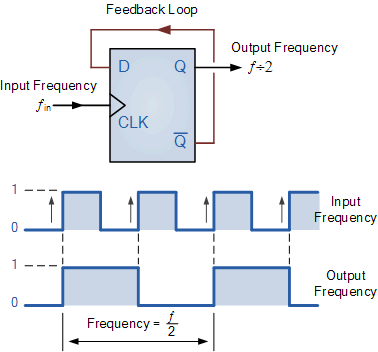
I don’t think that chip will help. There is an 8-pin D type flip flop available. While this may not be an exact fit, it is 8-pin and will work with a 5VDC supply. D flip flops can be wired as a T flip flop by connecting the Q bar output to the D input. Then wire your pulses to the CLK and 1/2 the input frequency will appear on the Q output.
 

djsfantasi

Joined Apr 11, 2010
9,237
"Oscillator
The oscillator frequency is programmed by the values selected for the timing components RT and CT. Capacitor CT is charged from the 5.0 V reference through resistor RT to approximately 2.8 V and discharged to 1.2 V by an internal current sink. During the discharge of CT, the oscillator generates an internal blanking pulse that holds the center input of the NOR gate high. This causes the Output to be in a low state, thus producing a controlled amount of output deadtime. An internal flip−flop has been incorporated in the UCX844/5B which blanks the output off every other clock cycle by holding one of the inputs of the NOR gate high. This in combination with the CT discharge period yields output deadtimes programmable from 50% to 70%."

Taken from datasheet, page 7
That means that there is a flip flop internal to the chip. It doesn’t imply that the flip flop is available externally for your use.
 

Papabravo

Joined Feb 24, 2006
22,082

djsfantasi

Joined Apr 11, 2010
9,237
I don’t think that chip will help. There is an 8-pin D type flip flop available. While this may not be an exact fit, it is 8-pin and will work with a 5VDC supply. D flip flops can be wired as a T flip flop by connecting the Q bar output to the D input. Then wire your pulses to the CLK and 1/2 the input frequency will appear on the Q output.
Or the chip I linked to in this post. A blue text color is a link. Click on the word “available” to see the chip.
 

narkeleptk

Joined Mar 11, 2019
586
I believe they are requesting suggestions on the types of electronic devices one may could scavenge the type of IC's you mentioned out of.
My advice to that is dont bother trying to scavenge for them and just get some from mouser, ebay or somewhere similar.
 

Papabravo

Joined Feb 24, 2006
22,082
I believe he is requesting suggestions on the types of electronic devices he may could scavenge the type of IC's you mentioned out of.
My advice to that is dont bother trying to scavenge for them and just get some from mouser, ebay or somewhere similar.
The parts you need can be had for pennies. The only reason to scavenge parts is if your time is worth nothing. To find something useful look for a minicomputer from the 1965 to 1975 era.
 

absf

Joined Dec 29, 2010
1,968
An old dot matrix printer, fax machine, public phones, old teletype machines should have those flip flop chips. I have plenty of boards opted out of telephone exchanges which have plenty discrete logic chips and 100nF caps.

If you have old PCs which use peripheral cards for serial parallel interfaces, video cards, game port cards etc. They have lots of TTL chips inside them too.
 

bbuehl

Joined May 6, 2019
2
I would suggest SN74LS393N or SN74LS393D the LS393 is a counter.
Of course another option is the trusty 555 timer.
Is there a requirement for pulse width or are you just looking at frequency?
 

djsfantasi

Joined Apr 11, 2010
9,237
I would suggest SN74LS393N or SN74LS393D the LS393 is a counter.
Of course another option is the trusty 555 timer.
Is there a requirement for pulse width or are you just looking at frequency?
He doesn’t need a counter. He wants to divide an existing counter/frequency output by 2. Thus, all that is required is a flip flop. Of which several members have proposed a solution.
 

bbuehl

Joined May 6, 2019
2
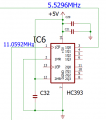
Connect the existing frequency to PIN 1 on a SN74LS393D and the frequency on PIN 3 will be divided by 2; PIN 14 +5 volts, PIN 7 ground and ground PIN 2.
upload_2019-7-16_14-11-44.png
 

MB107

Joined Jul 24, 2016
400
Connect the existing frequency to PIN 1 on a SN74LS393D and the frequency on PIN 3 will be divided by 2; PIN 14 +5 volts, PIN 7 ground and ground PIN 2.
View attachment 181795
I also have a similar need to cut a pulse in half. But the frequency is in the range of < 5KHz. And the voltages are spikes from a VRS sensor with output proportional to speed. Based on previous speedometer measurements in anther thread, i expect these voltages to exceed 100v p-p. Will the proposed circuits work in these conditions.
 
Top