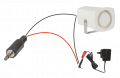
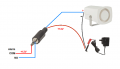
Typical wiring for a 3.5mm "siren input port" on a home alarm system

Thread Starter

Heath Raftery

Joined Dec 13, 2015
25
This used to be so easy...

I want an alarm that sounds a siren when a motion sensor is tripped. I finally opted for a "Kogan SmarterHome Security Alarm System".

https://www.kogan.com/au/buy/kogan-smarterhometm-security-alarm-system-kit-kogan

Alas, the built-in alarm is pathetic. So I'm wiring an external piezo screamer to the "siren input port". Despite this being a generic alarm system that's been rebranded a thousand times, I cannot find a shred of information on the port configuration. The manual says "the panel will trigger a relay short circuit (COM and NO contact closure) during an alarm".

So I've wired a 3.5mm mono audio plug in series with a 12V supply and the 12V screamer. No dice. If I manually short the plug sleeve and tip the screamer sounds as I would expect. But when plugged into the alarm system, there's a quiet buzzing from the screamer, and then no change when the alarm is triggered.

Anyone know how these things are supposed to be connected?
 

Attachments

sghioto

Joined Dec 31, 2017
8,633
Where does this 3.5mm plug connect to, the Siren Input port?
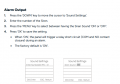
I believe this is the port confguration for the external siren.
1766455141051.png
 

Thread Starter

Heath Raftery

Joined Dec 13, 2015
25
What is the "number" for the siren mean?
Ha, your guess is as good as mine! I think most likely it is the "zone". There are 99 of those as well. But they make about as much sense as the rest of the manual. I've managed to set one up well enough to do the basics. For the siren setting, they all seem to be "ON" by default anyway.

I've also tried "pairing" an alarm relay. Again, nothing happens. I don't even know if I should be using a mono 3.5mm plug. I don't know the voltage specification. I don't know the current specification. I don't know how a user is supposed to know, so I figured I'm unaware of some de-facto standard or something.
 

Thread Starter

Heath Raftery

Joined Dec 13, 2015
25
Anyway to open up the unit to see?
Thought about it, but will keep my warranty intact for now. Also waiting on a response from the vendor, but not holding my breath there. Thought I left myself plenty of time before, you know, securing my property before the holidays...
 

Thread Starter

Heath Raftery

Joined Dec 13, 2015
25
Wouldn't you be looking for a siren OUTput?
Ha, yep! That would be my preference. I can't even imagine what a "siren input" would do. But it seems it's my only option. The alarm has an internal siren, and the manual says "Alarm Expansion – Supports one wireless relay, one wireless sound and light siren, and wired sirens to amplify alarm volume". How else might you connect a "wired siren"?
 

Attachments

ThePanMan

Joined Mar 13, 2020
862
Without documentation, I guess the “Siren Input” is an expansion slot for adding intrusion sensors like door or window switches. But then it wouldn’t be marked as an input. I understand your confusion.

Check the voltage on that input. Confirm it’s Open when inactive and Closed when in alarm.

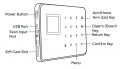
What's the USB port for? Powering the system?
 

Thread Starter

Heath Raftery

Joined Dec 13, 2015
25
Check the voltage on that input.
As this point I'm not even sure what to stick in there! I guess I could try a stereo plug and check the three contacts? Honestly I don't want to reverse engineer this thing, I was just hoping it was more obvious to someone than it is to me.

What's the USB port for? Powering the system?
Yes. 5V power, no data.
 

MisterBill2

Joined Jan 23, 2018
27,159
It seems that it has been guessed that the port is a contact closure. Evidently that is not the case. Does the manual actually state:" The manual says "the panel will trigger a relay short circuit (COM and NO contact closure) during an alarm", or is that an interpretation??
The first thing to do will be to use a multimeter to see if a voltage is supplied when the alarm is triggered, or is it actually a contact closure? OR is it a transistor switched on?? IT odes not seem reasonable to me that any alarm system would use a 3.5mmjack for a contact closure output.
 

Thread Starter

Heath Raftery

Joined Dec 13, 2015
25
It seems that it has been guessed that the port is a contact closure. Evidently that is not the case. Does the manual actually state:" The manual says "the panel will trigger a relay short circuit (COM and NO contact closure) during an alarm", or is that an interpretation??
Yes and yes. You can see the statement in context in sghioto's post:

https://forum.allaboutcircuits.com/...rt-on-a-home-alarm-system.209155/post-2015446

But the manual says a lot of things that are doubtful, or at least ambiguous.

The first thing to do will be to use a multimeter to see if a voltage is supplied when the alarm is triggered, or is it actually a contact closure? OR is it a transistor switched on??
What would you even measure? It's now up in the air what the port is, physically, electrically and functionally. Even if I did measure a voltage, what could you conclude? Or what if I didn't?

IT odes not seem reasonable to me that any alarm system would use a 3.5mmjack for a contact closure output.
Yeah right, I think this is the key - if there's no "typical" expectation, I might need to wait to hear back from the manufacturer, rather than undertaking reverse engineering.
 

Ya’akov

Joined Jan 27, 2019
10,226
Put a continuity tester on the two terminals of the plug inserted into the alarm and see if they become connected when the alarm sounds.
 

MisterBill2

Joined Jan 23, 2018
27,159
Based on a my guess as to the size of the alarm package shown in the image attached to post #11, my guess is that the output is not a relay contact, unless it is a small reed relay. .
So if the "contact" is anything other than an actual mechanical relay of some kind, it will have some effective internal resistance. SO, as a number of us have asked, please use a meter to check the output for voltage and resistance.
An effective interface to actually operate an actual relay to provide a contact closure would be a mosfet device with a low gate voltage requirement as a buffer.
 

cph1

Joined May 11, 2020
1
Sounds like it’s time to make some voltage and current measurements with and without the siren that came with the system to understand how the circuit is really operating.
 
Top