I don’t know if my post was seen, so I will point at it once more. The linked PDF is a very complete manual for traffic signal timing engineers and offers a taxonomy to more clearly label the states of the system with a domain specific vocabulary that helps to clarify the components.Thank you both. I will choose the timing of my choice. Since this is a hobby project aimed at increasing my knowledge
I went through the manual you posted, but it seems a bit challenging to grasp. Since I'm working on this project as a hobby, I'm aiming for something simpler, not too complex.I don’t know if my post was seen, so I will point at it once more. The linked PDF is a very complete manual for traffic signal timing engineers and offers a taxonomy to more clearly label the states of the system with a domain specific vocabulary that helps to clarify the components.

OK.I went through the manual you posted, but it seems a bit challenging to grasp. Since I'm working on this project as a hobby, I'm aiming for something simpler, not too complex.
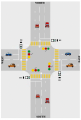
After the "power up" phase, the first state of the "run phase" would be no vehicle traffic and no pedestrians.I have created a diagram to better understand each state of the traffic signals. I'm sharing the first state where all vehicles are stopped, and pedestrians are allowed to cross in all directions.
I think after the 'power-up' phase, the first state in the 'run phase' typically involves no vehicle traffic and no pedestrians. This ensures a complete stop for all traffic. The next state usually allows vehicle traffic to flow, but pedestrians are still not permitted to cross.After the "power up" phase, the first state of the "run phase" would be no vehicle traffic and no pedestrians.
In Atlanta the general timer is 30 to 40 seconds depending on how many lanes for pedestrian crossing.Hello Everyone ,
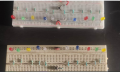
I have a breadboard, microcontroller, LEDs, and push buttons, and I'm interested in creating a two-way traffic light system for an experimental project. I have already designed a diagram for vehicle and pedestrian crossings.
View attachment 304398
Here are the simplified rules for both vehicles and pedestrians:
Rules for Vehicles:
- Red Light (Stop):
- When the traffic signal is red for eastbound or westbound vehicles.
- All vehicles in those lanes must come to a complete stop.
- Green Light (Go):
- When the traffic signal is green for eastbound or westbound vehicles:
- Vehicles in those lanes can go.
- Yellow Light (Prepare to Stop):
- When the traffic signal changes from green to yellow for eastbound or westbound vehicles:
- Vehicles should prepare to stop as the signal is about to turn red.
Rules for Pedestrians:
- Blue Light (Walk):
- When the pedestrian signal is blue for northbound or southbound pedestrians:
- Pedestrians can cross.
- Red Light (Stop):
- When the pedestrian signal is red for northbound or southbound pedestrians:
- Pedestrians must not cross.
For the traffic light system:
- The red LED should be active for 20 seconds.
- The green LED should also be active for 20 seconds.
- A 3-second interval is allocated for the yellow LED.
- The blue LED will be active for 20 seconds.
I'm facing some challenges in designing the logic for the pedestrian signal timing in traffic light system. Specifically, I'm finding it difficult to determine when and how much time should be allocated for pedestrian crossing.
I would greatly appreciate any suggestions you can provide to help me create a safe timing sequence for pedestrians.
Thank you for your any suggestion