Two way Traffic Light System Design

Thread Starter

Kittu20

Joined Oct 12, 2022
511
I was thinking of the lights at a crossroads. There are 4 sets of lights.
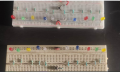
Oh, you're talking about 4 sets of lights. I've gone a step further – I've connected a total of 20 LEDs and two push buttons on two breadboards. Take a look at the screenshot I just shared.

1697185538007.png
 

Ya’akov

Joined Jan 27, 2019
10,242
Thank you both. I will choose the timing of my choice. Since this is a hobby project aimed at increasing my knowledge
I don’t know if my post was seen, so I will point at it once more. The linked PDF is a very complete manual for traffic signal timing engineers and offers a taxonomy to more clearly label the states of the system with a domain specific vocabulary that helps to clarify the components.

The design of these systems is not arbitrary, There are both de facto and de jure standards, as well as many years of practical experience embodied in the implementation of traffic signals.

I believe you would get more out of implementing something using these principles and the settled language of traffic signal engineering than you would just making things up on your own.
 

Thread Starter

Kittu20

Joined Oct 12, 2022
511
I don’t know if my post was seen, so I will point at it once more. The linked PDF is a very complete manual for traffic signal timing engineers and offers a taxonomy to more clearly label the states of the system with a domain specific vocabulary that helps to clarify the components.
I went through the manual you posted, but it seems a bit challenging to grasp. Since I'm working on this project as a hobby, I'm aiming for something simpler, not too complex.
 

Thread Starter

Kittu20

Joined Oct 12, 2022
511
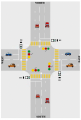
I have created a diagram to better understand each state of the traffic signals. I'm sharing the first state where all vehicles are stopped, and pedestrians are allowed to cross in all directions. Please see the attached diagram, and I've marked the 'Traffic Signals' to make them more visible. Your feedback is welcome

1697196894187.png
 

Ya’akov

Joined Jan 27, 2019
10,242
I went through the manual you posted, but it seems a bit challenging to grasp. Since I'm working on this project as a hobby, I'm aiming for something simpler, not too complex.
OK.

To be clear, section 4 and the glossary are all you would be concerned about in your case.
You might also want to add sensors to your project later since almost all traffic signals now depend on sensing and not timing alone. You could simulate the sensors by randomly asserting them to cause the system to have to accommodate virtual detector loops and pedestrian signals.

Good luck.
 

eetech00

Joined Jun 8, 2013
4,705
I have created a diagram to better understand each state of the traffic signals. I'm sharing the first state where all vehicles are stopped, and pedestrians are allowed to cross in all directions.
After the "power up" phase, the first state of the "run phase" would be no vehicle traffic and no pedestrians.
 

Thread Starter

Kittu20

Joined Oct 12, 2022
511
After the "power up" phase, the first state of the "run phase" would be no vehicle traffic and no pedestrians.
I think after the 'power-up' phase, the first state in the 'run phase' typically involves no vehicle traffic and no pedestrians. This ensures a complete stop for all traffic. The next state usually allows vehicle traffic to flow, but pedestrians are still not permitted to cross.

The sequence continues as follows:

  1. No vehicle traffic, no pedestrians (initial state).
  2. Vehicle traffic allowed, pedestrians are not allowed to cross.
  3. Pedestrian walk signal is activated, allowing pedestrians to cross while vehicle traffic stops.
 

BobTPH

Joined Jun 5, 2013
11,528
Go to an intersection. Observe the lights in both directions, and record the sequence in which they change. If you can’t write it down fast enough, use your phone’s video camera. The problem statement is to duplicate that sequence.
 

woozycactus

Joined Jan 4, 2021
113
Hello Everyone ,

I have a breadboard, microcontroller, LEDs, and push buttons, and I'm interested in creating a two-way traffic light system for an experimental project. I have already designed a diagram for vehicle and pedestrian crossings.

View attachment 304398


Here are the simplified rules for both vehicles and pedestrians:

Rules for Vehicles:

  1. Red Light (Stop):
    • When the traffic signal is red for eastbound or westbound vehicles.
    • All vehicles in those lanes must come to a complete stop.
  2. Green Light (Go):
    • When the traffic signal is green for eastbound or westbound vehicles:
    • Vehicles in those lanes can go.
  3. Yellow Light (Prepare to Stop):
    • When the traffic signal changes from green to yellow for eastbound or westbound vehicles:
    • Vehicles should prepare to stop as the signal is about to turn red.

Rules for Pedestrians:

  1. Blue Light (Walk):
    • When the pedestrian signal is blue for northbound or southbound pedestrians:
    • Pedestrians can cross.
  2. Red Light (Stop):
    • When the pedestrian signal is red for northbound or southbound pedestrians:
    • Pedestrians must not cross.


For the traffic light system:

  • The red LED should be active for 20 seconds.
  • The green LED should also be active for 20 seconds.
  • A 3-second interval is allocated for the yellow LED.
  • The blue LED will be active for 20 seconds.


I'm facing some challenges in designing the logic for the pedestrian signal timing in traffic light system. Specifically, I'm finding it difficult to determine when and how much time should be allocated for pedestrian crossing.

I would greatly appreciate any suggestions you can provide to help me create a safe timing sequence for pedestrians.

Thank you for your any suggestion
In Atlanta the general timer is 30 to 40 seconds depending on how many lanes for pedestrian crossing.
 
Top