Two-Stage Negative Feedback

Jony130

Joined Feb 17, 2009
5,598
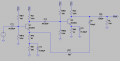
1) My calculation for AOL = 1458 but the sim shows AOL = vout / vin = 1.56 V / 1 mV = 1560.
I don't understand why the difference?
The answer is very simple. The simulation results differ from those you obtained via hand calculations because the simulation directly solves the circuit without any simplifications. And LTSpice is using different values for Vt, β then you. Also, the simulations include much more parameters then you in your hand calculations. For example, you have "skipped" 1 in Run = (β 1)*re r'e formula... Your voltage gain "formula" is not the exact formula... You did not include the "feedback loading effect." and so on.
This is why it is not a surprise that the LTspice obtains the "slightly" different result than you. And there is nothing to worry about.

Here you have a full gain expression

AV = (RB21 RB22 Rc1 Rc2 RL β1 β2)/[(re1 + Re11) (Rc2 + RL) (1 +β1) (RB21 Rc1 re2 (1 +β2) + RB22 Rc1 re2 (1 +β2) + RB21 RB22 (Rc1 + re2 + re2 β2))]

1.PNG

So you can use a spreadsheet and see yourself how the gain will change if you change the BJT's beta or r'e = re1.

2) My calculation for Rout(Feedback) = Rout / (1 + (AOL * β)) = 600Ω. Is this correct?
Yes, the result is correct.
 
Last edited:

Thread Starter

newbie2019

Joined Apr 5, 2019
95
The answer is very simple. The simulation results differ from those you obtained via hand calculations because the simulation directly solves the circuit without any simplifications. And LTSpice is using different values for Vt, β then you. Also, the simulations include much more parameters then you in your hand calculations. For example, you have "skipped" 1 in Run = (β 1)*re r'e formula... Your voltage gain "formula" is not the exact formula... You did not include the "feedback loading effect." and so on.
This is why it is not a surprise that the LTspice obtains the "slightly" different result than you. And there is nothing to worry about.

Here you have a full gain expression

AV = (RB21 RB22 Rc1 Rc2 RL β1 β2)/[(re1 + Re11) (Rc2 + RL) (1 +β1) (RB21 Rc1 re2 (1 +β2) + RB22 Rc1 re2 (1 +β2) + RB21 RB22 (Rc1 + re2 + re2 β2))]


Thanks again!

View attachment 179176

So you can use a spreadsheet and see yourself how the gain will change if you change the BJT's beta or r'e = re1.


Yes, the result is correct.
 

Thread Starter

newbie2019

Joined Apr 5, 2019
95
The answer is very simple. The simulation results differ from those you obtained via hand calculations because the simulation directly solves the circuit without any simplifications. And LTSpice is using different values for Vt, β then you. Also, the simulations include much more parameters then you in your hand calculations. For example, you have "skipped" 1 in Run = (β 1)*re r'e formula... Your voltage gain "formula" is not the exact formula... You did not include the "feedback loading effect." and so on.
This is why it is not a surprise that the LTspice obtains the "slightly" different result than you. And there is nothing to worry about.

Here you have a full gain expression

AV = (RB21 RB22 Rc1 Rc2 RL β1 β2)/[(re1 + Re11) (Rc2 + RL) (1 +β1) (RB21 Rc1 re2 (1 +β2) + RB22 Rc1 re2 (1 +β2) + RB21 RB22 (Rc1 + re2 + re2 β2))]


So you can use a spreadsheet and see yourself how the gain will change if you change the BJT's beta or r'e = re1.


Yes, the result is correct.
 

The Electrician

Joined Oct 9, 2007
2,986
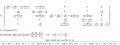
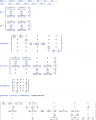
Your matrix is exactly the same as mine with RF and Re12 deleted from the circuit as I would expect :). The discrepancy in the form of your gain expression and mine illustrates a feature of Mathematica that I find annoying. The FullSimplify function sometimes gets a different result depending on how the terms in the input to the function are arranged. I wanted to make sure this was the problem.
 
Last edited:

The Electrician

Joined Oct 9, 2007
2,986
newbie2019, the YouTube video you found:

appears to have been borrowed from example 1 here: http://pallen.ece.gatech.edu/Academic/ECE_6412/Spring_2003/L280-SerShnt_ShntShnt-2UP.pdf

except that the YouTube example assumed β = 50 and the gatech example assumed β=100. Also, the YouTube version assumes the same hie for both transistors, whereas the gatech version uses different values.

The gatech version shows in detail how to account for the loading of the feedback network when calculating the open loop case.

I see some mistakes in both versions. For example, when calculating the gain of the first stage, the YouTube version fails to include the 100 ohm resistor in the emitter branch.

Are you still making progress?
 

Thread Starter

newbie2019

Joined Apr 5, 2019
95
This is really interesting. I was not aware of this. And I'm currently using Mathematica 11.3.
Not sure what post #44 and #52 mean.
The answer is very simple. The simulation results differ from those you obtained via hand calculations because the simulation directly solves the circuit without any simplifications. And LTSpice is using different values for Vt, β then you. Also, the simulations include much more parameters then you in your hand calculations. For example, you have "skipped" 1 in Run = (β 1)*re r'e formula... Your voltage gain "formula" is not the exact formula... You did not include the "feedback loading effect." and so on.
This is why it is not a surprise that the LTspice obtains the "slightly" different result than you. And there is nothing to worry about.

Here you have a full gain expression

AV = (RB21 RB22 Rc1 Rc2 RL β1 β2)/[(re1 + Re11) (Rc2 + RL) (1 +β1) (RB21 Rc1 re2 (1 +β2) + RB22 Rc1 re2 (1 +β2) + RB21 RB22 (Rc1 + re2 + re2 β2))]

View attachment 179176

So you can use a spreadsheet and see yourself how the gain will change if you change the BJT's beta or r'e = re1.


Yes, the result is correct.
newbie2019, the YouTube video you found:

appears to have been borrowed from example 1 here: http://pallen.ece.gatech.edu/Academic/ECE_6412/Spring_2003/L280-SerShnt_ShntShnt-2UP.pdf

except that the YouTube example assumed β = 50 and the gatech example assumed β=100. Also, the YouTube version assumes the same hie for both transistors, whereas the gatech version uses different values.

The gatech version shows in detail how to account for the loading of the feedback network when calculating the open loop case.

I see some mistakes in both versions. For example, when calculating the gain of the first stage, the YouTube version fails to include the 100 ohm resistor in the emitter branch.

Are you still making progress?
I am making some progress but I am trying to put the formula into my Excel spreadsheet and what a nightmare!. Is this formula for the open-loop gain?

I find it really frustrating when various videos etc. have errors. I suppose people aren't checking things before publishing.
 

Zeeus

Joined Apr 17, 2019
616
Not sure what post #44 and #52 mean.


I am making some progress but I am trying to put the formula into my Excel spreadsheet and what a nightmare!. Is this formula for the open-loop gain?

I find it really frustrating when various videos etc. have errors. I suppose people aren't checking things before publishing.
Would be nice if you post another circuit...looking at another circuit, might be good thing.
 

Jony130

Joined Feb 17, 2009
5,598
Not sure what post #44 and #52 mean.
This post was not written directly for you but it was an "internal communication" between me and The Electrician.

Is this formula for the open-loop gain?
This formula gives you the Open loop gain without taking into a count the loading of the feedback network.

I am making some progress but I am trying to put the formula into my Excel spreadsheet and what a nightmare!.
Why?

See the attachment file.

All resistors values are in kΩ.
 

Attachments

The Electrician

Joined Oct 9, 2007
2,986
Not sure what post #44 and #52 mean.


I am making some progress but I am trying to put the formula into my Excel spreadsheet and what a nightmare!. Is this formula for the open-loop gain?

I find it really frustrating when various videos etc. have errors. I suppose people aren't checking things before publishing.
Post #44 and #52 are related to a method that Jony130 and I like, described by Jacob Shekel in the 1940's for solving circuits such as yours.

See: https://forum.allaboutcircuits.com/threads/two-stage-bjt-amplifier-with-feedback.26710/ starting at post #43

Also: https://forum.allaboutcircuits.com/...-method-need-help-from-the-electrician.44651/

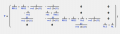
The relevant admittance matrix for your circuit (with provision for an unbypassed resistor in the emitter branch of Q2) would be done like this:

TwoStageZ A.png
 

The Electrician

Joined Oct 9, 2007
2,986
Can you point out the mistake in the gatech pdf?
For example, on page 3 he didn't include Rc2 in the closed loop model. Then on page 5 at "7.) Output resistance, v2/i2", he has:

Ro = R4||(R1+R2) = 1.916KΩ

If he had actually calculated R4||(R1+R2) he would have obtained 3.24324 KΩ; he included Rc2, but didn't show it. I noticed this because I set up the admittance matrix for the circuit and followed along his analysis, comparing his results with the results from the Shekel method.

Not only did he leave out Rc2, but I don't think the value for Rof is correct. Using the (1+af) factor gives a value for Rof which is substantially different from the value the Shekel method gives. I've noticed that the traditional calculations using feedback factor and loop gain can sometimes give incorrect results, because the assumptions made about theoretical series/shunt, etc., topologies (such as assumptions about impedances loading in non-ideal ways) may not be correct.

I saw at least one other error, but I would have to go back over the whole thing again to find it (or find them if more than one).
 

The Electrician

Joined Oct 9, 2007
2,986
He also neglected Rc2 in the calculation of a, at the bottom of page 4.

In the second line up from the bottom, he has for the first term: (-β2[R4||(R1+R2)]. There is a missing closing parenthesis.
It should be: (-β2[R4||(R1+R2)]). But, besides that, he left out Rc2; (-β2[R4||(R1+R2)]) does not evaluate to -191600.

The expression should be: (-β2[Rc2||R4||(R1+R2)])
 
Top