Two power sources for one light

Thread Starter

drmandarin

Joined Aug 12, 2021
7
Hi

First time here; not at all an engineer.
If I inadvertently make a protocol mistake please do point me right.

I would like to wire up a domestic light so that it can be powered from two independent domestic AC sources.
Please note that this is different from wiring a light with two-way / three-way (nomenclature depending on country) switches.

I envision one switch at each power source. If both switches are off, light is off. If either switch is on, or if both are on, the light is on.

Are there any suggestions for how I could construct such a circuit?

I hope the requirement is clear. I think it's pretty simple, I just don't know what component I need for the circuit to isolate the two sources from each other but not from the light.

Thanks
 

ApacheKid

Joined Jan 12, 2015
1,762
Hi

First time here; not at all an engineer.
If I inadvertently make a protocol mistake please do point me right.

I would like to wire up a domestic light so that it can be powered from two independent domestic AC sources.
Please note that this is different from wiring a light with two-way / three-way (nomenclature depending on country) switches.

I envision one switch at each power source. If both switches are off, light is off. If either switch is on, or if both are on, the light is on.

Are there any suggestions for how I could construct such a circuit?

I hope the requirement is clear. I think it's pretty simple, I just don't know what component I need for the circuit to isolate the two sources from each other but not from the light.

Thanks
Are the two "sources" always in phase? are they always the same RMS voltage?
 

Thread Starter

drmandarin

Joined Aug 12, 2021
7
I couldn't say without some testing I expect.
One source would be a spur from an existing circuit. The other source would be external lighting circuit from my garage door motor.
 

ApacheKid

Joined Jan 12, 2015
1,762
It might be possible to use two relays a normally-closed and a normally-open, then these could be wired in such a way that if both sources are active one is switched to the output, if one goes in active it switches to the other - can't quite be sure if this is feasible though...
 

ApacheKid

Joined Jan 12, 2015
1,762
Only one relay us needed. See my previous post.

Bob
That could work, but we'd need a direct, galvanic connection between one side of one source and one side of the other source, so long as that does no harm (grounding etc) I think this would work.
 

ElectricSpidey

Joined Dec 2, 2017
3,322
The only problem with Bob's idea is if there is also a local light or something connected to the "other switch" it would also be powered when the relay is active.

But, that might not be the case.
 
Last edited:

ApacheKid

Joined Jan 12, 2015
1,762
So, Dr. Mandarin, may I ask why? why do this? what is the basis of this problem, why has it arisen? is your house somehow fundamentally different to mine in terms of how AC power is delivered to it?
 

Thread Starter

drmandarin

Joined Aug 12, 2021
7
So, Dr. Mandarin, may I ask why? why do this? what is the basis of this problem, why has it arisen? is your house somehow fundamentally different to mine in terms of how AC power is delivered to it?
Of course :)
The why is quite simple: I have one set of lights which I would like to be powered regardless of which switch is activated.
But the important additional wrinkle is that for each switch, and both, "on" must mean "on" for the lights - which is quite different to the usual two-way/three-way light control paradigm.

I.e. if I am already in the room and I've switched the lights on with switch 1, I don't want the activation of switch 2 to switch the lights off.
 

ElectricSpidey

Joined Dec 2, 2017
3,322
So, I decided to delete my suggestion based on safety concerns, even though there is a way to make it safe, but would probably require more work that the OP would like to do, and require a third constant power source.
 

Delta Prime

Joined Nov 15, 2019
1,311
Hello there.welcome to AAC!
:)
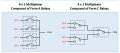
A multiplexer or mux is a topology that allows you to connect one input to multiple outputs or the reverse, one output to multiple inputs.
It is referred to by the number of inputs to the number of outputs. For instance, a 4:1 or 4 x 1 mux allows you to connect four inputs to one output. You can make any configuration you wish. It's only an example. And use only as a reference please!

multiple-inputs-to-one-output-720x318.jpg
 

zophas

Joined Jul 16, 2021
165
If the light is on when both switches are on. How do you turn the light off? You need to turn both switches off. If the switches are far apart you will be doing more walking than switching.
 

ApacheKid

Joined Jan 12, 2015
1,762
Of course :)
The why is quite simple: I have one set of lights which I would like to be powered regardless of which switch is activated.
But the important additional wrinkle is that for each switch, and both, "on" must mean "on" for the lights - which is quite different to the usual two-way/three-way light control paradigm.

I.e. if I am already in the room and I've switched the lights on with switch 1, I don't want the activation of switch 2 to switch the lights off.
OK.

Well this is actually a single AC supply, not two. This is very simple to do with two simple one/off switches wired in parallel.

If either switch is on the light will be on, if both switches are on the light will be on, only if each switch is off will the light be off.
 

Reloadron

Joined Jan 15, 2015
7,882
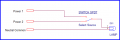
If I wanted to switch a lamp using either of two power sources I would just use a SPDT (Single Pole Double Throw) switch with a center Off so it looks like ON-Off-ON.

Switch Power Source.png

Two power sources and the SPDT switch selects either of the two with a center off. Just make sure the switch is rated for the voltage and current of the load. You can have power 1 or power 2 but not both at the same time and as was mentioned if the power sources are like US Residential split phase you need not worry about things getting ugly.

Ron
 

BobTPH

Joined Jun 5, 2013
11,496
That could work, but we'd need a direct, galvanic connection between one side of one source and one side of the other source, so long as that does no harm (grounding etc) I think this would work.
No, the relay isolates them. And my idea does exactly what the TS asked for.

Bob
 

ApacheKid

Joined Jan 12, 2015
1,762
Only if they are from the same split-phase from the transformer (in the US).
If they are from opposite phases, you will get a nice dead-short across the 240.
Yes this is an important parameter, from what I gather this is a residence and he's referring to the center tapped AC supply that comes into his house, from a single phase.

Knowing this has a big impact on the proposed solution.
 
Top