Moving Fairy Wings actuators, circuits, power sources??

Thread Starter

firsttimefairy94

Joined Oct 30, 2024
7
Hello,
I am very new to building electronics. I want to build a pair of fairy wings that ideally move in a few patterns but at least flutter. I found a video on YouTube that show a movement
I think I need a actuator. I looked up actuators but there are so many! What type would I need how would I know what type of batteries to power it? I have done basic soldering of LEDS before but nothing beyond that. Where do I look for the rest of the parts featured in the video? Sorry for all the questions. I am a fabric guy not a electronics guy but I want to learn.

Is there a better route to go?
 

panic mode

Joined Oct 10, 2011
4,864
some Christmass tree ornaments are still large
1730309204217.png

assuming this is something rather small (perhaps Halloween costume for a child and not for parade float) the simplest and quickest to implement is to use servo. movements can be controlled by either an MCU or some timing logic (555 or TTL/CMOS). at any rate you would want wings to be porous enough to reduce drag (use net rather than parachute fabric). a small MCU (digispark or whatever) , battery and a switch would be the only other parts needed. and servos are low cost and easy to scale if needed - without changing control circuit or program.
 
Last edited:

Ya’akov

Joined Jan 27, 2019
10,226
I think the TS is building wings for their own use. It isn‘t an ornithopter, so the rotation motion and power to weight ratio is not a concern. In fact “fairy wings” generally resemble butterfly wings—thin and iridescent. This means the materials used will probably be a negligible load when stationary and present the load challenge when moving due to air resistance. The TS almost certainly doesn’t expect them to move very quickly, and an idealized case would be if they could react to emotions—happy, sad, excited—or at least look that way.

It seems that two actuators, possibly motors—even large servos would he a good way to go. In fact very large hobby servos and an MCU would probably be the most productive direction.
 

Ya’akov

Joined Jan 27, 2019
10,226
The bird wing mechanism requires a high initial amplitude pulse at the top and bottom of the cycle.
The bird wing muscles involves chain of bio chemical reactions for the storage and release of kinetic energy.
The transformation to potential energy within our component realm, I imagine would need fast charge high voltage pulses.
The mechanical pulse is longitudinal, but the circuit is electromagnetic by convention. The challenge might involve weight.

A motor can be geared to run slowly but needs added strength when the motor armature reaches the top and bottom of the cycle.
If a hand crank was attached there is periodic increase in torque.
“Fairy wings” not bird wings. Think butterfly wings about twice the width and half the height of a person.
 

MisterBill2

Joined Jan 23, 2018
27,159
About the power supply for whatever actuator, consider that the power required is proportional to the work performed. So for a costume for a human for more than a short time, it would probably be a few "D" sized cells, depending on the voltage required.
Are there any videos showing the actual movements of the wings? A simple single axis hinge is not that difficult, but as soon as a more complex motion is introduced it gets more complicated. Probably a single crank scheme driven by a small gear-motor is all that is required, but the packaging will be the challenge.


Notice that in not any of the photos is any view of the mechanism, or even the hinge area, visible. Notice also that the stated source is in the UKRAINE, a country presently under attack by an evil empire.
 
Last edited:

Ya’akov

Joined Jan 27, 2019
10,226
About the power supply for whatever actuator, consider that the power required is proportional to the work performed. So for a costume for a human for more than a short time, it would probably be a few "D" sized cells, depending on the voltage required.
Give that it is for a fairy costume (and other considerations) a small “powerbank” of the readily available type (providing PD, and so higher voltages) would be far more sensible than trying to conceal a bulky battery made of D cells.
 

MrChips

Joined Oct 2, 2009
34,626
Assuming that this a fairy costume with light loads, your aim would be small, compact motors to generate slow to fast flutter.
I would suggest small DC toy motors that run on 1.5 - 3 V and are readily available. Motor speed is easily controlled by a resistor in series.

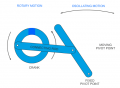
The flutter mechanism is simple. Notice how the motor on an automotive windshield wiper works. This is designed for high torque at low speeds. You want the opposite, low torque at high speeds.

A simple mechanism is a rotating wheel or arm. A post or connection point set at a distance from the center of the motor axle can create an oscillating motion.


1730377653912.png

https://technologystudent.com/despro_flsh/linkage_treadle2.gif
 

MisterBill2

Joined Jan 23, 2018
27,159
Certainly the rather difficult part will be the hinge mechanism. And certainly "Y" is correct about the drive power. But the cheap "toy class " motors are both the lowest efficiency and the lowest performance types.
 

Thread Starter

firsttimefairy94

Joined Oct 30, 2024
7
About the power supply for whatever actuator, consider that the power required is proportional to the work performed. So for a costume for a human for more than a short time, it would probably be a few "D" sized cells, depending on the voltage required.
Are there any videos showing the actual movements of the wings? A simple single axis hinge is not that difficult, but as soon as a more complex motion is introduced it gets more complicated. Probably a single crank scheme driven by a small gear-motor is all that is required, but the packaging will be the challenge.


Notice that in not any of the photos is any view of the mechanism, or even the hinge area, visible. Notice also that the stated source is in the UKRAINE, a country presently under attack by an evil empire.
Good catch! I did not notice the source of the wings. I will go with similar wings from a different seller.
 

panic mode

Joined Oct 10, 2011
4,864
the simple DC motor system would certainly work but it is limited in what it can do if one is interested in customization.
for example one can change the speed but travel of wings would always be the same fwd/rev stroke. also this would require lever mechanism which ...as simple as it is... is still a complication. i would also be concerned with such mechanism getting tangled with clothing or hair. and i don't know... it lacks cool factor - that could have been done centuries ago.. or mileanias ago if using clock mechanism or bow as a power source.

using two servos, mechanism completely goes away - each wing can be attached to own servo so mechanically things could not be simpler. and since stroke is always back and forth, there is no problem even if something does get stuck to the servo arm. and this is more flexible to create wing motions use different speed, stroke, intervals and numerous combinations. also triggering of different mode can be vey flexible... in simplest case it could be button or two, can automatically change modes based on timer but it could also react to external stimuli... for example flash of light or sound or motion (accelerometer)... and if the wings have LEDs (Everyone loves LEDs) they could be made to react as well... so i would rather let the fairy be fairy and MAGICAL...
 

Ya’akov

Joined Jan 27, 2019
10,226
the simple DC motor system would certainly work but it is limited in what it can do if one is interested in customization.
for example one can change the speed but travel of wings would always be the same fwd/rev stroke. also this would require lever mechanism which ...as simple as it is... is still a complication. i would also be concerned with such mechanism getting tangled with clothing or hair. and i don't know... it lacks cool factor - that could have been done centuries ago.. or mileanias ago if using clock mechanism or bow as a power source.

using two servos, mechanism completely goes away - each wing can be attached to own servo so mechanically things could not be simpler. and since stroke is always back and forth, there is no problem even if something does get stuck to the servo arm. and this is more flexible to create wing motions use different speed, stroke, intervals and numerous combinations. also triggering of different mode can be vey flexible... in simplest case it could be button or two, can automatically change modes based on timer but it could also react to external stimuli... for example flash of light or sound or motion (accelerometer)... and if the wings have LEDs (Everyone loves LEDs) they could be made to react as well... so i would rather let the fairy be fairy and MAGICAL...
I think that two large hobby servos is the most promising arrangement—the only question being the noise they will make. But I think only a linear motor would avoid the noise.
 

Ya’akov

Joined Jan 27, 2019
10,226
the simple DC motor system would certainly work but it is limited in what it can do if one is interested in customization.
for example one can change the speed but travel of wings would always be the same fwd/rev stroke. also this would require lever mechanism which ...as simple as it is... is still a complication. i would also be concerned with such mechanism getting tangled with clothing or hair. and i don't know... it lacks cool factor - that could have been done centuries ago.. or mileanias ago if using clock mechanism or bow as a power source.

using two servos, mechanism completely goes away - each wing can be attached to own servo so mechanically things could not be simpler. and since stroke is always back and forth, there is no problem even if something does get stuck to the servo arm. and this is more flexible to create wing motions use different speed, stroke, intervals and numerous combinations. also triggering of different mode can be vey flexible... in simplest case it could be button or two, can automatically change modes based on timer but it could also react to external stimuli... for example flash of light or sound or motion (accelerometer)... and if the wings have LEDs (Everyone loves LEDs) they could be made to react as well... so i would rather let the fairy be fairy and MAGICAL...
By the way, I think the idea thing would be to have a set of controls that allow the wings to mirror emotions do the user could choose things that match their words or states of mind.
 
Top