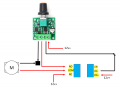
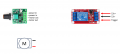
Running 1 12v motor from 2 different power sources

Thread Starter

titans7

Joined Dec 18, 2024
38
You guys were such a huge help with my son's project, (newbie) simple circuit project for Momentary push button start switch | All About Circuits , that I figured I'd come back and get some more information.

Is it possible to run a single 12v motor from 2 different 12v power sources?
- Using a NC / NO relay with COM, I will send 12v power through the time delay relay through the NC circuit.
- When the time delay relay swaps to NO, it will send that 12v power through a PWM that can be regulated to whatever output I want through adjustment.

In theory, I have a diode on the output of the time delay relay which goes straight to the motor. I also have a diode on the output of the PWM controller so that nothing feeds back.

Seems very simple in my mind, but am I missing anything? By using the NC / NO relay setup, it ensures that I'm not sending 12v power from NC and PWM power from NO at the same time.
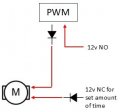
Powder Dispenser PWM.jpg
 
Last edited:

ElectricSpidey

Joined Dec 2, 2017
3,312
If you have NC/NO and a common, then you have a SPDT relay.

You don't need the diodes.

Connect the motor positive to the common.
Connect the supply positive to PWM positive input.
Connect the output positive of the PWM to the NO connection.
Connect the constant supply positive to the NC connection.

Assuming common ground.

This post contains an edit after rereading the OP.
 
Last edited:

MisterBill2

Joined Jan 23, 2018
27,170
Indeed, interaction between two power sources is a consideration, and usually it is to be avoided. Using a relay is the better plan in this case.
The "common" side of the connection may also matter, because that "perfectly conductive ground" does not exist in reality. Common, or even "Return" are better choices and often better defined.
 

Thread Starter

titans7

Joined Dec 18, 2024
38
Perfect. I'm actually in the process of wiring it up now. Will check with my multimeter before connecting to motor.
 

Thread Starter

titans7

Joined Dec 18, 2024
38
If you have NC/NO and a common, then you have a SPDT relay.

You don't need the diodes.

Connect the motor positive to the common.
Connect the supply positive to PWM positive input.
Connect the output positive of the PWM to the NO connection.
Connect the constant supply positive to the NC connection.

Assuming common ground.

This post contain
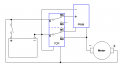
The ground is giving me an issue. As shown below:
- Motor + to COM
- PWM output to NO
- Power to NC, PWM input, relay input
- CH is just a trigger.

The NO side of the circuit works fine as long as the grounds are kept separate. So main ground and PWM input ground can be together, but PWM output and motor need to be together. If the grounds are separated, then the NO side works. I have total control of motor speed. If all grounds are tied together, then it's like the PWM isn't there. Motor is wide open.

Now, I eliminate the PWM and just hook up all grounds together, the motor runs wide open. When the relay counts down, power is killed, motor turns off.

But when the PWM is hook up like below and all grounds are common, the relay will count down and swap, however speed is not changed. Still wide open. It's almost like Its getting a back feed through the ground. But what do I know, thus I'm asking question on this forum. Ha.

1738031531970.png
 

ElectricSpidey

Joined Dec 2, 2017
3,312
I think I know what the problem is.

The PWM switches on the low side, and I should have realized that from the start, as most do.

The positive input to the PWM is common with the output so it just passes current when the relay is at NO.

You can confirm this by doing a continuity test across the positive input and the positive output of the PWM with the wires disconnected.

Sorry about the issue, you're going to have to work something else out, perhaps back to your original scheme with the diodes.

It's too late for me to think straight right now.
 
Last edited:

BobTPH

Joined Jun 5, 2013
11,463
If Spidey is right, you need to connect the power supply + directly to the motor and switch the ground through the relay.

Motor - to COM
PS - to NC
PWM - to NO
 

Thread Starter

titans7

Joined Dec 18, 2024
38
You guys beat me too it and why I didn't catch that is crazy. The PWM controller states on the box "pwm VOLTAGE controller"

With 12v entering the small controller, I just measured 5.09 volts at the output to motor. As I adjust, the output voltage changes, as it should. For some reason I got caught up in the power leads changing state from NC to NO and totally forgot about ground. So as mentioned, I need to have either ground switched through the relay or have a way to kill the 12v ground and thus just have the adjusted voltage going to the motor.
 

ElectricSpidey

Joined Dec 2, 2017
3,312
BobTPH is correct, BUT...that would mean connecting both of the supply positives together, and that's not going to work.

Are you sure you need 2 supplies? And what is the reason for that?

Perhaps when you said 2 different sources you were not actually meaning 2 physical supplies and just the different controls.

IE: PWM and steady.

If you can use only one supply, then switching the motor negative is the answer.

Motor negative to COM.
PWM motor negative output to NO.
Supply negative to NC.
 

Thread Starter

titans7

Joined Dec 18, 2024
38
BobTPH is correct, BUT...that would mean connecting both of the supply positives together, and that's not going to work.

Are you sure you need 2 supplies? And what is the reason for that?

Perhaps when you said 2 different sources you were not actually meaning 2 physical supplies and just the different controls.

IE: PWM and steady.

If you can use only one supply, then switching the motor negative is the answer.

Motor negative to COM.
PWM motor negative output to NO.
Supply negative to NC.

Yes, you are correct. My terminology is off.

the 2 sources are PWM and steady.
 

LesJones

Joined Jan 8, 2017
4,511
As the PWM switches the negative then why not just us it the drive the base via suitable resistor of a suitably rated PNP power transistor. The emitter of this transistor would be connected to 12 V positive and the collector connected to the motor positive. It would be a good idea to add a diode between supply negative and the collector to deal with any inductive voltage spikes from the motor windings. You would need to tell us how much current the motor takes for us to suggest a suitable PNP trnasistor.
Les.
 

Thread Starter

titans7

Joined Dec 18, 2024
38
If you want a soft startup such as using PWM then switch over to full power you don't need two sources. You can do it all from a single source. If you confirm this I'll bang out a drawing for you.
The other way around. My trigger, a switch, will star the sequence. It will be full 12v for a timed duration. Then is will swap to the PWM for a controlled finish.
 

Thread Starter

titans7

Joined Dec 18, 2024
38
This is not the exact relay I have but its very similar other than a digital timer. Power + - into relay with a start trigger. Then NO, COM, NC

1738071353800.png
 

ElectricSpidey

Joined Dec 2, 2017
3,312
If you are using only a single physical power supply, then you should be good to go with switching the motor negative between the supply ground and the PWM negative output.

Just confirm the PWM low side switching first. (both positives should be common)

I'm sorry I can't give a diagram.
 

Tonyr1084

Joined Sep 24, 2015
9,744
OK, this drawing shows the way I had imagined. You said you want it the other way around. Give me a few more mins and I'll modify the drawing. Meanwhile, here.
Screenshot 2025-01-28 at 7.12.34 AM.png
Corrected drawing to follow.
 
Top