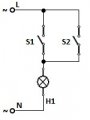
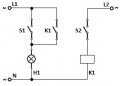
I think the TS is more concerned about the physical ON OFF indication of the switches. If a switch is in the OFF position then the light should be off and visa versa. You lose that functionality when you have two switches controlling one light, with one power source or two.
I solved this same issue using wireless controllers. The system I used was the Lutron Caseta system. There are other similar systems available. It involves replacing the original switch with the wireless controller. The remote can be placed anywhere. Multiple remotes can control the same lamp. In fact, the remote can be mounted to the wall to appear like a normal switch. Both the remote and the controller can turn the lamp on or off.
It's a little pricey at about 60 USD for the controller and one remote but it beats having to try to install another switch, i.e. pull wire, install switch box, etc.
I think the TS is more concerned about the physical ON OFF indication of the switches. If a switch is in the OFF position then the light should be off and visa versa. You lose that functionality when you have two switches controlling one light, with one power source or two.
I think the TS is more concerned about the physical ON OFF indication of the switches. If a switch is in the OFF position then the light should be off and visa versa. You lose that functionality when you have two switches controlling one light, with one power source or two.
I'm not worried about the physical indicators; not least because the second switch doesn't have a physical on/off indicator.
The requirement is that if either switch is ON, the light must be one. Hence the light must be off only if BOTH switches are off.
Thank you all for the very helpful and constructive comments and advice. Whenever I ask a question like this I am reminded of how much I still do not know.
I think in my particular use case, the relay-based / multiplexer option seems to provide what I need.
Only if they are from the same split-phase from the transformer (in the US).
If they are from opposite phases, you will get a nice dead-short across the 240.
My first thoughts too. Not to mention, if you DO get a dead short at 240 VAC - you're going to get a lot of excitement the moment both switches are switched on. So far this is all speculation. There's a lot we don't know.
First - forgive me if I missed it but we don't know what AC voltage; Split phase or not or what kind of lamp is being switched on. It could be a common household AC voltage with split phase and the lamp could be just a screw base lamp. But we don't know where the power(s) is(are) coming from. One might be a generator/inverter while the other is the house current. It COULD be a low voltage lamp. Could be LED or CFL, or could be incandescent type. There's a lot we don't know.
In any case, if it's 120VAC split phase and one switch is on L1 and the other is on L2, isolating them with a diode from each end AND (and this is a key factor) the lamp is incandescent in nature. I say "in nature" because incandescent lamps are no longer sold in high wattages. In this case a source from either end, same phase or opposites, the diodes will prevent back feeding one line from the other (a.k.a a dead short).
Now, here's my final rub: Some poor electrician is going to come along and think this is normal wiring per code wherever the code is written, and find a sudden and shocking surprise. Possible destroyed equipment, possible burn injury, possible fatal exposure. While it is possible to do thousands of things, code prevents someone from making a system that nobody but the one who built it understands. The next poor fella could find him/her self in a world of hurt. Not to mention possible fire starting and burning down (assumed) the house. Aside from the diodes - and an incandescent type lamp - I wouldn't recommend further pursuit of this project. Sure, relays would work, but they have to be the right kind of relay. AC coil designed for continuous operation and contacts rated for the load.
Earlier I mentioned not knowing what type of lamp. This could possibly be a high current lamp and may need 15 amps. A simple LED home screw base lamp won't need nearly that much power. But what happens when you sell the house and the next owner installs a higher wattage lamp? This is why I advise against this project.
We need to know what the AC voltage is - from where each AC source is coming from - whether it is split phase - what type and wattage the lamp is. That's where we need to START this conversation. My suggestion about diodes may be a moot point. I don't know how an LED lamp would work if it only saw half wave voltage. Same goes for CFL.

 Facebook
 Google
 GitHub
 Linkedin