Two-out-of-three probability [recreational puzzle]

Thread Starter

Raymond Genovese

Joined Mar 5, 2016
1,653
Let’s say person X plays person Y in racquetball. It is known that X is a better player than Y. In fact, the odds of X beating Y are .60.

If they play a “best of 3” match, how often can we expect player X to win?

How about if X’s odds of winning a game are .70 or .80 or .90?
 

WBahn

Joined Mar 31, 2012
33,075
Let's say that X's odds of winning are p (that way we only have to solve it once).

X wins the match if they win two games or if they win all three.

The odds of them winning all three games is p^3.

The odds of them winning a particular sequence of two games is p²(1-p). There are three ways for them to do this. So the result is

P(X wins match) = p^3 + 3(p²-1) = p²(3-2p)

Checks:

P(p = 0.00) = 0
P(p = 0.50) = 0.5
P(p = 1.00) = 1

So we have the following

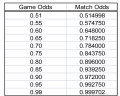
P(p = 0.60) = 64.8%
P(p = 0.70) = 78.4%
P(p = 0.80) = 89.6%
P(p = 0.90) = 97.2%

Not surprisingly, we see that playing a best 2/3 increases the likelihood that the better team will win the match.

This suggests another problem. I'll post it in another thread.
 

Thread Starter

Raymond Genovese

Joined Mar 5, 2016
1,653
@WBahn I appreciate you using a spoiler. I would be very surprised if you didn't get it, but I will post my spoiler and story of where this came from below...and then look at yours ;)

(hope I didn't make any mistakes)


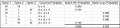
The odds of winning the match if you hold an edge of .60 against .40 in a single game are, in fact, .648, which is an increase in your single game advantage of .60.

Outcomes and probabilities in a two-out-of-three match where one player has a 0.60 edge of winning a single game.
Table-1.jpg

If it bothers you that the table only uses six outcomes where strictly speaking, there are eight possible outcomes in a three game match, rest easy as you don’t need to calculate those other two outcomes. Consider the case of where you win the first and second games. For that outcome, you win the match and that outcome occurs with a probability of .360 (.6 x .6). If you were to play the third game, the outcomes, W, W, W occurs with a probability of .216 (.6 x .6 x .6) and the outcome W, W, L occurs with a probability of .144 (.6 x .6 x .4). You win the match in either case and the combined probability of those two outcomes is, of course, .360.

Any time you hold an edge in a single game (ignoring the probability of winning at 1.0); you will hold a bigger edge in winning a two-out-of-three match. How much bigger the match edge is depends on how big of a game edge you hold.

Match advantages at different game advantages.
Table -2.jpg


After examining Tables 1 and 2, you may be able to see the formula for calculating the match probability. That formula is MWP= (2LP x HP2) + HP2 where MWP=the match win probability, HP= is the high probability of winning a game, or edge, and LP, or 1-HP, is the low probability of winning a game.

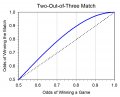
Function relating game odds to match odds.
Figure-1.jpg

You can see that as your edge approaches 1.0 and .5, your added advantage in the match decreases. But when you hold a .75-.85 game edge, your match advantage is almost an addition 10% - a substantial increase!

How I came across this:

About 10-12 years ago, I spent some time playing Gin Rummy at an online site. They had a friendly Sunday Night Tournament where you played best of three matches until there was one winner. It was strictly for fun.

Over the course of nearly a year or so, I did *very* well and frequently won the tournament and even won the Tournament of Champions (where only past Tournament winners played).

I started thinking about what kind of “edge” I really had (if I had any at all). That led to writing a Visual Basic program to simulate match play at various edges (I am by no means a mathematician and I frequently find myself using some kind of mental simulation to grasp certain ideas – in this case it was mental and visual)

Eventually, using the simulation, I had enough “empirical” observations, to think about it in other terms.

When I go off on these “just for S & G” endeavors (which I do for relaxation), I developed the habit long ago of writing it up. Even though there was no other reason other than curiosity to look into this, I knew that if, years later, I was struck by the same curiosity, I would have some record. Additionally, forcing yourself to record the investigation (even as notes in a folder) facilitates clearer thinking – in my experience.

I ran across the write-up of this (which I have not thought much about since) while getting ready to decommission an old XP machine. Thought some others might find it interesting.
 
Top