Two op amp circuit

WBahn

Joined Mar 31, 2012
32,852
Here's another way to see why the solution to the circuit is indeterminate when Av→∞. In that case (ideal opamps) Vx = Vy so that (Vx-Vy)=0. Since the output voltage of an opamp is Vo = Av*(Vx-Vy), for an ideal opamp this becomes Vo = ∞*0, an indeterminate result if no other constraints determine a value for Vo.
But that is true for any analysis that uses the ideal opamp model.
 

MrAl

Joined Jun 17, 2014
13,707
But that is true for any analysis that uses the ideal opamp model.
Hi,

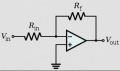
Yes, and it works for those circuits, i've used it countless times. This idea here is that it works for A going toward infinity because the differential drops toward zero, or rather delta v drops toward zero. For delta v approaching zero as the gain approaches infinity the solution becomes entirely dependent on the other circuit components, namely the resistors. In the case of the inverting op amp, we get Vout=-Vin*Rfb/Rin which illustrates that case in point.

That's not the only use however. It can also get rid of components that are superfluous in the circuit, which is nice of course because then the response formulation gets simpler. With finite gain however this doesnt always happen.
 
This may be what is happening, but I think it is more likely that Vo2 is the result of saturation.
.........
and I start to suspect that the LM358 results are from saturation rather than a happy coincidence of offset voltages that put the outputs so close to the rails.
.
My post #55 was meant more in the sense of "this is what built-in offset in the model would be required to produce theoretical Vo1 and Vo2 equal to the observed values; is it believable?" than "here's the actual cause of the observed results".

I think you're quite right in your analysis of the situation.

The nominal offset of the LM358 is 2 mV and if that is the value built-in to the model, we would expect the output to be well into saturation in one direction, well past the unsaturated Vo1 and Vo2 with only .1167 mV offset.
 
But that is true for any analysis that uses the ideal opamp model.
I was hoping someone would raise that issue. That's why I included "...if no other constraints determine a value for Vo."

The standard inverting amplifier (Let Vx be the voltage at the + input and Vy be the voltage at the - input:
Amp.png

shows the issue. If we assume an ideal opamp, Vx=Vy=0 and the opamp gain "equals" ∞. The opamp provides that Vout = Av*(Vx-Vy) which is ∞*0. We could take this to mean that ∞*0 could be any value; for this circuit the resistors provide a constraint so that only one Vout satisfies KCL for a given Vin.

The resistors in the circuit under discussion in this thread apparently don't provide the necessary constraint; why not? How can the lack of constraint be explained in a simple, intuitive way? A full mathematical analysis shows that it's the case, but how can one look at the circuit and say immediately "that circuit is indeterminate if the opamps are ideal"?
 
Just to be perverse, I bread boarded the circuit using several LM324 quad op-amp chips. With a maximum input offset voltage of 5mV (as noted in one data sheet) it was of little surprise to observe the outputs heading for the rails without fail.
Did both outputs head for the rails, or just one with Vo1-Vo2 assuming the expected value?
 

t_n_k

Joined Mar 6, 2009
5,455
Did both outputs head for the rails, or just one with Vo1-Vo2 assuming the expected value?
Just the one op amp output went to the rail (rather to the expected limit for the supply voltage). The other output adjusted to the expected difference Vo1-Vo2. This isn't surprising - as Tesla reasoned earlier in the thread.
I'm still intrigued by your notion that input offsets & open loop gain could account for a particular result. One might be fortunate enough to randomly select two op amps with input offsets of almost or absolutely equal magnitude but opposite polarity and sufficiently close Aol. Would this confirm your prediction? I would imagine a good chance of so doing.
Unfortunately in my situation the LM324's I used are a quad type fabricated on the one die - hence unlikely to satisfy the foregoing scenario - at least for the offset requirement.
 
Last edited:

MrAl

Joined Jun 17, 2014
13,707
I was hoping someone would raise that issue. That's why I included "...if no other constraints determine a value for Vo."

The standard inverting amplifier (Let Vx be the voltage at the + input and Vy be the voltage at the - input:
View attachment 75687

shows the issue. If we assume an ideal opamp, Vx=Vy=0 and the opamp gain "equals" ∞. The opamp provides that Vout = Av*(Vx-Vy) which is ∞*0. We could take this to mean that ∞*0 could be any value; for this circuit the resistors provide a constraint so that only one Vout satisfies KCL for a given Vin.

The resistors in the circuit under discussion in this thread apparently don't provide the necessary constraint; why not? How can the lack of constraint be explained in a simple, intuitive way? A full mathematical analysis shows that it's the case, but how can one look at the circuit and say immediately "that circuit is indeterminate if the opamps are ideal"?

Hello there Electrician,

Sorry but I have to strongly disagree (about the necessary constraint) because as you can see from Jony's first post it does have a constraint or else we could never get a decent result out of using this concept. The constraint is just more complicated in this circuit as it is not as direct, but we still see that the other components decide what the outcome is when we let the gain go toward infinity. So i dont think it is good to think of it in terms of 0*infinity i think it is better to think of it in terms of a*(1/d) where 'a' gets larger and larger as (1/d) gets smaller and smaller, so the result becomes dependent on the slopes.

I do have to strongly agree that a small offset like 2mv will render this circuit maybe not useless but it will destroy the relationship that we've all come to know and love now. With my simulations and calculations i have found that even 1mv is too much as it forces one or both op amps into saturation. That's of course unless there is another offset to balance that first offset. This means if this circuit is to be used for anything it should use low input offset op amps.

For what it is worth, with two offset adjustments, we could use this circuit to compare the internal gains of two op amps, as long as they are not too much different.
 
Hello there Electrician,

Sorry but I have to strongly disagree (about the necessary constraint) because as you can see from Jony's first post it does have a constraint or else we could never get a decent result out of using this concept.
The classic circuit I showed in post #64 has only a single solution even though the opamp is ideal (Av=∞ and Vx-Vy=0); the resistors constrain the solution to be unique. Jony130's original circuit has many solutions if the opamps are ideal; the resistors do not constrain the solution to be unique.
 
Just the one op amp output went to the rail (rather to the expected limit for the supply voltage). The other output adjusted to the expected difference Vo1-Vo2. This isn't surprising - as Tesla reasoned earlier in the thread.
I'm still intrigued by your notion that input offsets & open loop gain could account for a particular result. One might be fortunate enough to randomly select two op amps with input offsets of almost or absolutely equal magnitude but opposite polarity and sufficiently close Aol. Would this confirm your prediction? I would imagine a good chance of so doing.
Unfortunately in my situation the LM324's I used are a quad type fabricated on the one die - hence unlikely to satisfy the foregoing scenario - at least for the offset requirement.
If it's convenient (since you might still have the breadboard handy) provide an offset adjustment like this: get a AA battery and place a 10k trimpot in series with a 1 ohm (or more if needed) resistor across it. You can adjust the trimpot to get a millivolt range of voltage across the 1 ohm resistor. Connect this in series with one input of one opamp. You might have to reverse the connection to the opamp to get the proper polarity. This will allow you to cancel out, or modify, the offset of that one opamp. You should be able to bring the circuit out of saturation; you get the picture. This way you don't have to rely on chance selection of opamp offsets.

I gave some thought to how to mimic saturation with the analysis. I modified Jony130's circuit of post #54 by connecting a resistor Ro in series with the output of U2. The left end of Ro is connected to the output of U2, and the right end now becomes the opamp "output"; the right end or R4 is connected to the right end of Ro; this is the node Vo2 now. I made Ro 100 ohms. Now I can connect a battery of 13.7 volts in series with a .01 ohm resistor to the right end of R4 which clamped that node to 13.7 volts, simulating saturation in the mathematical analysis. I set the offset of U1 to .002 volts and the analysis showed that the output of U2 (left end of R0) rises to 190.683 volts, but the right end is clamped to 13.7177 volts. The difference Vo1-Vo2 is 4.4003 volts.
 

Thread Starter

Jony130

Joined Feb 17, 2009
5,598
Jony:
Where did you get this circuit and was it associated with any particular application?
This circuit was sent to me via PM by the student who encountered problems during simulation.
This amplifier was supposed to be used as a input stage for a differential input ADC. And this was a part of a project: "measuring DC voltage in range +/-220V". And this amp was given to him by his professor.
 

MrAl

Joined Jun 17, 2014
13,707
The classic circuit I showed in post #64 has only a single solution even though the opamp is ideal (Av=∞ and Vx-Vy=0); the resistors constrain the solution to be unique. Jony130's original circuit has many solutions if the opamps are ideal; the resistors do not constrain the solution to be unique.
Hello again Electrician,

Ok, well it looked like it did based on the fact that his equations came out exactly equal to the right result, and he let A go to infinity. Wasnt there only one result?

I think we also have to be careful here about what we are calling unique. We dont see unique outputs, we just see unique output difference with unique input difference. So when we have V1-V2=1 we always get Vout2-Vout1=2 (or it's negative). In terms of the circuit values, Vout1-Vout2=(V2-V1)*R2/R1 (or it's negative). The solution comes out based on the component values. That's as unique as we are going to get with this circuit :)
 

MrAl

Joined Jun 17, 2014
13,707
This circuit was sent to me via PM by the student who encountered problems during simulation.
This amplifier was supposed to be used as a input stage for a differential input ADC. And this was a part of a project: "measuring DC voltage in range +/-220V". And this amp was given to him by his professor.
Hi again,

Ok then there may be other constraints place on the components or ideas that we dont know about.
Usually in a course there are certain restrictions that are talked about in class but dont appear in the assignments. That could be the case here too.
 
Top