Turning on a solenoid

Thread Starter

imadeausername

Joined Dec 19, 2017
6
Hello All,

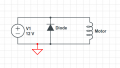
I am new to this and I just started playing around with solenoids, I have seen some control boxes which acts as absorbers for high power solenoids and I am looking to make a simple one. I am trying to understand the consequences of this design (diagram below):

  • Using a 12V car battery
  • The solenoid requires 12V and 35A
  • The voltage spike will be around 400V when coil De-energizes
  • suppose the diode can tolerate the voltage and current when coil De-energizes

I just have a few questions:

  • When the coil De-energizes will this voltage spike cause damage/coil burnout to the motor as the motor can only work with 12V?
  • Will the battery get damaged in any way?
  • Are there any diodes out there that can handle this spike?
  • What can I do to improve this design?

Screenshot from 2017-12-19 23-57-16.png


Thanks!
 

Reloadron

Joined Jan 15, 2015
7,887
  • Using a 12V car battery
  • The solenoid requires 12V and 35A
  • The voltage spike will be around 400V when coil De-energizes
  • suppose the diode can tolerate the voltage and current when coil De-energizes
This sounds more like a relay contact rating than a solenoid. A solenoid coil rated at 12 V and 35 Amps would be a 420 Watt coil which is a little unusual. That said the diode in the drawing is commonly called a flyback diode as well as (sometimes called a snubber diode, commutating diode, freewheeling diode, suppressor diode, suppression diode, clamp diode, or catchdiode) is a diode used to eliminate flyback, which is the sudden voltage spike seen across an inductive load when its supply current is suddenly reduced or interrupted. No shortage of naming conventions. Generally speaking the diode needs to be rated for the current and voltage of the load with an overhead. When power is removed the coil field will collapse and the flyback diode will conduct. The current at this instant will be whatever the load current was. Here is a previous thread on the subject and a Google of "choosing a flyback diode" should yield plenty of results. Again, a 12 Volt 35 Amp coil sounds very unusual?

  • When the coil De-energizes will this voltage spike cause damage/coil burnout to the motor as the motor can only work with 12V?
  • Will the battery get damaged in any way?
  • Are there any diodes out there that can handle this spike?
  • What can I do to improve this design?
1. No, and with a flyback diode that inductive kick or spike will be "snubbed" but no, even less the diode the motor in this case will not be damaged. However, less the diode other sensitive electronics on the same supply could be damaged, thus the use of the flyback diode.
2. No once the switch is opened the battery or any supply is no longer in the circuit.
3. We went from a "solenoid" to a motor in your attached drawing? In the case of a solenoid, yes, there are diodes which can handle hundreds of amps. You really need to better define what you have?
4. Better define exactly what you have.

Ron
 

MaxHeadRoom

Joined Jul 18, 2013
30,654
If this IS a 35a coil then together with the diode, there will be a certain amount of delay in the drop out time due to the amount of energy required to be dissipated when the solenoid is de-energized.
Max.
 

Janis59

Joined Aug 21, 2017
1,894
About magnetic relays - my co-worker here was long years the main engineer in company what is making air compressors for the region. For long years they used a russian magnetic launcher (contactor) for 16 Amps and it worked well for thousands and thousands of units laid out yearly. But then that russian plant was economically killed and other plants making contactors was too greedy, so the director of compressor company decided to buy "very good and even more cheap" contactors from Poland, what was labelled as 25Amp. First year they fabricated around 3000 compressors from what 2900 was returned in half of year with burned-off contacture. So - the main question always one must ask - do those Amperes are Chinese Amperes or British Amperes. Because it is obvious that one thousand of Chinese Watts are equal to 2...5 English Watts (just look for their (China made) battery operated (two pieces AAA cells) 2x2x2 inch lodspeakers with dedicated amplifier labelled for 3 kW (!!) power. And many Polish products (not all) are just kinda of the same.
 

Janis59

Joined Aug 21, 2017
1,894
About diodes - if the switcher will be BJT or FET, then diode must be about the same order rapid as those switcher, or slightly faster and not slower. If that is simply contacture, may use any slow diode. Slow diodes very well survives the over-current for short periods. Generally, for 10 msec they may be loaded with ANY giant current if the (time of peak) x (current of peak) < (normal current) x (those 10 msec). Therefore for 35 Amp there is no need to install diode stronger than 35...50 Amp. Other is with ultra-fast diodes, there the peak current ought be calculated, knowing the coil resistive component (You may easily measure that with a tester). L x (dU/dt) = i ....once said one semi-genial researcher, and from that times this formula works well.
 

Danko

Joined Nov 22, 2017
2,167
L x (dU/dt) = i ....once said one semi-genial researcher
Current in coil never increasing after current from source get off, but decreasing only. By the way, extra voltage induced just by decreasing current.
{ “the direction of an induced emf is such that it will always opposes the change that is causing it”. In other words, an induced emf will always OPPOSE the motion or change which started the induced emf in the first place.
So with a decreasing current the voltage polarity will be acting as a source and with an increasing current the voltage polarity will be acting as a load. So for the same rate of current change through the coil, either increasing or decreasing the magnitude of the induced emf will be the same. }
http://www.electronics-tutorials.ws/inductor/inductor.html
 

Thread Starter

imadeausername

Joined Dec 19, 2017
6
If this IS a 35a coil then together with the diode, there will be a certain amount of delay in the drop out time due to the amount of energy required to be dissipated when the solenoid is de-energized.
Max.

Ah okay! Does this mean that the solenoid will not retract as soon as it is disconnected from the supply? Or will this delay depend on the speed of the diode?
 

Danko

Joined Nov 22, 2017
2,167
Ah okay! Does this mean that the solenoid will not retract as soon as it is disconnected from the supply? Or will this delay depend on the speed of the diode?
Speed of diode means how fast it is closing under reverse voltage. To forward current any diode seems like piece of wire.
For faster current decreasing they connect some resistor in series with diode. Resistor eats magnetic field energy and becomes hot.
Of course, you will have some impulse voltage on resistor. For example current in 10 Ohm resistor will produce 10 Ohm x 35 A = 350V.
So, your commutator should hold this voltage.
 
Last edited:
Top