Trying to make a digital RPM meter without a microcontroller.

Thread Starter

SufferingStudent()

Joined Dec 24, 2023
3
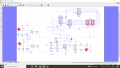
1703425645161.pngThe switches SW3 and SW4 are to be swapped for photodiodes in the physical prototype. The circuit is supposed to light D1 then D2 when the switches are flicked in a certain order then send a signal to the decade counter followed by the 2 seven segment decoders to display the number of counts as a number. The input connected to IC4 is a reset for the counter. I have managed to make it work for 1 display but I'm pretty sure no rpm of a propeller is a 1 digit number : | I have no idea how to connect multiple ICs in this way so the signal is carried when 1 display reaches 9 to make the next display 1. I have consulted data sheets; they are no help. If anyone could provide any guidance it would be much appreciated as I have been suffering with this for months. (Am I even using the right ICs???)
 

Alec_t

Joined Sep 17, 2013
15,103
1) Is this a school/college assignment?
2) Re-setting the counter at 2Hz gives a rather awkward scale factor of 120 for rpm. How will you handle that?
3) Have you considered using the CD4017 as a counter IC ?

Welcome to AAC!
 

Jerry-Hat-Trick

Joined Aug 31, 2022
777
I've not worked my way through the detail of your circuit, but could you use CD4026 ICs which are decade counters incorporating a 7 seven segment LED driver and a carry pin so you can cascade them. Presumably you need count over a fixed period rather than the time between counts?
 

WBahn

Joined Mar 31, 2012
32,704
What data sheets have you consulted? The TI datasheet shows how to cascade the CD4510B, both with parallel and ripple clocking.

Your rat's nest of wiring makes it hard to follow your signal paths, but it appears you are just displaying the same value on both digits.

You are also hard-tying the carry output of your counter to 5 V and the output of one of your inverters to ground. This is going to cause you all kinds of problems if you actually build this circuit.

Typically, an RPM indicator like this would capture the counter value after a certain period of time and display the captured value statically while the counter is reset and and is counting up for a new value. There are several other strategies that can be used to give the user a more useable display than having to watch it count up and mentally remember what the highest value it got to was before it went back to zero.
 

Thread Starter

SufferingStudent()

Joined Dec 24, 2023
3
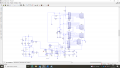
1704043789601.pngOK... thanks for the advice you guys, I think I finally got it to count right up to 9999 but it has occurred to me as WBahn mentioned, the circuit I should have built probably should show the frequency of pulses rather than counting up. If possible I would like to keep as much of what I have already made as possible because if I have to start over I might cry. Is there any way to convert this?
 

Thread Starter

SufferingStudent()

Joined Dec 24, 2023
3
What data sheets have you consulted? The TI datasheet shows how to cascade the CD4510B, both with parallel and ripple clocking.

Your rat's nest of wiring makes it hard to follow your signal paths, but it appears you are just displaying the same value on both digits.

You are also hard-tying the carry output of your counter to 5 V and the output of one of your inverters to ground. This is going to cause you all kinds of problems if you actually build this circuit.

Typically, an RPM indicator like this would capture the counter value after a certain period of time and display the captured value statically while the counter is reset and and is counting up for a new value. There are several other strategies that can be used to give the user a more useable display than having to watch it count up and mentally remember what the highest value it got to was before it went back to zero.
thanks dude
 
Top