Trying to filter out the last bits of noise on a DCDC filter

Thread Starter

Zurn

Joined Mar 4, 2019
122
Hello,

I'm powering a hydrophone (underwater microphone) using a 24V DCDC converter (from a 16V battery). I've managed to filter out most of the higher frequencies using the filter listed in the component's datasheet, but there's still a significant unwanted presence below 11kHz. I'm wondering if anyone can give me some pointers on how to eliminate the final bits of noise.

The DCDC is a PKE3316ZPI by Flex.

The filter looks like this:
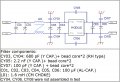
dcdcfilter.jpg

I'd added every component listed above except CY03, CY04, CY07, and CY08 (I have no earth to tie them to, and when I sent them to ground it made no noticeable difference).

As I said, it works quite well. Here's a spectrogram of what shows up on audio file before I add the filter:
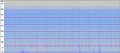
spectrograph-dcdc-nofiltering.jpg

Noisy. Here's what it looks like after I add the filter:
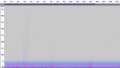
spectrograph-dcdc-withfilter.jpg

Much better! But I still need to get rid of those final bands of noise seeping into our signal, which seem to dissipate completely around 11kHz.

I should add that I know this noise is coming from the DCDC because I've run the same test with the hydrophone powered from a bench power supply and there only tiny bit of system noise below the 1kHz mark.

Oh, and the spikes you see in the spectrograms are from me tapping the table to ensure that the signal is actually being recorded.

Any advice would be greatly appreciated!
 

Papabravo

Joined Feb 24, 2006
22,065
I see you have a differential mode choke. Can I ask why you do not also have a common mode choke?
Also 11 kHz. is way too low a frequency for switching noise. You might want to do some additional sleuthing to discover the source.
 

Ian0

Joined Aug 7, 2020
13,113
If it is switching at 400kHz, how is it producing interference below 11kHz, unless its feedback loop is unstable?
What sort of hydrophone is it that requires 15W?
 

Thread Starter

Zurn

Joined Mar 4, 2019
122
I see you have a differential mode choke. Can I ask why you do not also have a common mode choke?
Oh, does the symbol on the filter schematic suggest differential mode choke? Because the component I'm using is almost certainly a common mode choke.

If it is switching at 400kHz, how is it producing interference below 11kHz, unless its feedback loop is unstable?
What sort of hydrophone is it that requires 15W?
Perhaps? My next step was to solder the components together on breadboard and see what that does to the noise (should have mentioned the spectrograms shown above are from a circuit that's just on a breadboard).

The hydrophone doesn't require 15W, in fact it only draws about 20 mA. I'm just trying to use a DCDC that I have readily available.
 

Papabravo

Joined Feb 24, 2006
22,065
It depends on the polarity dots and how it is actually wound. I see your schematic has the symbol for differential mode but the details of how it is wound have been left out. So, you say it is common mode and my question would be, why don't you also have a differential mode choke. Without knowing the actual source of the 11 kHz. noise it would be like sticking Band Aids on the problem hoping for an improvement.

ETA: chokes are bidirectional, and they should prevent noise from the supply getting to your module as well as preventing your module from sending the noise back upstream.
 

Ian0

Joined Aug 7, 2020
13,113
Oh, does the symbol on the filter schematic suggest differential mode choke? Because the component I'm using is almost certainly a common mode choke.


Perhaps? My next step was to solder the components together on breadboard and see what that does to the noise (should have mentioned the spectrograms shown above are from a circuit that's just on a breadboard).

The hydrophone doesn't require 15W, in fact it only draws about 20 mA. I'm just trying to use a DCDC that I have readily available.
It would be well worth finding a lower power DC-DC converter. It would make less noise.
A flyback converter regulates by producing shorter pulses, but each has the same dI/dt as if it were producing 15W.
Will the hydrophone work from 16V? Is it just a phantom-powered microphone? If so, they usually have a very wide operating voltage, sometimes 10V to 48V.
 

Thread Starter

Zurn

Joined Mar 4, 2019
122
Without knowing the actual source of the 11 kHz. noise it would be like sticking Band Aids on the problem hoping for an improvement.
I completely agree with this - but is there really any question it's coming from anything other than the DCDC converter? (Again, recall that if I run the same test with the hydrophone powered by a bench power supply it comes out sparkly clean).

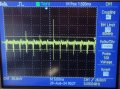
I've tried tracking down something informative with my scope, but I'm quite uncertain as to what ideal in/out signals look like. DC coupled just shows a solid line. I did find the following on an AC coupled signal, however, which, perhaps, maybe, tells us something? The first is on the input of the DCDC:

IMG_20240827_140809819.jpg

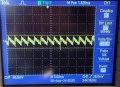
And this is what the output looks like:

IMG_20240827_140652058.jpg

Maybe that's my noise?

So, you say it is common mode and my question would be, why don't you also have a differential mode choke.
Well, the honest answer is I know very little about noise filtering and I was simply following the circuit built in the datasheet (which says use a 1.6 mH common mode choke). I'm learning lots though!

Lastly:
Will the hydrophone work from 16V?
No, these are 24V only hydrophones.

Thanks for the replies!
 

Thread Starter

Zurn

Joined Mar 4, 2019
122
The ripple on your supply at 11kHz is due the the supply having such a small load that it is "cycle skipping".
Yes, I was just pursuing yr earlier suggestion of a smaller wattage converter... this makes a lot of sense!

If this is true, then add some load and see if the frequency changes or goes away.
I will absolutely try this.... tomorrow! (Must go catch a bus now).
 

Papabravo

Joined Feb 24, 2006
22,065
The problem may not be from the converter itself, but what the converter is susceptible to. Think of it as a big antenna that picks up and amplifies other sources. This may be due to influences that are completely outside the design of the converter that the designers could not foresee. If you do not know the actual source of the noise, then you have literally no hope of eliminating it.
 

Thread Starter

Zurn

Joined Mar 4, 2019
122
Okay, problem solved...

It was indeed from having such a small load on the DCDC. Adding even a few watts of power made a significant change in the noise presence.

Thanks everyone!
 

MisterBill2

Joined Jan 23, 2018
27,316
First, I am guessing that the noise is measured at the output terminals of the circuit we are shown. That is a guess because it is not shown.
What is missing is filtering of the 24 volt output. The two shunt capacitors, 10 nF and the bypass capacitors to ??? would not have a lot of effect. Aside from that, coupling the output back to the input, also coupled to that same common "ground" might be a problem. AND I see reference to ferrite beads with no hint on the circuit as to their location. Are they possibly on the capacitor leads??
Blocking noise requires a series impedance at the noise frequency, I see not one bit of that shown in the output circuit section of the drawing.
Considering that the DC/DC converter output impedance is probably quite low,shunting it with a small capacitor will not be adequate. You do need some series reactance to block the noise voltage.
 
Top