Trying to create board from schematic

ag-123

Joined Apr 28, 2017
294
One of the pain points of the single layer Perfboard, is that everything is upside down
If you used KiCad and draw the PCB digitally, you can digitally "flip" it around.
That's what I did, then I simply followed that and soldered my wires on the board at the "back" (flipped left to right)

:rolleyes:
Would it make sense to get dual layer grid board and run the trace connections 'above ground' so to speak??
I started using these sort of PCBs, they are pricier but better made. Found in the same online marketplaces.
But that "flipped" issue is the same, using KiCad makes it 'easier', it can digitally show the "flipped' view.
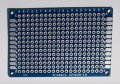
pcb1.jpg
 
Last edited:

ag-123

Joined Apr 28, 2017
294
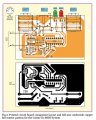
It's only upside down when you're looking at the wiring side. If that confuses you, do a PCB layout and use that as your wiring guide. If you take care to avoid unnecessary wire crossings, you can do most of the interconnect with bare wire. That's what I did for this board:
View attachment 269663
Component leads were used for much of the wiring. The green wire is #30 wire wrap wire. I have the special strip/wrap tool, but I just use regular wire strippers. I used #24 wire from CAT5 cables for the power rails.

I put the pads on the top to avoid creating shorts from the bare wires on the wiring side.
View attachment 269664
Wow, that's more complex and compact than I've (ever) done :D
 

dl324

Joined Mar 30, 2015
18,326
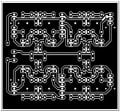
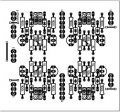
PCB layout for 4 discrete flip flops and component side showing placement and jumpers.
4discreteFFBot.jpg4discreteFFComp.jpg
Note that the trace side is mirrored. I make my own boards using toner transfer.

I hand wired the 6 flip flop board because I didn't want to take the time to transfer, etch, and drill a board.
 

ag-123

Joined Apr 28, 2017
294
PCB layout for 4 discrete flip flops and component side showing placement and jumpers.
View attachment 269667View attachment 269668
Note that the trace side is mirrored. I make my own boards using toner transfer.

I hand wired the 6 flip flop board because I didn't want to take the time to transfer, etch, and drill a board.
nice ! These days a fad is this:
I've got one, need to spent a day to work that and assemble it, probably more days to make that work. I've been procrastinating.
 
Last edited:

Irving

Joined Jan 30, 2016
5,109
Regarding hookup wire, I use this wire...its insulated but you don't need to strip it.. the insulation melts away and becomes its own flux. Simply solder one end, route it, solder other end, wiggle to break it off.

1655482933133.png
 

Irving

Joined Jan 30, 2016
5,109
nice ! These days a fad is this:
I've got one, need to spent a day to work that and assemble it, probably more days to make that work. I've been procrastinating.
I've used my CNC mill to do this. Needs a really high-speed spindle and good quality 60° V-cutter to get a clean cut else leaves very fine tendrils of copper which can end up as shorts.. Can be quite slow on boards with lots of curvy traces.
 

Thread Starter

skezza

Joined Jun 17, 2022
10
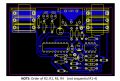
OK, so before I dive too deeply into the software, the first thing I've done is invert the PCB layout and remove most all of the unnecessary blue. I think all of the blue was making it significantly harder to follow. I did this in paint, so nothing too clever. Just flipped the diagram and the lettering for components.

Which leaves me with this:


Inverted PCB.png

Now looking at that.... it doesn't appear quite as complicated. I wonder if I laid the components out as per the original schematic, flipped and followed this using wire as tracks, whether I could pretty much nail this.... Without the use of software at all? I'm going to download some anyway, to see what I can experiment with first, but yeah, the above is certainly a lot easier to follow if poorly optimized compared to the superb layout above.

As they say, "Time spent in reconnaissance is rarely wasted”. Definitely want to understand this before I go into round 2 :D
 

Jon Chandler

Joined Jun 12, 2008
1,595
I'd suggest using EasyEDA, free from JLCPCB, to lay out the board. EasyEDA is in fact pretty easy to use, and laying out a board will be pretty simple since you have a drawing to start from.

Then you can order 5 boards from JLC for less than 5 bucks (+ shipping). The end result is a professional board that will produce a durable, good looking end result.
 

Thread Starter

skezza

Joined Jun 17, 2022
10
I've ordered the PCB for now. I think that is probably the most sensible solution. However I really wanted to dive a little more into what you were saying earlier. As I mentioned, I used to modify guitar pedals etc with an iron and an eagerness to swap out components (it's amazing how a different cap can totally change the sound of a pedal).

Now that I'm a bit older, I think I'd like to understand the fundamentals a bit more, as the above is really just circuit hacking. You mentioned that I could have just followed the schematic layout.
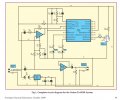
This is the circuit schematic.
View attachment 269683

So if I was to have followed this on my perfboard. Would it have simply been a case of running a 5v rail all around the edge and tapping off it, i.e. literally following the diagram above with copper rails. I must say, the schematic is so much easier than the PCB :D the things you learn eh? I'm tempted to take this up as a bit of a hobby. I've always enjoyed soldering and hacking things but this just feels the next logical level.
 

MrChips

Joined Oct 2, 2009
34,807
I've ordered the PCB for now. I think that is probably the most sensible solution. However I really wanted to dive a little more into what you were saying earlier. As I mentioned, I used to modify guitar pedals etc with an iron and an eagerness to swap out components (it's amazing how a different cap can totally change the sound of a pedal).

Now that I'm a bit older, I think I'd like to understand the fundamentals a bit more, as the above is really just circuit hacking. You mentioned that I could have just followed the schematic layout.


So if I was to have followed this on my perfboard. Would it have simply been a case of running a 5v rail all around the edge and tapping off it, i.e. literally following the diagram above with copper rails. I must say, the schematic is so much easier than the PCB :D the things you learn eh? I'm tempted to take this up as a bit of a hobby. I've always enjoyed soldering and hacking things but this just feels the next logical level.
Certainly.
It is much easier to follow the circuit schematic than a PCB that someone else had laid out. One of the objectives of the PCB is to minimize total area of the finished board. This means that one is at liberty to place components wherever in order to make it compact.

I would suggest using solderless breadboards first if you want to get into this as a hobby. In this way you can easily try out different components and circuit design without having to do any soldering.

You have come to the perfect place, AAC forums, for help and guidance if you want to get into this fascinating and rewarding hobby.
 
Top