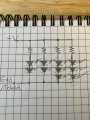
Trying to create a 3-channel ''movie theatre'' marquee chaser

Thread Starter

SpielbergRules247365

Joined Aug 9, 2022
47
We'd draw out the whole schematic in most cases too, but for the purposes of us understanding how you have the LEDs wired, the output for one count is sufficient for us to see what you're doing.
Oh, I see. Thanks for the clarification. :)

Yeah, not sure how I made that dumb mistake with everything in parallel. All the LEDs are in 2x2 and 2x3 sets on the prototype...
 

Audioguru again

Joined Oct 21, 2019
6,826
Coin cells will not power all those LEDs. You are lucky that their current is too low to burn out the LEDs that have no resistors.
Even a larger 9V "smoke detector" battery does not have enough current.
 

djsfantasi

Joined Apr 11, 2010
9,237
I’ll draw a schematic for you, as an electronics hobbyist would, using a series/ parallel circuit (properly), BUT…

I need the correct information! Back many posts ago, a couple of us asked for information on the LEDs. In order to make this work correctly, we need the Vf specification of the LEDs. Someone suggested a Vf of 2V but this was never confirmed. I went back to page 2 and didn’t find your answer. Otherwise, we’re only guessing. Vf is the forward voltage that the LED drops when operating.

If you don’t know Vf of your LEDs, here’s a couple of ways to measure it. Lab A might be the easiest way to measure it.

You’ve asked or mentioned a couple of times, “But it works?” In electronics, things aren’t always black and white. Something with the wrong resistor value might work but not well and not without problems. It might work for a while without burning up - but it eventually will. Things might work for a while but will rapidly stop working as a battery ages. And so on. A properly designed circuit won’t have these issues.
 

djsfantasi

Joined Apr 11, 2010
9,237
Coin cells will not power all those LEDs. You are lucky that their current is too low to burn out the LEDs that have no resistors.
Even a larger 9V "smoke detector" battery does not have enough current.
You have LEDs with no resistors, BECAUSE YOUR LEDS ARE ALL IN PARALLEL. You never wired them properly in a series/parallel circuit, as we’ve been trying to get you to do.

Here’s a schematic WITHOUT values of one string of ten LEDs.

FBE7A95E-E14A-42AD-8465-838ABBCE34C2.jpeg
 

dl324

Joined Mar 30, 2015
18,326
All the LEDs are in 2x2 and 2x3 sets on the prototype...
  1. How many of the CR2032 are you putting in series? As I recall, the schematics have always shown 3, but I think I recall you talking about adding a 4th.
  2. Are all of the LEDs the same color?
  3. What is the range of forward voltages for the LEDs?
  4. Have you measured battery voltage when you noticed that some LEDs were dimmer than others?
 

djsfantasi

Joined Apr 11, 2010
9,237
  1. How many of the CR2032 are you putting in series? As I recall, the schematics have always shown 3, but I think I recall you talking about adding a 4th [He has 3 in series. He mentioned 4 in series to get more current until someone said that won’t work. His measurements are for 3 batteries.]
  2. Are all of the LEDs the same color? [Good question, but he won’t answer that AND doesn’t know the Vf of the ones he has. It appears that they are all the same color.]
  3. What is the range of forward voltages for the LEDs? [Been asked several times. Has never been answered. I suspect a) he does know the Vf and b) he doesn’t know what Vf even is. I explained how to measure it.]
  4. Have you measured battery voltage when you noticed that some LEDs were dimmer than others? [No, but he’s measured the battery voltage after running for a while.]
If you’ve read his posts, this is what he said.
 

Thread Starter

SpielbergRules247365

Joined Aug 9, 2022
47
I’ll draw a schematic for you, as an electronics hobbyist would, using a series/ parallel circuit (properly), BUT…

I need the correct information! Back many posts ago, a couple of us asked for information on the LEDs. In order to make this work correctly, we need the Vf specification of the LEDs. Someone suggested a Vf of 2V but this was never confirmed. I went back to page 2 and didn’t find your answer. Otherwise, we’re only guessing. Vf is the forward voltage that the LED drops when operating.

If you don’t know Vf of your LEDs, here’s a couple of ways to measure it. Lab A might be the easiest way to measure it.

You’ve asked or mentioned a couple of times, “But it works?” In electronics, things aren’t always black and white. Something with the wrong resistor value might work but not well and not without problems. It might work for a while without burning up - but it eventually will. Things might work for a while but will rapidly stop working as a battery ages. And so on. A properly designed circuit won’t have these issues.
Thanks for that info. I could have sworn I answered the LED spec question(s).

I think I answered it with a link to the Amazon website I bought them from. Basically., it's 2-2.2V and 20mA.

I did a lot of Googling to try and find out more information about them. Doesn't seem to be a "standard" type of LED, AFAIK.

I did reply too the schematic thread (and thank you for that and the tips on measuring the Vf.)

Mike
 

djsfantasi

Joined Apr 11, 2010
9,237
I think I answered it with a link to the Amazon website I bought them from. Basically., it's 2-2.2V and 20mA.
First, I suspect that 20mA is the MAXIMUM current allowed through the LED. Often, they are bright enough at 10mA and possibly 5mA. The lower current is good for your battery powered circuit as the batteries will last longer.

At 20mA, your circuit is drawing 240 mA for the LEDs. 80mA for the series/parallel string (vs 200mA for all the LEDs in parallel) times 3 strings.

But if 5mA is bright enough, they’re only drawing 60mA TOTAL.

Secondly, when calculating the resistance, you can’t use the unloaded battery. The voltage will be lower than 9V. You provided a measurement of 8.2V in one post.

For example, using a supply of 8.2V, Vf of 2.2V and a current of 5mA, here’s how to calculate the resistance for two LEDs in series.

R=(8.2-2*2.3)/0.005
= (8.2-4.4):0.005
=3.8/0.005
=760Ω

820Ω is the closest standard value. Calculating the resistor for three LEDs is left as an exercise.
 

Audioguru again

Joined Oct 21, 2019
6,826
I think weak and tiny CR2032 coin cell batteries are used.
The datasheet from Duracell battery company says,
"Standard continuous discharge current= 0.3mA."
"Maximum continuous discharge current= 3mA."
 

Attachments

Thread Starter

SpielbergRules247365

Joined Aug 9, 2022
47
I think weak and tiny CR2032 coin cell batteries are used.
The datasheet from Duracell battery company says,
"Standard continuous discharge current= 0.3mA."
"Maximum continuous discharge current= 3mA."
Thanks for that info. I had mentioned before that before the addition of the transistors, the board ran for literally almost 3 days (with about 1-3/4 days of "satisfactory brightness.")
 

Thread Starter

SpielbergRules247365

Joined Aug 9, 2022
47
First, I suspect that 20mA is the MAXIMUM current allowed through the LED. Often, they are bright enough at 10mA and possibly 5mA. The lower current is good for your battery powered circuit as the batteries will last longer.

At 20mA, your circuit is drawing 240 mA for the LEDs. 80mA for the series/parallel string (vs 200mA for all the LEDs in parallel) times 3 strings.

But if 5mA is bright enough, they’re only drawing 60mA TOTAL.

Secondly, when calculating the resistance, you can’t use the unloaded battery. The voltage will be lower than 9V. You provided a measurement of 8.2V in one post.

For example, using a supply of 8.2V, Vf of 2.2V and a current of 5mA, here’s how to calculate the resistance for two LEDs in series.

R=(8.2-2*2.3)/0.005
= (8.2-4.4):0.005
=3.8/0.005
=760Ω

820Ω is the closest standard value. Calculating the resistor for three LEDs is left as an exercise.
Thanks for those updated calculations. I did provide the 8.2V in a previous post.

I will try the 820 and recalculate for the 3 LED's

Thanks!
 

Thread Starter

SpielbergRules247365

Joined Aug 9, 2022
47
If you did 3-3-3-1 instead of 3-3-2-2, you could eliminate one resistor.

Have you tried operating at a current of 5mA before? Try 270 ohms for the 3 series LEDs.
Great idea on the 3-3-3-1! Will do that

I did not meter for the current, but I will take your advice and use the 270Ω


Can you confirm something for me? Should the resistors go on the cathode or anode side. I can't remember for the life of me.

but doesn't all the current go from positive to ground? Man I can't remember things...

Thanks!
 

dl324

Joined Mar 30, 2015
18,326
I did not meter for the current, but I will take your advice and use the 270Ω
A word of caution. Current meters aren't ideal and inserting one in a circuit to measure current could perturb the circuit enough that you aren't actually measuring what you think you are. It's far better to measure the voltage drop across a resistor and calculate the current.

Assuming 2.3V for the LED forward voltage and 8.2V for the battery voltage:
\( \large R=\frac{V}{I}=\frac{V_{BAT}-V_{LED}}{I_{LED}}=\frac{8.2V-3*2.3V}{5mA}=260\Omega\)

I said to use 270 ohms because the difference between 260 and 270 is within the tolerance of a 5% resistor and you wouldn't be able to tell the difference in brightness from a 5% change in current.
Can you confirm something for me? Should the resistors go on the cathode or anode side. I can't remember for the life of me.
It doesn't matter.
 
Last edited:

Thread Starter

SpielbergRules247365

Joined Aug 9, 2022
47
A word of caution. Current meters aren't ideal and inserting one in a circuit to measure current could perturb the circuit enough that you aren't actually measuring what you think you are. It's far better to measure the voltage drop across a resistor and calculate the current.

Assuming 2.3V for the LED forward voltage and 8.2V for the battery voltage:
\( \large R=\frac{V}{I}=\frac{V_{BAT}-V_{LED}}{I_{LED}}=\frac{8.2V-3*2.3V}{5mA}=260\Omega\)

I said to use 270 ohms because the difference between 260 and 270 is within the tolerance of a 5% resistor and you wouldn't be able to tell the difference in brightness from a 5% change in current.
It doesn't matter.
Thank you for both of those. I am embarrassed I have forgotten so much
 

dl324

Joined Mar 30, 2015
18,326
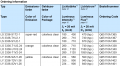
Unless you're buying LEDs that have been binned (sorted) for matching forward voltage, you're probably going to get ones that have been binned for brightness.

This is from an OSRAM datasheet for ultra-brights:
1661981217068.png
1661981061993.png
1661981084268.png
1661981129860.png

1661981277785.png
 

bassbindevil

Joined Jan 23, 2014
922
The best thing is to experiment and see what current gives adequate brightness. You may find that a fraction of a mA is ample. Then you can measure the forward voltage at that current and use that in your calculations.
 

Audioguru again

Joined Oct 21, 2019
6,826
I agree that a current meter "uses up" some of the voltage in a circuit making its measurement WRONG if the supply voltage is low like in this circuit. A current meter is fine in an old vacuum toob circuit that has a supply that is hundreds of volts.
It is simple and very accurate to measure the voltage across a resistor that provided current to an LED then calculate the current.

Exactly the same amount of current flows at the anode and cathode of an LED.
 
Top