True RMS meters?

OBW0549

Joined Mar 2, 2015
3,566
Thanks for clarifying. So the most viable way to measure RMS is through accurate temperature measurement then?
Under the right circumstances, it would be; as noted in the app note, his circuit is only good for 300 mVrms to 10 Vrms. Not a very big range.

What about extremely low power waveforms?
I've used the AD536 chip you mentioned earlier, with pretty good results; that would probably be my first choice for general-purpose RMS measurements.

What other methods are there, other than ADC and then integration?
I've used this method, too, and it worked well for me in one application where I needed a 10Hz-3KHz frequency response; but the higher you need to go in frequency, the higher the sample rate you need to use along with a DSP with greater and greater horsepower.
 
My $0.02 FWIW...

So the most viable way to measure RMS is through accurate temperature measurement then?
For high (power) level signals (e.g. AF Power, RF power and 'mains frequency' applications) absolutely...

What about extremely low power waveforms?
Aye! There's the rub! The requisite amplification, as a practical matter, cannot be 'all things to all signals' -- Hence the presentation of limitations similar (but of disparate nature) to those of SLTF/ETF techniques.
Moreover, inasmuch as thermal absorption/dissipation is, in essence, a macroscopic phenomenon, unacceptably protracted response/'settling' time may be an issue...

Best regards
HP
 
Last edited:

WBahn

Joined Mar 31, 2012
32,877
most of the dvm's on the market read "true rms" if they didnt what would the meaning be of an ac reading on the 120 volt ac (rmss) line? and all "true rms" meters will read true rms on sine waves. square waves or waves with severe distortion will read wrong, theres no way to predict what without knowing how distorted they are.
I think you are confusing "true RMS" with "RMS reading".

A common way for a meter to measure an AC waveform is to rectify it (often just half wave) and low-pass filter it (a physical meter movement can perform this function on an analog meter) and then just calibrate the readout so that the RMS value is displayed based on the assumption that the input signal is sinusoidal. These are NOT true-RMS meters, they are average responding meters that respond to the average value of a rectified waveform and then rely on an assumption of that waveform's shape to convert that average to an RMS reading.

A true RMS meter is just that -- it doesn't matter what the waveform shape looks like (within reason based on the sampling rate or the bandwidth of the meter), it will give the actual RMS voltage for that waveform. In the old days this was often done thermometrically where the input signal was applied to a resistor and the temperature rise of the resistor was measured, which is directly proportional to the power dumped into the resistor, which is directly proportional to the square of the RMS value of the signal. In a digital meter it is usually done by sampling the signal and calculating a running average of the RMS value of the waveform over the last N samples.
 

cmartinez

Joined Jan 17, 2007
8,768
I think you are confusing "true RMS" with "RMS reading".

A common way for a meter to measure an AC waveform is to rectify it (often just half wave) and low-pass filter it (a physical meter movement can perform this function on an analog meter) and then just calibrate the readout so that the RMS value is displayed based on the assumption that the input signal is sinusoidal. These are NOT true-RMS meters, they are average responding meters that respond to the average value of a rectified waveform and then rely on an assumption of that waveform's shape to convert that average to an RMS reading.

A true RMS meter is just that -- it doesn't matter what the waveform shape looks like (within reason based on the sampling rate or the bandwidth of the meter), it will give the actual RMS voltage for that waveform. In the old days this was often done thermometrically where the input signal was applied to a resistor and the temperature rise of the resistor was measured, which is directly proportional to the power dumped into the resistor, which is directly proportional to the square of the RMS value of the signal. In a digital meter it is usually done by sampling the signal and calculating a running average of the RMS value of the waveform over the last N samples.
What I'm understanding is this:
There was a time in which people used a technique to measure the average value of a waveform and mistakenly called it RMS measurement.
Since the word RMS (like many, many other words) was corrupted due to its frequently invalid use by commerce, the term "True RMS" was born.... so now we have cheap-o brand simple RMS, and "True RMS" to distinguish the two...
There was a time in which diamonds were synonyms of brilliants, and then zircon came along, and for a time people said "brilliant-brilliant" to mean diamond, or "jewelry-jewelry" to mean the real thing...
 

Reloadron

Joined Jan 15, 2015
7,891
Back to the subject of reading the output of a MSW Inverter using a DMM.

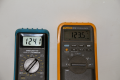
Pictures below are two DMMs, a Cheap DMM and a Not Cheap DMM, they are both measuring the same RMS sine wave:
RMS Sine.png

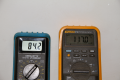
The same two meters measuring the same MSW Inverter output:
RMS MSW.png

For the curious at heart this link is a pretty good read on the subject. Reading in part:

When taking readings with a non True RMS reading meter, a 120 Volt RMS
sinewave will still measure about 120 volts RMS. This is because the meter
uses the mathematical relationships shown below to give a proper RMS
reading for a sinewave. However if used with a modified sinewave or square
wave these meters will only read about 90-105 volts. Don't be misled, there
is nothing wrong with the inverter or the meter, and to prove this try the
following test. plug in a normal light bulb and check its brightness. If there is
only 90-105 volts RMS available it will look orange as it would during a brown
out. If it appears to have normal brightness the voltage is approximately
120VAC RMS.
So looking at my numbers on the cheap verse quality DMM I can certainly understand what the original poster is seeing.

As to getting into True RMS voltmeters my earliest experiences run back to the old HP 400H VTVM which was actually an Average Responding RMS Indicating meter. True RMS went to the old HP 411A and 411B which I worked with during the early 70s and were 60s vintage. Also memories of the Boonton 92BD. Here nor there as has nothing to do with the original posters question.

Ron
 

Reloadron

Joined Jan 15, 2015
7,891
What I'm understanding is this:
There was a time in which people used a technique to measure the average value of a waveform and mistakenly called it RMS measurement.
Since the word RMS (like many, many other words) was corrupted due to its frequently invalid use by commerce, the term "True RMS" was born.... so now we have cheap-o brand simple RMS, and "True RMS" to distinguish the two...
There was a time in which diamonds were synonyms of brilliants, and then zircon came along, and for a time people said "brilliant-brilliant" to mean diamond, or "jewelry-jewelry" to mean the real thing...
Not exactly, the popular term was Average Responding / RMS Indicating and manufacturers like HP made it very clear the instrument responded to the average value of a sine wave and the scale was calibrated to indicate the RMS value. Sine wave was also specified. This is true for example of the HP 400H I made reference to in my last post. For those wanting True RMS values there were other meters designed to provide RMS Responding / RMS Indicating meters. Make sense?

Ron
 

cmartinez

Joined Jan 17, 2007
8,768
Not exactly, the popular term was Average Responding / RMS Indicating and manufacturers like HP made it very clear the instrument responded to the average value of a sine wave and the scale was calibrated to indicate the RMS value. Sine wave was also specified. This is true for example of the HP 400H I made reference to in my last post. For those wanting True RMS values there were other meters designed to provide RMS Responding / RMS Indicating meters. Make sense?

Ron
Yes, it makes sense. But still... why use the term "true" rms in the first place? Does it mean that people were reading "fake" rms before "true" rms came along?
 

Reloadron

Joined Jan 15, 2015
7,891
Yes, it makes sense. But still... why use the term "true" rms in the first place? Does it mean that people were reading "fake" rms before "true" rms came along?
That's a good question that I never really gave much thought to. The blue meter in my post is a false RMS meter and the yellow meter is a true RMS meter. :)

The way I always looked at this is how the meter responds to an incoming waveform. For example the terms I used earlier, Average Responding / RMS Indicating or RMS Responding / RMS Indicating. I am not sure when the term True was coined into things. There are countless application notes and white papers out there on the subject but you got me on the true and false thing. Many of the old documentation and manuals does make reference to "the true RMS value"
A new voltmeter has now been developed that
both responds to the rms value of the ac waveform
and has a high crest factor rating. This rating is
the measure of the voltmeter's ability to read the
rms value of waveforms that have a high peakto-
rms ratio such as low-duty-cycle pulse trains.
That "new" voltmeter was the HP 3100 circa early 60s. :)

Anyway, you got me with the true / false thing.

Ron
 

cmartinez

Joined Jan 17, 2007
8,768
That's a good question that I never really gave much thought to. The blue meter in my post is a false RMS meter and the yellow meter is a true RMS meter. :)

The way I always looked at this is how the meter responds to an incoming waveform. For example the terms I used earlier, Average Responding / RMS Indicating or RMS Responding / RMS Indicating. I am not sure when the term True was coined into things. There are countless application notes and white papers out there on the subject but you got me on the true and false thing. Many of the old documentation and manuals does make reference to "the true RMS value"

That "new" voltmeter was the HP 3100 circa early 60s. :)

Anyway, you got me with the true / false thing.

Ron
That's it?? Wadaya mean "you got me"?? You owe me a beer man! Ha ha ha... this is a good thread, I learned a lot, thanks.
Cheers!
 

crutschow

Joined Mar 14, 2008
38,526
I think "true" came into use because most cheap multimeters stated they displayed RMS, without the caveat that it was Average Responding/RMS Indicating and thus the readings were accurate only for a sinewave.
So instead of using the more accurate, but long designation, of RMS responding/RMS indicating, they started using True RMS for meters with that function to indicate the reading was accurate (true, not false) for any waveform, not just a sinewave.
 
Yes, it makes sense. But still... why use the term "true" rms in the first place? Does it mean that people were reading "fake" rms before "true" rms came along?
IMESHO:

'Tis 'True RMS' because the instrument is actually measuring the RMS value --- as opposed to displaying an assumption-weighted (arithmetic) mean...

Hence the indication is a true RMS reading vs. a conditionally-true RMS reading --- (à la 'true believer',' true love', etc...) :)

Best regards
HP
 
Last edited:

cmartinez

Joined Jan 17, 2007
8,768
I think "true" came into use because most cheap multimeters stated they displayed RMS, without the caveat that it was Average Responding/RMS Indicating and thus the readings were accurate only for a sinewave.
So instead of using the more accurate, but long designation, of RMS responding/RMS indicating, they started using True RMS for meters with that function to indicate the reading was accurate (true, not false) for any waveform, not just a sinewave.
That was my point exactly. Salespeople LIE and make false claims to sell their product. I remember the most modern late '80s software claimed to be "artificial intelligence" .. I mean truly??? For real????
 

cmartinez

Joined Jan 17, 2007
8,768
IMESHO:

'Tis 'True RMS' because the instrument is actually measuring the RMS value --- as opposed to displaying an assumption-weighted (arithmetic) mean...

Hence the indication is a true RMS reading vs. a conditionally-true RMS reading --- (à la 'true believer',' true love', etc...) :)

Best regards
HP
For the record... I don't remember an intrument being sold claiming that it measured "assumed" rms....
 

WBahn

Joined Mar 31, 2012
32,877
That was my point exactly. Salespeople LIE and make false claims to sell their product. I remember the most modern late '80s software claimed to be "artificial intelligence" .. I mean truly??? For real????
I don't think that there was any evil intention to deceive. Analog VOMs, particularly the ones that had broad usage in shops, garages, and homes, had been overwhelmingly average-responding, RMS-reading for decades. There was not need to mark them specifically since that's what almost all of them were. Not surprisingly, the first DVMs were the same way. When RMS-responding meters started becoming available, especially to that market, it was at a significant price premium and, not surprisingly and not unreasonably, manufacturers wanted to emphasize which meters were which for a number of reasons -- to justify the price premium, yes, but also from a technical need. If someone spent the money to get an RMS-responding meter, it was possibly because they needed an RMS-responding meter. Since the meter looks, in every other respect, just like an average-responding meter sitting in the drawer next to it, it had technical merit to label the meter to indicated that it was RMS-responding. The term True RMS is just as reasonable as any other term and is far easier for someone that doesn't understand how meters work and what would be meant by "RMS-responding".
 

WBahn

Joined Mar 31, 2012
32,877
For the record... I don't remember an intrument being sold claiming that it measured "assumed" rms....
Read the owner's manual of almost any average-responding meter and it will indicate that it is average responding and that it is calibrated in RMS for a sinusoidal waveform. If that doesn't qualify as claiming that it measures an assumed RMS value, what would?
 

cmartinez

Joined Jan 17, 2007
8,768
Read the owner's manual of almost any average-responding meter and it will indicate that it is average responding and that it is calibrated in RMS for a sinusoidal waveform. If that doesn't qualify as claiming that it measures an assumed RMS value, what would?
You're right... it's probably always been in the small print...
I don't mean to be annoying or obnoxious here... I'm just trying to get my point across... maybe tomorrow, when I'm well and rested, I'll sound more centered and reasonable.
In the meantime, thank you all for a very constructive chat... and good night.
 
Top