True RMS meters?

studiot

Joined Nov 9, 2007
4,998
Memory fails again.

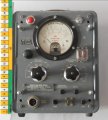
It was a Cossor, not Marconi, but there were often more than one manufacturer for Nato spec equipment.

The discussion about signal level is interesting because this meter has an old style switched input attenuator from 30 mV to 300 Volts FSd.

This brings up the interesting point because the attenuator (although compensated) will be affected by signal frequency, so no matter how perfect the RMS measurement system is, if the input chain changes it there will be an effect in the reading. That is the measurement is only the RMS of the signal presented to the sensing circuit, which is not necessarily the same as the input.

Secondly note that RMS does not necessarily mean linear scaled.


Finally note good old fashioned practice of stating things like mod history and equipemnt weight on the front.
CT454Voltmeter.jpg
 

OBW0549

Joined Mar 2, 2015
3,566
That was my point exactly. Salespeople LIE and make false claims to sell their product. I remember the most modern late '80s software claimed to be "artificial intelligence" .. I mean truly??? For real????
It's unfair, as well as inaccurate, to attribute this "average responding/RMS responding" confusion to people making "false claims" or being "cheap" or being "mistaken."

Back in the days of analog voltmeters, which is when this all started, it simply was not practical to build an AC voltmeter that responded to the actual RMS value of an arbitrary waveform, at least not at a price affordable by ordinary mortals. Nearly all voltmeters, except for the most expensive scientific instruments, measured AC by first scaling the input (by attenuation or by amplification, as needed for the desired range), then rectifying the result (usually just half-wave rectification), then lowpass filtering the rectified signal (usually done simply by the inertial mass of the electromechanical meter movement). Volts RMS was simply the preferred display units, even though what the voltmeters actually responded to was the averaged absolute value of the measured signal, not its true RMS value.

And I guarantee you, EVERYONE smart enough to use a voltmeter back then knew exactly how they worked, and was fully aware that the "RMS" readings they showed were accurate only for pure sine waves and that for any other waveform, you had to apply a waveform-dependent "fudge factor" that in any case would yield only approximate results. We all knew that. There was no deception involved, whatsoever.

And it wasn't a matter of being "cheap", either: the above was true even for high-end analog VOMs like the Simpson Model 260, which back in the 1960s was priced way, WAY out of my affordable range.
 

studiot

Joined Nov 9, 2007
4,998
And I guarantee you, EVERYONE smart enough to use a voltmeter back then knew exactly how they worked, and was fully aware that the "RMS" readings they showed were accurate only for pure sine waves and that for any other waveform, you had to apply a waveform-dependent "fudge factor" that in any case would yield only approximate results. We all knew that. There was no deception involved, whatsoever.
It's also true that service manuals and sheets (do they still make these?) used to quote voltages measured with a particular voltmeter (AVO in the UK case) and waveshapes would also be shown.
It didn't then matter if you meter wasn't reading true RMS or otherwise, so long as you supplied the required input and measured with the required type of meter, since you were only getting a relative reading anyway.

Nato inspectors used to police the production line and not only did you have to use the correct type (model) of meter, but also the specified serial number (note this showing on my pic).
 
Last edited:

cmartinez

Joined Jan 17, 2007
8,768
It's unfair, as well as inaccurate, to attribute this "average responding/RMS responding" confusion to people making "false claims" or being "cheap" or being "mistaken."

Back in the days of analog voltmeters, which is when this all started, it simply was not practical to build an AC voltmeter that responded to the actual RMS value of an arbitrary waveform, at least not at a price affordable by ordinary mortals. Nearly all voltmeters, except for the most expensive scientific instruments, measured AC by first scaling the input (by attenuation or by amplification, as needed for the desired range), then rectifying the result (usually just half-wave rectification), then lowpass filtering the rectified signal (usually done simply by the inertial mass of the electromechanical meter movement). Volts RMS was simply the preferred display units, even though what the voltmeters actually responded to was the averaged absolute value of the measured signal, not its true RMS value.

And I guarantee you, EVERYONE smart enough to use a voltmeter back then knew exactly how they worked, and was fully aware that the "RMS" readings they showed were accurate only for pure sine waves and that for any other waveform, you had to apply a waveform-dependent "fudge factor" that in any case would yield only approximate results. We all knew that. There was no deception involved, whatsoever.

And it wasn't a matter of being "cheap", either: the above was true even for high-end analog VOMs like the Simpson Model 260, which back in the 1960s was priced way, WAY out of my affordable range.
I'm back.... more rested, and in a more reasonable disposition.

My father was a doctor (a pediatrician) and I'm the third of 6 siblings. I have at least 50 cousins and , wouldn't you believe it, I'm the only engineer in the entire family. I grew up extremely interested in all things technical and scientific, but with very little resources to experience the actual thing. But I didn't let that frustrate me. So mostly I devoured magazines like Scientific American, Popular Electronics and anything I could lay my hands on. I also enjoyed reading encyclopedias and whatever book I found laying around that treated technological and science subjects. I did try to build some of the circuits shown in those publications. One of the first was a very primitive metal detector that worked through AM radio interference. I remember riding the bus when I was 12 all the way downtown to find and buy the components involved... for days and days I tried and tried to make the stupid thing work, but I failed miserably. Many years later I found the failed circuit again and learned that I had actually burned the components because I did not know how to solder them properly, and I had also made basic mistakes like wrong polarity and misconnected nodes.
Anyway, it wasn't until my very late teens that I actually had the opportunity (and the means) to lay my hands on a voltmeter. By then (it was the early '80s) those instruments were already being sold with the label "True RMS" in the box. But I did not know what that meant. I was still in highschool and didn't have any formal training on how to use those things.
But here is what I do remember from those days: at the same time that those True RMS were being sold, some places were selling old surplus equipment at a discount. And some of those old voltmeters that only measured assumed RMS, included a document with tables that had in them "correction factors" to be applied to the reading in order to calculate the True RMS if the waveform of the signal being measured was not a sinusoid. A factor for a triangular waveform, and another one for a square one, etc... and that factor also changed depending on the frequency of the waveform being measured....

I had completely forgotten about that document until I read your post this morning. So thanks for your eye-opening explanation.

So this is what I now understand:
  • There was a time in which multimeters showed the average of a signal being measured, and also the RMS of that signal, IF the signal involved was of the sinusoid type.
  • When that signal was not a sinusoid, then a correction factor needed to be applied to the reading, depending on the geometry of that signal.
  • The geometry of that signal was known only if one was either familiar with the circuit, or one had the extremely good luck of owning an oscilloscope, and also had the generous gift of the intelligence (and training) needed to know how operate it.
  • In time, more advanced instruments reached the market that had specialized circuitry in them that internally compensated their measurements to display the True RMS of any waveform, within the instrument's limits, of course.
  • Eventually the old instruments that needed the extra documentation to be used properly, disappeared from the market and were completely replaced by the new ones.
  • The next generation of technicians (like me) eventually forgot about this difference between older and newer equipment, and had heated arguments in internet forums with their older peers that caused chaos and violent riots...
Seriously now, thanks again for your explanation, it definitely cleared all of my objections.
 

cmartinez

Joined Jan 17, 2007
8,768
BTW... I love reading about the history of science. But the history of instrumentation is a sub-subject that also strongly draws my attention.
For those of you sharing this same interest, I recommend reading Longitude, by Dava Sobel.
 

OBW0549

Joined Mar 2, 2015
3,566
  • The geometry of that signal was known only if one was either familiar with the circuit, or one had the extremely good luck of owning an oscilloscope, and also had the generous gift of the intelligence (and training) needed to know how operate it.
I got an oscilloscope when I was 11 years old. It was an old Eico kit scope; my father bought it off an EE co-worker for $25 (which actually was a fair amount of money back in 1960), and it had seen better days. Even in mint condition, it would have been a piece of crap by today's standards: frequency response was 50 Hz - 25 KHz; sweep was "synchronized", not triggered, and only went from 30 Hz to about 3 KHz; and both the vertical and horizontal deflection systems were (I'm trying to be very kind, here) highly non-linear. The sweep also ran from right to left, not left to right, which made waveform interpretation a bit... dodgy.

Nevertheless, despite its shortcomings that thing was my pride and joy, and I learned a lot from it.
 
Top