Facebook
 Google
 GitHub
 Linkedin
Hello everyone. A while a go, I got an old Allen Bradley PLC from an acquaintance. I played around with it a bit until it's PSU failed. There was no output from it whatsoever. I decided to repair it, as I can still use this PLC for some home project. At first, I just quickly analysed it and found out that electrolytic cap (C11) failed and PWM IC couldn't start (it was also making squeeking noises). I replaced it and found out that IC itself is also shorted. In the process of making measurements, I also made a short with probe and burned power switching mosfet. I replaced both of them and it started working - well...somewhat. This is a dual output power supply (5V and 24V) and I'm measuring around 35-40V and 4.1V respectively. So, obviously something is not functioning ok. So, I decided to analyze it more deeply and I reverse engineered it. I took quality high res photos of pcb and I drew PCB from which I could generate schematic - really fun process and now I want to do more of this .
.
However, I've come up with following schematics. On the first image you can see transformer and optocoupler, connecting output section with control section (switching). Then we have input section, which is fine, control section (switching), which is also fine I suspect and lastly output section, which is the most interesting part of this design. Based on transformer and connections in input and control section, I think this is a forward converter type of SMPS - please correct me if I'm wrong. Secondary winding, that's used for +5V is also used for feedback, although I don't fully understand how the part which goes into U4 reference pin works.
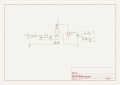
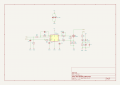
The other part of this section is really interesting to me. There are 3 transistors. Q2 and Q4 are some kind of emmiter followers. Q2 is driven by U5 voltage reference, then Q4 is driven by Q2. And lastly, Q5 is driven by Q4. Q5 controls voltage reference U5 and serves as some kind of feedback. I don't know if pin 6 of J2 is input from PLC circuit or is actually output. The section that I tried to explain is switching control for Q3 which is used as buck or boost converter? How?
I'm having some hard time to fully understand this design so I'm looking for some advice/tips/explanations to help me better understand it and possibly fix the problem. Please correct me if I misunderstood something.
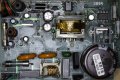
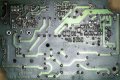
I'm also attaching image of the PCB if by any chance someone recognizes it or if it helps in some other way.
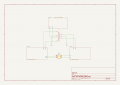
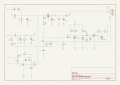
.However, I've come up with following schematics. On the first image you can see transformer and optocoupler, connecting output section with control section (switching). Then we have input section, which is fine, control section (switching), which is also fine I suspect and lastly output section, which is the most interesting part of this design. Based on transformer and connections in input and control section, I think this is a forward converter type of SMPS - please correct me if I'm wrong. Secondary winding, that's used for +5V is also used for feedback, although I don't fully understand how the part which goes into U4 reference pin works.
The other part of this section is really interesting to me. There are 3 transistors. Q2 and Q4 are some kind of emmiter followers. Q2 is driven by U5 voltage reference, then Q4 is driven by Q2. And lastly, Q5 is driven by Q4. Q5 controls voltage reference U5 and serves as some kind of feedback. I don't know if pin 6 of J2 is input from PLC circuit or is actually output. The section that I tried to explain is switching control for Q3 which is used as buck or boost converter? How?
I'm having some hard time to fully understand this design so I'm looking for some advice/tips/explanations to help me better understand it and possibly fix the problem. Please correct me if I misunderstood something.
I'm also attaching image of the PCB if by any chance someone recognizes it or if it helps in some other way.