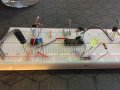
Troubleshooting on my first "real" circuit

Thread Starter

christiannielsen

Joined Jun 30, 2019
389
At 5V, the outputs of the 4017 can probably source about a mA. So the smallest value would be around 5k. You could go lower since you don't need the outputs to maintain a valid logic level.
I missed that you have the second timer wired as an astable. A one shot made more sense, so that's how I read it. What is your intent for the second timer.
You showed it as being connected between pins 5 and 6.
IC2 is suppose to make a PWM signal to the servo.
 

Thread Starter

christiannielsen

Joined Jun 30, 2019
389
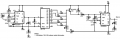
Here's an updates schematic:
View attachment 191933
With VCC=5V, that would be 1.67V.

What does the servo you're driving do? Does it simply drive the motor whenever the timer output is HIGH?
What are you trying to measure?
Thank you for updating the schematic. It makes more sense than mine.

A servo operates with a PWM signal of 0.5 to 2.45 ms to position the servo. It should be 1.0 ms for 0 degrees and 2.0 for 180 degrees. (according to this video:
)

And that is the two positions the servo in the end should toggle between every 1.5 seconds.
 

Thread Starter

christiannielsen

Joined Jun 30, 2019
389
An RC servo motor is moved by placing a signal on the signal lead of the servo, with a period of 20ms (or 50Hz) whose pulse width varies from 1ms to 2ms. A pulse whose width is 1.5ms is considered center.
yes and that is what IC2 aka the last timer should provide ;-)
What I meant was: How did I even make the servo run considering all the errors I've made :)
 

djsfantasi

Joined Apr 11, 2010
9,237
I put the limiting resistor between cathode and ground.

I am unfortunately not strong in practicing VCC/3 and what components it takes to do that. I was aiming for a frequency (I just copied the values of the components from a YT video) to positioning the servo motor at 0 degrees and 180 degrees. I must say though: my multimeter doesn't actually measure what it is suppose to measure :) I dont understand what makes the servo move...
...When LED3 is removed, the servo moves and you don’t know why? Without a resistor on the LED, the signal from the 555 is practically a short. As such, there is no output from the 555 and why would the servo move?
 

Thread Starter

christiannielsen

Joined Jun 30, 2019
389
I did put in a limiting resistor but it didn't make any difference. The servo only run when I pull up LED2.

Does anyone understand what the circuit is suppose to do? Did I explain it well enough?
 

BobaMosfet

Joined Jul 1, 2009
2,211
Okay so I have drawn a diagram the best I can. I had some trouble with it which I presume you can see but I dont know how to draw it correctly. I think I definitely might have an error around Timer 1.

View attachment 191919
You're doing GREAT. It isn't easy to put it all together off the bat. A schematic can be drawn by hand. The main thing that a schematic does is it shows:

how components are connected.
how components are oriented (if it matters)
how much voltage is involved
the name and/or value of each component

If you want to use a schematic and PCB product, I cannot recommend DIPTrace highly enough. It's free for learning, and it is fairly intuitive. It's a little awkward at first, but with youtube videos, and the fantastic support of the folks at DIPTrace, you could easily be using it and making a PCB in 5 days of casual interaction.
 

djsfantasi

Joined Apr 11, 2010
9,237
I did put in a limiting resistor but it didn't make any difference. The servo only run when I pull up LED2.

Does anyone understand what the circuit is suppose to do? Did I explain it well enough?
Where did you actually place the limiting resistor? I count four obvious places you could have placed it; two of which won’t work. So basically you had a 50/50 percent chance of it working.

Can you mark up the schematic, hand draw the connection or otherwise document clearly where the resistor was placed
 

Thread Starter

christiannielsen

Joined Jun 30, 2019
389
Thank you for hanging in here.

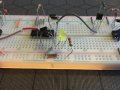
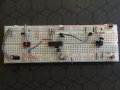
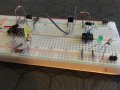
I have taken a picture of where I put in the resistor. I think it is according to the schematic so I guess it wont help me hand drawing it in.
Perhaps I misplaced other components on the breadboard?
Here is a couple of pictures.
IMG_1956.JPGIMG_1957.JPGIMG_1958.JPGIMG_1959.JPG
 

Chris65536

Joined Nov 11, 2019
270
Does it still require the yellow LED to be removed in order to work? Someone wrote that the 4017 can only source 1mA. The LED could easily use all of that, and reduce the voltage at the base of Q1 so it doesn't turn on. I think the use of an NPN for Q1 is odd, but I might be wrong.
 

djsfantasi

Joined Apr 11, 2010
9,237
Does it still require the yellow LED to be removed in order to work? Someone wrote that the 4017 can only source 1mA. The LED could easily use all of that, and reduce the voltage at the base of Q1 so it doesn't turn on. I think the use of an NPN for Q1 is odd, but I might be wrong.
Exactly where my thoughts were headed. A high level output of a 4017 can only source a few mA. With a 330Ω resistor in series with the LED, it will take up to 10mA if it’s available. But it appears not to be available. Plus, there is no base resistor on the BJT, so the circuit requires a bit more current than necessary. I started to calculate everything but never finished it.

What we are saying is with the LED, there is insufficient current to drive the transistor. If you do the calculations yourself, remember the output voltage is only 4.3V because you have to subtract 0.7V for your diode OR.
 

Thread Starter

christiannielsen

Joined Jun 30, 2019
389
Does it still require the yellow LED to be removed in order to work? Someone wrote that the 4017 can only source 1mA. The LED could easily use all of that, and reduce the voltage at the base of Q1 so it doesn't turn on. I think the use of an NPN for Q1 is odd, but I might be wrong.
Yes it does.
Doesnt a LED take about 20mA normally?

If I shouldn't use a NPN for Q1 then what should I use?

I actually didn't calculate anything before I started. I am just a beginner. Should I run it at 6 volt instead?
 

ElectricSpidey

Joined Dec 2, 2017
3,336
Q1 is in follower mode so it's emitter voltage is dependent on the divider created by the 4017 outputs and the yellow LED net.

If you want to leave the yellow LED where it is, I would try using a high brightness version with a 10k or higher resistor.
 

Thread Starter

christiannielsen

Joined Jun 30, 2019
389
I don't think that the output of a 555 can drive your servo. Try using a transistor as a driver (being driven by the 555).
It seems it can. Please watch the video.

Q1 is in follower mode so it's emitter voltage is dependent on the divider created by the 4017 outputs and the yellow LED net.

If you want to leave the yellow LED where it is, I would try using a high brightness version with a 10k or higher resistor.
The led's is actually just for me to observe what is happening.

Maybe something like this?
View attachment 192097
Thank you. I just havent found out why I just cant use the single one I have, instead of putting in another one? What is it with the one I have that won't work? what does it do bad?
 

Chris65536

Joined Nov 11, 2019
270
Thank you. I just havent found out why I just cant use the single one I have, instead of putting in another one? What is it with the one I have that won't work? what does it do bad?
Your Q1 will start to turn off as the trigger voltage approaches 2/3 V, but that is not a big deal. The main reason was to make it work with the yellow LED. Now that I think about it though, what is the point of the 4017? You could just double the size of C1 and feed the output of the first 555 to Q1.
 
Top