Yes it is measuring Error, because i was not able to measure all 8 pins at once, so it is same voltage but the time of the measurement is different(voltage changed a bit).
A CD4060 IC includes the inverters to use as a crystal oscillator, or as an RC oscillator. As another option, DigiKey, among other suppliers, sells a lot of crystal time base oscillator modules that are very stable. For a divider you can use either a CD4040 or the 4060, and have a very stable time base. BUT you will need to know the speed that you want in advance, then calculate the resulting pulse rate, and then go back up through powers of two to find an available input frequency. The math is tedious but not hard. And if it does not easily give a convenient number, you can add one or more CD4017 decade dividers, which allow division by 1 through 10 and put them in the string. And doing it that way requires no glue logic.
A CD4060 IC includes the inverters to use as a crystal oscillator, or as an RC oscillator. As another option, DigiKey, among other suppliers, sells a lot of crystal time base oscillator modules that are very stable. For a divider you can use either a CD4040 or the 4060, and have a very stable time base. BUT you will need to know the speed that you want in advance, then calculate the resulting pulse rate, and then go back up through powers of two to find an available input frequency. The math is tedious but not hard. And if it does not easily give a convenient number, you can add one or more CD4017 decade dividers, which allow division by 1 through 10 and put them in the string. And doing it that way requires no glue logic.
I will take a look into this option. But in meantime i want to get this circuit to work. Can someone test it on breadboard for me with same values etc.?
I spent whole day trying different things but no success so far... i don't want spend more time until someone else tries it and say it is working.
I will take a look into this option. But in meantime i want to get this circuit to work. Can someone test it on breadboard for me with same values etc.?
I spent whole day trying different things but no success so far... i don't want spend more time until someone else tries it and say it is working.
I had a problem today with a board I had made. There was about 400Ω leakage to ground. I inspected the track carefully and could see no problem. There was a capacitor to ground which I removed but the leakage remained. I gave the board a good scrub with IPA and the leakage disappeared and the board was working properly.
Leakage across the board may be causing the problem with your board so I suggest giving it a good clean.
Pot is set to 3.1 kOhm. 0.93ms is time high and 0.71ms is time low.
But frequency and time are not so important, it should be around 600hz and ton/tof time should not be less than 1us. I just need stable oscilation and it have to run for long period (at least few hours)
If finally "nothing" seems to work, just take ALL components out and start afresh. You could try soldering in the air, just the respective components to each other (no breadboard, no PCB, no veroboard). Solved many stupid problems with 3 terminal regulators this way.
If finally "nothing" seems to work, just take ALL components out and start afresh. You could try soldering in the air, just the respective components to each other (no breadboard, no PCB, no veroboard). Solved many stupid problems with 3 terminal regulators this way.
Breadboarded the circuit about half an hour ago; will post results tomorrow.
I didn't use a pot (already suggested that you replace yours with a fixed value resistor). I made slight variations in the component values so I could use parts I already had out.
Breadboarded the circuit about half an hour ago; will post results tomorrow.
I didn't use a pot (already suggested that you replace yours with a fixed value resistor). I made slight variations in the component values so I could use parts I already had out.
Running continuously for more than 14 hours. Time period is the same as when it started; 1.78ms misread, actually 1.55ms.
I used 3.2k (2.2k + 1k) instead of 3.1k. The timing cap was a 0.22uF film in parallel with a 0.1uF ceramic. Timer is TI NE555. I added two LEDs to the output so I could see if it was still running without having use a scope.
Something exceeding strange is going on. Based on reported voltages when the circuit has hung:
The discharge pin sits at 2.7 volts while the voltage on the timing cap is less than half a volt. 2.5 mA is going somewhere through R6 if R6 is truly 1k. About 750 µA of that is flowing through R5, so the balance must be going into the discharge pin. There is no reasonable mechanism by which that can be happening - it should be either very near ground or very near the supply voltage. The worst case bias current for trigger & threshold is less than 3 µA, so that leaves almost the entire 750 µA into the capacitor. That simply can't be happening unless something is defective.
Bipolar 555s have very large shoot-through current in the output, which places serious demands on the decoupling capacitor. 10 nF may be insufficient. I would increase it to no less than 100 nF and it MUST be on the shortest possible leads right at the 555. It cannot connect through long paths in a breadboard. I note that 1 µF was tried, with some apparent improvement, but the value becomes largely irrelevant if it is not connected correctly to do the required job.
Either the whole batch of 555s being used are bad or there is something wrong with the connections. Some photographs that show the actual circuit, including the connections to the power supply, would be helpful.
When the circuit hangs, the pins should be examined with the oscilloscope. The discharge pin should be also be measured right on the pin using the scope or high impedance meter, then measured again with the scope or meter shunted with about [EDIT] about ten times the nominal value of R6 (the intent being to confirm the current through R6 without actually measuring it directly).
Something exceeding strange is going on. Based on reported voltages when the circuit has hung:
The discharge pin sits at 2.7 volts while the voltage on the timing cap is less than half a volt. 2.5 mA is going somewhere through R6 if R6 is truly 1k. About 750 µA of that is flowing through R5, so the balance must be going into the discharge pin. There is no reasonable mechanism by which that can be happening - it should be either very near ground or very near the supply voltage. The worst case bias current for trigger & threshold is less than 3 µA, so that leaves almost the entire 750 µA into the capacitor. That simply can't be happening unless something is defective.
Bipolar 555s have very large shoot-through current in the output, which places serious demands on the decoupling capacitor. 10 nF may be insufficient. I would increase it to no less than 100 nF and it MUST be on the shortest possible leads right at the 555. It cannot connect through long paths in a breadboard. I note that 1 µF was tried, with some apparent improvement, but the value becomes largely irrelevant if it is not connected correctly to do the required job.
Either the whole batch of 555s being used are bad or there is something wrong with the connections. Some photographs that show the actual circuit, including the connections to the power supply, would be helpful.
When the circuit hangs, the pins should be examined with the oscilloscope. The discharge pin should be also be measured right on the pin using the scope or high impedance meter, then measured again with the scope or meter shunted with about [EDIT] about ten times the nominal value of R6 (the intent being to confirm the current through R6 without actually measuring it directly).
OK, i am posting again some more pictures in order to find mistake.
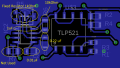
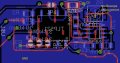
So first of all some more pictures of pcb layout
and both layers
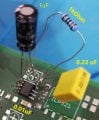
here is real PCB with suggested changes which i am running at the moment.
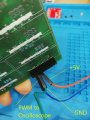
and here are power supply connections
i tried 2 different 555 chips so far

 Facebook
 Google
 GitHub
 Linkedin