Troubleshooting a transitor

Thread Starter

tuan.le007

Joined Nov 29, 2016
46
upload_2017-3-6_16-16-25.png

How Do I test if the transistor is working?
I used a DMM and measured between the Collector and Emitter and its shorted.
Does that enough to say that the transistor is bad and needs to be replaced?

Or do I need to unsolder the transistor itself and test between
C & E again to verify that it is shorted?

How do I go about testing this transistor?
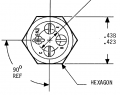
upload_2017-3-6_16-20-39.png
 

AlbertHall

Joined Jun 4, 2014
12,624
If there was no power and no input signal and the collector/emitter resistance reads less than 100Ω then most likely the transistor is short-circuit though the short could be external to the transistor: a stray blob of solder; stray strand of wire; etc. To confirm the transistor should be removed and if it still reads short between collector and emitter then the transistor is faulty. If the transistor is OK then check between the emitter and collector connections on the board. If that reads less than 100Ω then the fault is on the board.
 

dl324

Joined Mar 30, 2015
18,308
How Do I test if the transistor is working?
Use a diode tester to check the junctions. Even in circuit, the junctions can usually be tested; I've done it many times.
I used a DMM and measured between the Collector and Emitter and its shorted.
Does that enough to say that the transistor is bad and needs to be replaced?
Can't say without knowing what else is connected to the collector and emitter. Could be something across the CE that shorted out.
 

Thread Starter

tuan.le007

Joined Nov 29, 2016
46
If there was no power and no input signal and the collector/emitter resistance reads less than 100Ω then most likely the transistor is short-circuit though the short could be external to the transistor: a stray blob of solder; stray strand of wire; etc. To confirm the transistor should be removed and if it still reads short between collector and emitter then the transistor is faulty. If the transistor is OK then check between the emitter and collector connections on the board. If that reads less than 100Ω then the fault is on the board.
thank you! I will try removing the wires connected to the transitors and test it out.
 

Thread Starter

tuan.le007

Joined Nov 29, 2016
46
I removed the wires and tested the transistor by it self.

I did a continuity test on C and E and its not shorted.
I did a diode test on BASE to Collector = .500V
Base to Emitter = .500V

So this transistor is good?
 

AlbertHall

Joined Jun 4, 2014
12,624
Certainly looks like it.
If you measure between the base and collector connections on the board do you still get a short with the transistor removed?
 

Thread Starter

tuan.le007

Joined Nov 29, 2016
46
Certainly looks like it.
If you measure between the base and collector connections on the board do you still get a short with the transistor removed?[/QUOTE

between the base and the collector connections. there is a 276k ohm resistance.
between the base and the emitter connections...there is a short of 5 ohm? (maybe the length of the wire causes 5 ohm)
 

dl324

Joined Mar 30, 2015
18,308
I don't think we have a curve tracer here.
You could build a test fixture to apply several different base currents, varying CE voltage, and measure output. What a curve tracer would do for you in a convenient manner.

Good junctions gives some confidence that the transistor is functional. A curve tracer gives more definitive results.

I know for microwave transistors, good junctions don't mean the device is functional. I reverse biased a BE junction to breakdown on one and it killed the beta; junctions were still good though.
 

ian field

Joined Oct 27, 2012
6,536
thank you! I will try removing the wires connected to the transitors and test it out.
You can get in-circuit transistor testers - whether they'll work with that beast is a whole 'nother matter.

Its usually just simpler to avoid any ambiguity and isolate it. With the high voltage transistors in TVs/monitors, I'd start by only isolating the collector and check it for leakage (there shouldn't be any at all on a silicon transistor). TBF: that was a fairly simple and well rehearsed routine - the symptoms usually indicated whether I needed to isolate 2 out of 3 leads so I could check for everything.

As already suggested - the easiest route is to test the Vf of both junctions with a DMM diode check range, you should get somewhere near about 0.65 - 0.7V for both junctions for a silicon (about 0.2V for germanium).

A germanium transistor can be leaky enough for a decisive fail of a silicon transistor - it might be more informativer to short the base and emitter together and test whether it can withstand the maximum operating voltage without breaking down.

A silicon transistor should have no reverse leakage on either junction - but the base emitter junction can "Zener" at somewhere around 5 - 8V. the high Ohms range on an Avo 8 will certainly cause that to happen.
 

marcf

Joined Dec 29, 2014
299
One go no go test that I use is to set the DVM to "ohms". For a NPN device place the negative lead on the emitter and the positive lead on the Collector. Wet your thumb and forefinger and touch one to the base and the other to the collector. You should see the meter go from 'OL" to some resistance. As your fingers dry out the reading will slowly return to a very high or "OL" reading. For a PNP reverse the leads. Of course, the device must be out of the circuit. This is a very crude test, but at least a 'dead' device will not show these indications.
 

ian field

Joined Oct 27, 2012
6,536
One go no go test that I use is to set the DVM to "ohms". For a NPN device place the negative lead on the emitter and the positive lead on the Collector. Wet your thumb and forefinger and touch one to the base and the other to the collector. You should see the meter go from 'OL" to some resistance. As your fingers dry out the reading will slowly return to a very high or "OL" reading. For a PNP reverse the leads. Of course, the device must be out of the circuit. This is a very crude test, but at least a 'dead' device will not show these indications.
The change in reading from "wet finger bias" may not be all that obvious on the power transistor described by the TS.

Anything over 100V rating could have gain as low as 20 - when you get into the realms of horizontal scan transistors; gain as low as 2 isn't unheard of.
 
Top