Facebook
 Google
 GitHub
 Linkedin

Hi
I'm currently building a set of 'battlebot' type contraptions for students to use. They're very simple - basically just some batteries, a switch and a motor. My plan was that each bot would be equipped with a capacitive toggle switch (Adafruit AT42QT1012) so that competing bots could touch the sensor and switch them off. Just a bit of a fun way to show a use of capacitors.
Anyway, I'm not an electronics expert but I've used MOSFETS to do this kind of thing many times in the past (though not with capacitive switches) and never had any issues. The blurb that comes with these little boards from Adafruit even shows a simple circtuit for controlling a motor - basically just a MOSFET and a diode.
Now, the boards work absolutely fine when there is nothing attached to them. They switch on and off completely as they should do. However, when I attach the circuit (sketch below) they still turn on completely reliably but they don't turn off with out repeated touching of the sensor which isn't much use to me. I have tried the following MOSFETS (all logic level) - IRF540N, IRLZ44N, AO3400, P55NF06L and they all behave exactly the same. I've also tried a small MOSFET switch module and have the same problem. The issue seems to be at the board end as the board is not detecting the touch to switch off.
This is all running from 3 AA batteries (4.5v) which may be a little low for the MOSFETS so I have used 4 AA batteries but it seems to make no difference.
In the circuit below I've added a 10k pull down resistor across the source and gain and I've also added a 0.1 microFarad capacitor as I was advised that this would 'stabilise' (not really sure what that meant) the MOSFET. Anyway, that made no difference.
I've tried putting the sensor at the end of 15cm wires away from anything conductive that might be causing a problem and it also makes no difference.
The issue also doesn't seem to be a defective board as I bought two of these and they both do exactly the same.
Both the Adafruit break out board and my little MOSFET circuit work perfectly well in isolation but they won't work together.
I would be incredibly grateful for any assistance!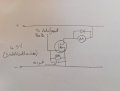
I'm currently building a set of 'battlebot' type contraptions for students to use. They're very simple - basically just some batteries, a switch and a motor. My plan was that each bot would be equipped with a capacitive toggle switch (Adafruit AT42QT1012) so that competing bots could touch the sensor and switch them off. Just a bit of a fun way to show a use of capacitors.
Anyway, I'm not an electronics expert but I've used MOSFETS to do this kind of thing many times in the past (though not with capacitive switches) and never had any issues. The blurb that comes with these little boards from Adafruit even shows a simple circtuit for controlling a motor - basically just a MOSFET and a diode.
Now, the boards work absolutely fine when there is nothing attached to them. They switch on and off completely as they should do. However, when I attach the circuit (sketch below) they still turn on completely reliably but they don't turn off with out repeated touching of the sensor which isn't much use to me. I have tried the following MOSFETS (all logic level) - IRF540N, IRLZ44N, AO3400, P55NF06L and they all behave exactly the same. I've also tried a small MOSFET switch module and have the same problem. The issue seems to be at the board end as the board is not detecting the touch to switch off.
This is all running from 3 AA batteries (4.5v) which may be a little low for the MOSFETS so I have used 4 AA batteries but it seems to make no difference.
In the circuit below I've added a 10k pull down resistor across the source and gain and I've also added a 0.1 microFarad capacitor as I was advised that this would 'stabilise' (not really sure what that meant) the MOSFET. Anyway, that made no difference.
I've tried putting the sensor at the end of 15cm wires away from anything conductive that might be causing a problem and it also makes no difference.
The issue also doesn't seem to be a defective board as I bought two of these and they both do exactly the same.
Both the Adafruit break out board and my little MOSFET circuit work perfectly well in isolation but they won't work together.
I would be incredibly grateful for any assistance!