Trouble desoldering a heatsink

Thread Starter

eyesee

Joined Oct 19, 2013
82
Hello,

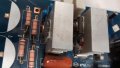
I am struggling to desolder a heatsink from a Behringer powered mixer PSU board (photos attached). I need to replace the power transistors which have shorted. I can't even unscrew the transistor from the heatsink on the right as the other heatsink is blocking it!

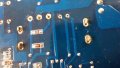
I have removed as much solder as I can from each of the tabs and component legs using flux and desolder wick.

The heatsink is still not budging?

Any tips/suggestions?
 

Attachments

ericgibbs

Joined Jan 29, 2010
21,448
hi eye,
I have used medium sized pliers to grip the head of the screw when its not accessible by a screw driver.
If the transistors are dead, just cut thru their legs above the PCB and de-solder the leg bits.
E
 

Thread Starter

eyesee

Joined Oct 19, 2013
82
I don't think I would be able to get cutters to the transistor legs on top of the PCB. Also, there is the temperature sensor in the way.
 

drc_567

Joined Dec 29, 2008
1,156
... the large heat sink pieces are defeating your efforts with a soldering iron. You need to find some way to preheat the heat sinks. ... melting point of most common solders is 10 or 20 degrees above 350 F. ... an oven of some sort would work, except that it would be contaminated by lead solder fumes.
 

jpanhalt

Joined Jan 18, 2008
11,087
Are the heat sinks grounded? The mounting lugs are soldered to plated through holes. If you pull too hard or put too much heat to them, you may pull the plating and "hole" right out of the pcb. That may make re-installation more difficult.

The right heat sink looks like the lugs are part of a clamp. It appears to be the clamp that is soldered. You might be able to pry the clamp out enough using heat to free that edge. Can you see whether the screw is threaded into the heat sink or has a nut? If so, I would work on the right one first and try to loosen the nut. If threaded into the heatsink, the left one will be easier to remove first using Eric's idea.

Hot air (solder melting hot) is the best way to get two joints up to temperature at the same time. Another method is to heat the joint and use a blast of high-pressure air to blow out the remaining solder while wiggling the lug.
 

dl324

Joined Mar 30, 2015
18,339
It looks like you've removed most of the solder. Have you been able to determine which pins are preventing removal? If it's just one, you could try heating that lead while trying to move the heatsink. But be careful that you don't rip out the plated through holes because there's solder holding them together.
 

ian field

Joined Oct 27, 2012
6,536
Hello,

I am struggling to desolder a heatsink from a Behringer powered mixer PSU board (photos attached). I need to replace the power transistors which have shorted. I can't even unscrew the transistor from the heatsink on the right as the other heatsink is blocking it!

I have removed as much solder as I can from each of the tabs and component legs using flux and desolder wick.

The heatsink is still not budging?

Any tips/suggestions?
You need a decently heavy soldering iron and add MORE solder so you can get good heat transfer. Ease each pair of pins out a little each time.

You only need one HS out to get at the screw on the other.
 

jpanhalt

Joined Jan 18, 2008
11,087
If you do not have a hot air soldering device, I have used a propane torch. It takes a lot more skill with a torch to avoid overheating, but that is how I did it until last year when I finally got a heat gun for desoldering.

If you go the torch route, cover areas that are to be safe with aluminum foil. It seems the more wrinkled the better. In this case, the higher temperature and heat from the torch may be an advantage. You can heat the heat sink directly. It's aluminum, so you can test temperature with a short piece of solder. The solder won't stick. Work on one side, wiggle that loose, then the other. You may also be able to just preheat the heatsink, say to 150 to 200°C, then use your soldering iron on the mounting tabs.

Of course, the heat sink will be too hot to handle, so attach handles ahead of time. Bare wire wrapped and twisted will make handles and stay relatively cool.
 

Thread Starter

eyesee

Joined Oct 19, 2013
82
I tried adding more solder the second time, then removing excess with a manual desoldering pump and residual using flux gel and desoldering wick.

The heatsink is mounted on a clamp but I can't see how they separate?

I did try using a Weller heatshrink gun masking off surrounding areas with Polyimide tape but I don't think the temperature was high enough. I will try using a temperature controlled hot air station, what temperature should I set it to?
 

jpanhalt

Joined Jan 18, 2008
11,087
I use aluminum foil for protecting from heat. It naturally allows an air layer between what is being protected and the foil exposed to heat. That is a good insulator. Particularly if you are using a flame, the shielding is excellent, and if your flame happens to hit the foil, you will see the wrinkling change. It will work the same with hot air, but the temperature is not enough to melt it.

While polyimide tape (Kapton) is good for high temperature and can actually work like a solder resist, I don't think it is as good for heat protection as loose aluminum foil is.
 

atferrari

Joined Jan 6, 2004
5,012
From my experience (massively salvaging components) you should use a heat gun to increase the temperature of the heatsink and then the PCB in way.

Of course you should do that, very carefully. Keep the gun far from the PCB and be patient.
 
Last edited:

Tonyr1084

Joined Sep 24, 2015
9,744
Looks like you've done a pretty good job of removing the solder from the transistor leads. Assuming you've been successful at that I would suggest you re-solder the heatsink and then using a large hot iron heat two heatsink leads on one side and apply pressure to pull them up a little. Be careful you don't rip the pads out. Then do the same with the other side. Little by little you'll lift the heatsink up high enough to free it.

PROGNOSIS FOR SUCCESS ? ? ? Poor! You've already heated the snot out of the pads and it looks like they're already beginning to lift. It's unlikely the heatsink is any part of the circuitry, but I can't say for sure. It's looking like if you continue trying to get the heatsink out you'll end up losing the pads and possibly, if it's plated through you may even pull the copper out of the middle of the board.

Since you've removed as much solder as you have, perhaps you can wiggle the heatsink. Doing so will weaken the solder and fatigue it until it comes loose. But I would still fear damaging the pads and through-hole.

Good luck.
 

bertus

Joined Apr 5, 2008
22,930
Hello,

As already almost all solder is removed, you could try to wiggle the pin of the heatsink with some plyers.
When all four pins can be moved freely, the heatsink should be able to be removed.
You can also try to free the transistor and resitor legs that way.

Bertus
 

MisterBill2

Joined Jan 23, 2018
27,587
If the pads are an electrical connection to the heat sink then there is some concern about damaging them, but if not, unsolder the transistor leads and then heat the sink anchor pins one at a time while pulling up. If the holes are plated through you will pull out that part, but it does not matter electrically. Heating each pin and flexing the board a small amount and eventually it comes off. ALL of the very high heat methods proposed are fine if you are salvaging the board, not fixing it. but that kind of board heating is ONLY for a board that you are willing to scrap.
AND, yes, you can indeed grab the screw head and turn it and remove the screw that way as well I have done that and it may be a better approach, but you may need to remove the two closest resistors temporarily.
 

Lyonspride

Joined Jan 6, 2014
137
It's broken, what's the worst you can do?

You best bet is a heat gun on the underside whilst pulling the heatsinks off from the other.

If all else fails, de-solder as bets you can, and then rip the damn things off the PCB, I do this on a weekly basis, I just make good afterwards. You can always drill the heaksinks, thread the holes and then screw them down once repaired.
 

MisterBill2

Joined Jan 23, 2018
27,587
Post #1 gives the impression that you are trying to repair the unit, so none of those advocates of total destruction are giving useful advice.T have been able to remove heat sinks and transformers by heating one pin at a time and pulling up on that corner, some, with the board flexing a small amount. Then moving to the next corner and heating that pin and pulling up with the board flexing just a bit. Yes, it takes a lot longer and it may result in the plated thru hole losing the plating through. But the part does move up out of the hole a bit at a time and being removed.
BUT i this case it looks like undoing the screw is a better approach When the screw is out then you can unsolder the transistor leads. Probably just working at wiggling the heat sink will cause the solder to crack so that the whole assembly can be pulled out. Patience is the key here. ANY FOOL CAN DESTROY THINGS WITH BRUTE FORCE.
 

Lyonspride

Joined Jan 6, 2014
137
T have been able to remove heat sinks and transformers by heating one pin at a time and pulling up on that corner, some, with the board flexing a small amount. Then moving to the next corner and heating that pin and pulling up with the board flexing just a bit. .
Not to p*ss on anyones parade, but that board pictured has surface mount ceramic capacitors all over it. Those things are a swine for going short cct through bending/flexing the PCB.
 

rsjsouza

Joined Apr 21, 2014
426
T have been able to remove heat sinks and transformers by heating one pin at a time and pulling up on that corner, some, with the board flexing a small amount. Then moving to the next corner and heating that pin and pulling up with the board flexing just a bit.
I usually do this procedure when things become very difficult as well, but obviously paying attention to Lyonspride's warning.

To me, the photograph of the pads only guarantees the solder was totally removed from a certain depth into the PCB - the rest of the hole is probably still completely full of solder. As others have said, re-filling the pads with leaded solder (lower fusion point) and using a very high thermal mass iron with a wide contact tip area will improve your chances of success. Obviously that the pads seem to be already compromised due to the excessive heat (I am assuming the attempts already thermally stressed everything around them).

Another thing that helps me is to take a long break to relieve my frustration with the stupid thing. :D

At any rate, good luck with this!
 
Top