Triggering NE555 with IR sensor

Thread Starter

Starfox

Joined Nov 17, 2018
18
You shouldn't need a transistor. The receiver output just needs to go lower than Vcc/3.

Please post a schematic.
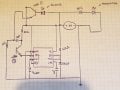
In this circuit diagram if you look, only the collector and the emitter are connected to the BD139 NPN (Transistor (2)). If I remove this transistor, the 555 will still trigger, but the 555 output will still remain high while the receiver is LOW (object blocking it). Once I added transistor (2), when I blocked the IR receiver with the object, the 555 triggers, the output of the 555 goes high. With the object still in the way, the timer will finish and its output will go back to low. I need this behavior since I need the conveyor belt to resume once the timer is done (since the object will be blocking until the timer is done, then it will move).
Thanks Dennis!

circuit_Starfox.jpg
 

Thread Starter

Starfox

Joined Nov 17, 2018
18
38 kHz, then emitter should modulated at 38 kHz. For short distance I would use an IR LED & IR transistor with no modulation.
I only need it to detect a small cup, so the sensors will be only placed like 10cm away from each other. Currently the IR emitter is used with no modulation. If I modulate the emitter would it travel a farther distance due to the provided carrier energy? Also if I modulated it, wouldn't it disturb the 555 trigger, since the modulation would cause it to be rapidly on and off, rather than a steady IR trip wire?
 

dl324

Joined Mar 30, 2015
18,362
In this circuit diagram if you look, only the collector and the emitter are connected to the BD139 NPN (Transistor (2)).
Using a transistor in that manner makes no sense.

Where did you get the circuit for the IR receiver? It doesn't make any sense either. It's either a photo transistor or a transistor with a photo diode between the collector and base.

You don't show a current limiting resistor for the LED on the output of the timer.

I gave you an example of a more acceptable way to draw your timer circuit, yet you continue to use your difficult to read style. We prefer for the flow in a schematic to be left to right and top to bottom. We also prefer that unnecessary wire jogs be avoided. If you're going to use the dot connection methodology, use it consistently.
 

Thread Starter

Starfox

Joined Nov 17, 2018
18
Using a transistor in that manner makes no sense.

Where did you get the circuit for the IR receiver? It doesn't make any sense either. It's either a photo transistor or a transistor with a photo diode between the collector and base.

You don't show a current limiting resistor for the LED on the output of the timer.

I gave you an example of a more acceptable way to draw your timer circuit, yet you continue to use your difficult to read style. We prefer for the flow in a schematic to be left to right and top to bottom. We also prefer that unnecessary wire jogs be avoided. If you're going to use the dot connection methodology, use it consistently.
I had drawn it based on the pin-out of the IC. I will use the dot connection consistently now. I apologize, I am still a student and learning a lot of this. There isn't a current limiting resistor for that LED currently on my breadboard, I can add one. I built the circuit for the photo diode receiver, since I was receiving very weak output signal. I connected the output of the photo receiver to the base, and the collector to vcc, in order to try and amplify the signal output from the receiver. I was able to achieve a farther receiving range by doing this. I also understand that it makes no sense for transistor (2) to be configured like that, but then why does it work? and how should I be doing it instead? When I remove transistor (2), the object between the sensors would have to be removed in order for the timer output to go low again. With the transistor, the object doesn't need to be removed for the output to go low.

Thanks, Dennis
- Tristen
 

dl324

Joined Mar 30, 2015
18,362
I had drawn it based on the pin-out of the IC.
Schematics drawn using pin order are generally unreadable. The schematic symbol I used uses a more common methodology of having inputs on the left and outputs on the right. This facilitates a right-to-left left-to-right flow. I put the reset pin on the top because it made more sense. In many applications, it's connected to VCC.

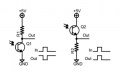
You are using a two pin photo transistor (or transistor with photo diode). How you connect it determines the output you get:
upload_2018-12-27_13-42-4.png
If you use the circuit on the left, you can connect "Out" to the coupling cap on trigger. The resistor value should be chosen based on the current from the photo transistor.
EDIT: Scratch the above suggestion. You want a trigger when the light is blocked.
 
Last edited:

dl324

Joined Mar 30, 2015
18,362
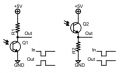
This is more appropriate for your conditions:
upload_2018-12-27_18-17-28.png
You want to use the circuit on the right. When the light is interrupted, you'll get a negative going edge.

If the current is too low, you can connect the phototransistor to an NPN transistor to make a photo darlington.
 
Top