Facebook
 Google
 GitHub
 Linkedin

I don't think I have a solid approach when analyzing complex circuits like these. I hope some of you can give me general directions and help me tackle this one.
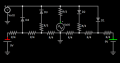
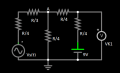
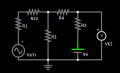
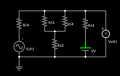
Given that the diodes are ideal and \(V_s(t)\) is a triangular waveform generator, I am asked to:
1. Derive the analytic expression of the transcharacteristic \(V_o \; = \; f(V_s)\) and draw it.
2. Recognize eventual properties and characteristics of the circuit.
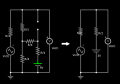
Whenever I analyze circuits with diodes I always start by supposing that all of them and the AC generator are off to check their actual bias. I also try to redraw the circuit to simplify it a bit and maybe find familiar configurations. No luck with this one.
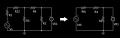
I started with something like this:
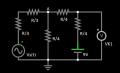
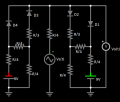 and ended up with this: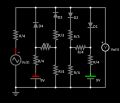
I won't bother you with my first try, I ended up failing to find a clean solution so I asked my professor about it. He didn't have much time and the only thing he managed to tell me was that all the time I wasted on my calculations could have been saved if only I had noticed that this was a symmetric circuit and then he showed me the graph of the transcharacteristic which was, in fact, symmetric to the \(V_o = V_s\) line.
I went back at it again and this is how I proceeded:
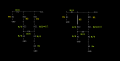
This time I considered only half the circuit:
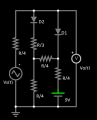
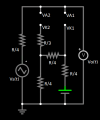
If both \(D_1\) and \(D_2\) are off, then I can say that \(V_{A1} = V_{A2} = V_s(t) = 0V\), \(V_{K1} = \frac{\left( R/4 + R/4 \right)}{\left( R/4 + R/4 \right) + R/4}9V = \frac{2}{3}9V = 6V\) and \(V_{K2} = \frac{R/4}{R/4 + R/4 + R/4}9V = \frac{1}{3}9V = 3V\).
Therefore, until \(V_s(t)\) doesn't reach \(3V\), \(V_o(t) = V_s(t)\).
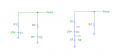
When \(V_s(t) = 3V\), \(D_2\) is forward biased and the circuit becomes:
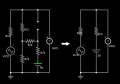
Applying Millman two times I can derive \(V_o(t)\):
First I simplified the branch like so: \(\frac{\frac{9V}{\frac{R}{4}+\frac{R}{4}}}{\frac{4}{R}+\frac{1}{\frac{4}{R}+\frac{4}{R}}} = \frac{2}{6}9V = 3V\).
And then derived \(V_o(t) = \frac{4V_s(t)+3\left(3V\right)}{4+3} = \frac{4}{7}V_s(t)+\frac{9}{7}V\).
My problem lies here: I know that the value of \(V_{K1}\) has changed but I don't know how to calculate it..
If I'd be able to, I could say for what value of \(V_o(t)\) \(D_1\) would get forward biased and the circuit would become:
And therefore \(V_o(t) = \frac{4\frac{V_s(t)}{R}+4\frac{9V}{R}}{\frac{4}{R}+\frac{4}{R}+\frac{28}{11R}} = \frac{11}{29}V_s(t)+\frac{11}{29}9V\).
But now I wouldn't know how to justify that the other half of the circuit is the opposite of the one I just analyzed..
Given that the diodes are ideal and \(V_s(t)\) is a triangular waveform generator, I am asked to:
1. Derive the analytic expression of the transcharacteristic \(V_o \; = \; f(V_s)\) and draw it.
2. Recognize eventual properties and characteristics of the circuit.
Whenever I analyze circuits with diodes I always start by supposing that all of them and the AC generator are off to check their actual bias. I also try to redraw the circuit to simplify it a bit and maybe find familiar configurations. No luck with this one.
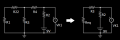
I started with something like this:
and ended up with this: I won't bother you with my first try, I ended up failing to find a clean solution so I asked my professor about it. He didn't have much time and the only thing he managed to tell me was that all the time I wasted on my calculations could have been saved if only I had noticed that this was a symmetric circuit and then he showed me the graph of the transcharacteristic which was, in fact, symmetric to the \(V_o = V_s\) line.
I went back at it again and this is how I proceeded:
This time I considered only half the circuit:
If both \(D_1\) and \(D_2\) are off, then I can say that \(V_{A1} = V_{A2} = V_s(t) = 0V\), \(V_{K1} = \frac{\left( R/4 + R/4 \right)}{\left( R/4 + R/4 \right) + R/4}9V = \frac{2}{3}9V = 6V\) and \(V_{K2} = \frac{R/4}{R/4 + R/4 + R/4}9V = \frac{1}{3}9V = 3V\).
Therefore, until \(V_s(t)\) doesn't reach \(3V\), \(V_o(t) = V_s(t)\).
When \(V_s(t) = 3V\), \(D_2\) is forward biased and the circuit becomes:
Applying Millman two times I can derive \(V_o(t)\):
First I simplified the branch like so: \(\frac{\frac{9V}{\frac{R}{4}+\frac{R}{4}}}{\frac{4}{R}+\frac{1}{\frac{4}{R}+\frac{4}{R}}} = \frac{2}{6}9V = 3V\).
And then derived \(V_o(t) = \frac{4V_s(t)+3\left(3V\right)}{4+3} = \frac{4}{7}V_s(t)+\frac{9}{7}V\).
My problem lies here: I know that the value of \(V_{K1}\) has changed but I don't know how to calculate it..
If I'd be able to, I could say for what value of \(V_o(t)\) \(D_1\) would get forward biased and the circuit would become:
And therefore \(V_o(t) = \frac{4\frac{V_s(t)}{R}+4\frac{9V}{R}}{\frac{4}{R}+\frac{4}{R}+\frac{28}{11R}} = \frac{11}{29}V_s(t)+\frac{11}{29}9V\).
But now I wouldn't know how to justify that the other half of the circuit is the opposite of the one I just analyzed..