Treadmill blowing 13 Amp fuse in plug

Thread Starter

Pantlessnoodle

Joined Sep 13, 2020
42
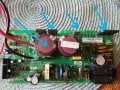
That is a MC100LS version, there were several, you have the one with the off-board L.V. transformer, later models had it on board.
The LED in one corner is a diagnostic LED, when running normally, it should flash continuously very slowly.
Max.
The LED in the corner, it flashes upon start up then just stays on solid
 

MaxHeadRoom

Joined Jul 18, 2013
30,695
I should stay on solid until it gets the move command when it should then flash very slowly as the motor starts.
See what it does when the lamp is connected.
Max.
 

Thread Starter

Pantlessnoodle

Joined Sep 13, 2020
42
I should stay on solid until it gets the move command when it should then flash very slowly as the motor starts.
See what it does when the lamp is connected.
Max.
Hey Max so I waited until my new motor arrived to rule it out. It came this afternoon and I tried it and ouch still blows the fuse. So do you think it is the mosfet?
 

Thread Starter

Pantlessnoodle

Joined Sep 13, 2020
42
The normal action is for the motor to slowly accelerate, you cannot have the belt take off to what ever the speed is set to, if this is not working due to say a shorted Mosfet, it will apply full power to the motor immediately and blow the fuse.
I assume the motor spun freely?
A filament lamp should show a gradual increase in brilliance as the ramp start builds up.
Are you sure it is not a brush rubbing sound? you would have to lift the brushes to prove that.
What is the part number on the motor board.?
Max.
I was wondering if I hook up a rectifier to a dc pwm power regulator would that be viable?
 

Attachments

MaxHeadRoom

Joined Jul 18, 2013
30,695
I assume you want to use that to plug into the HD2 socket to run the MC2100 board on its own?
This would test the board itself, and also show if the Mosfet was bad etc.
I previously made up some small Picmicro based PCT's for doing this for some who wanted to run the board & motor for machine tools etc, i.e. stand-alone.
A pot controls the speed and and a stop/start PB.
Any other motor controller you built, has to have a ramp up for the motor, especially with the flywheel still attached.
Max.
 

Thread Starter

Pantlessnoodle

Joined Sep 13, 2020
42
I assume you want to use that to plug into the HD2 socket to run the MC2100 board on its own?
This would test the board itself, and also show if the Mosfet was bad etc.
I previously made up some small Picmicro based PCT's for doing this for some who wanted to run the board & motor for machine tools etc, i.e. stand-alone.
A pot controls the speed and and a stop/start PB.
Any other motor controller you built, has to have a ramp up for the motor, especially with the flywheel still attached.
Max.
I was thinking to bypass the board itself and run the motor direct using a regulator of some sort. I was thinking a high wattage scr controller then a rectifier then finally wire that to the motor. My fear is the controller won't be fine enough for gradual speed for treadmill use.
 

MaxHeadRoom

Joined Jul 18, 2013
30,695
I was thinking to bypass the board itself and run the motor direct using a regulator of some sort. I was thinking a high wattage scr controller then a rectifier then finally wire that to the motor. My fear is the controller won't be fine enough for gradual speed for treadmill use.
The simple SCR controller won't do it, these T.M's have a speed sensor, usually on the belt, this comes into the motor board and goes up to the processor in the console, where it regulates the signal before sending back down to the motor controller.
If you have a meter, you can remove the heat sink screw on the devices and slide the circuit board out of the aluminum chassis to test the diode and Mosfet.
Max.
 

Thread Starter

Pantlessnoodle

Joined Sep 13, 2020
42
The simple SCR controller won't do it, these T.M's have a speed sensor, usually on the belt, this comes into the motor board and goes up to the processor in the console, where it regulates the signal before sending back down to the motor controller.
If you have a meter, you can remove the heat sink screw on the devices and slide the circuit board out of the aluminum chassis to test the diode and Mosfet.
Max.
great idea i do have a meter what readings should i get? also i noticed an ever so slight squeal cming from the board when powered. could this be a capacitor?
 

MaxHeadRoom

Joined Jul 18, 2013
30,695
In circuit, check for indication of short circuit between pins of Mosfet .and of the diode.
If doubtful, you may have to remove from the board to confirm.
When replacing chassis, make sure the heatsink insulation is in place.
Max.
 

Thread Starter

Pantlessnoodle

Joined Sep 13, 2020
42
In circuit, check for indication of short circuit between pins of Mosfet .and of the diode.
If doubtful, you may have to remove from the board to confirm.
When replacing chassis, make sure the heatsink insulation is in place.
Max.
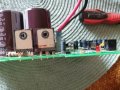
I have attached a picture the blue arrows I got no continuity beep from the multi meter. I guess they need replacing right?
 

Attachments

Thread Starter

Pantlessnoodle

Joined Sep 13, 2020
42
Last edited:

MaxHeadRoom

Joined Jul 18, 2013
30,695
Did you ever do the filament lamp test? This can be done out of the aluminum chassis.
If the Mosfet is shorted it will not blow the fuse like a motor with a flywheel will.
It should ramp up in brilliance.
Max.
 

Dodgydave

Joined Jun 22, 2012
11,395
You can test the MOSFET for shorts, unpower the treadmill, unplug motor, and put your DVM on Diode test , check MOSFET across middle pin and right pin, ideally open circuit result.
 
Top