I do not know why an emitter follower was also (wrongly) called Common Collector.
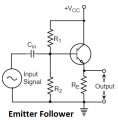
The voltage feeding the base does not need to come from a second power supply, instead it is usually provided by two resistors in series to ground from the collector's power supply making a voltage divider like this:
I do not know why an emitter follower was also (wrongly) called Common Collector.
The voltage feeding the base does not need to come from a second power supply, instead it is usually provided by two resistors in series to ground from the collector's power supply making a voltage divider like this:
What is shown is an example of an AC signal current amplifier.
You do not need the AC signal, C1, nor R2 for the circuit to work. It depends on the application of the circuit.
The AC signals are analog audio or video. The emitter follower provides a high input impedance and a low output impedance.
The voltage divider biases the base at a calculated voltage so that an analog input can cause the output swing to be the maximum it can be.
The input and output capacitors block the DC but pass the AC.
If you have a DC input signal then the emitter output voltage is a diode voltage drop less than the input voltage.
The AC signals are analog audio or video. The emitter follower provides a high input impedance and a low output impedance.
The voltage divider biases the base at a calculated voltage so that an analog input can cause the output swing to be the maximum it can be.
The input and output capacitors block the DC but pass the AC.
If you have a DC input signal then the emitter output voltage is a diode voltage drop less than the input voltage.
I understand, thank u very much, am having difficult problems and questions concerning transistors a lot, until am about to give up on it.
As I was studying transistor configurations, I got stumbled on the CC configuration, because the emitter is always the terminal which is left common and grounded in the original schematic, I think it is supposed to be the collector because it's called a "common collector"
emitter follower is a common collector... it's the same thing. They are used for current gain and have Av ~ 1 (slightly less than 1).
Common anything means that the input and output is not on it, so common to both... so common emitter has input at base and output at collector, this has different characteristics than a common collector (again emitter follower) which has input at base and output at emitter... one of the reasons it's called an emitter follower because the voltage follows the input and there is no inversion.
Don't have difficult problems and questions concerning transistors a lot, and don't give up, because transistor operation is Very Simple if you have the correct text book and/or a good teacher.
emitter follower is a common collector... it's the same thing. They are used for current gain and have Av ~ 1 (slightly less than 1).
Common anything means that the input and output is not on it, so common to both... so common emitter has input at base and output at collector, this has different characteristics than a common collector (again emitter follower) which has input at base and output at emitter... one of the reasons it's called an emitter follower because the voltage follows the input and there is no inversion.
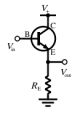
Ok thank u, but is there any difference of making the input be between base to emitter, (like in fig 1), and making the input be between base to collector (like in fig 2) but still in the common collector configuration
Don't have difficult problems and questions concerning transistors a lot, and don't give up, because transistor operation is Very Simple if you have the correct text book and/or a good teacher.
What text book do you have and does your teacher know anything about transistors?
Maybe in this forum or on other forums there are good tutorials about transistors. But watch out, online there are some things that are completely wrong. Some Instructables are written by a 10 years old kid who knows nothing about electronics.
I have seen thousands of emitter followers in circuits but I have never seen one with the collector common with the input. Ground is always the common.
What text book do you have and does your teacher know anything about transistors?
Maybe in this forum or on other forums there are good tutorials about transistors. But watch out, online there are some things that are completely wrong. Some Instructables are written by a 10 years old kid who knows nothing about electronics.
I have seen thousands of emitter followers in circuits but I have never seen one with the collector common with the input. Ground is always the common.
fig 2 is not practical but very interesting. There isn’t much advantage to doing it that way. You can achieve the same with proper biasing resistors. The reason why it’s not practical is that you really need two sources to achieve with one reversed. The load is between the 2nd source and ground being switched with full voltage at base. The negative bias on load causes base to bias lower and achieve higher current through the base which in turn achieves more current through collector... again only really works in saturation and no practical use plus very difficult to achieve with one source and circuits just are not designed that way because it’s more practical to have on source and ground. Also you have to throw out almost all the way to calculate transistors done that way. Looks interesting in simulation.
fig 2 is not practical but very interesting. There isn’t much advantage to doing it that way. You can achieve the same with proper biasing resistors. The reason why it’s not practical is that you really need two sources to achieve with one reversed. The load is between the 2nd source and ground being switched with full voltage at base. The negative bias on load causes base to bias lower and achieve higher current through the base which in turn achieves more current through collector... again only really works in saturation and no practical use plus very difficult to achieve with one source and circuits just are not designed that way because it’s more practical to have on source and ground. Also you have to throw out almost all the way to calculate transistors done that way. Looks interesting in simulation.
Please,in which way do u think is best for me to understand transistor circuit, because I find myself limited in only reading about transistors with 2 power sources, and when I see the one with one power source I feel like a novice.
The 2 DC source illustrations are created to just show how DC bias work not as a way to actually use them. There are a number of good resources that explain this from online to text books.
Re: your question with regards to input from base to emitter vs input from base to collector.
You are misreading the example drawings. The circuit drawings are simply examples of voltage and current flow within a transistor circuit. They are not intended to represent any particular application. What you are observing is a voltage source applying a current to the base of the transistor. It matters little where the other terminal of the voltage source is connected, once you take into account the net DC voltage and current at the base.
In any transistor circuit application, there will be a base current. There will also be a base voltage. The base voltage is referenced to a node in the circuit. It can be any node you choose. It is common practice for the reference to be circuit common. It is also very common practice for the reference to be earth ground. The reference can be the transistor's collector (as in a common collector configuration) or the transistor's emitter (as in a common emitter configuration).
In AC signal applications, one is only concerned with the AC signal. Usually the reference node is circuit common or earth ground. For AC analysis, the reference node can be +Vs or -Vs or GND. The DC voltage present does not matter. +Vs, -Vs and GND are the same node as far as AC is concerned, assuming that the power supply and power rails are properly AC coupled.
The base and collector of a transistor use the same voltage polarity. Then a simple 2-resistor in series voltage divider is used to bias the base at a calculated voltage.
Sometimes a voltage regulator biases the base of a transistor when the collector supply voltage wanders all over the place. The input to the voltage regulator is the voltage that the collector uses.
The base and collector of a transistor use the same voltage polarity. Then a simple 2-resistor in series voltage divider is used to bias the base at a calculated voltage.
Sometimes a voltage regulator biases the base of a transistor when the collector supply voltage wanders all over the place. The input to the voltage regulator is the voltage that the collector uses.
ok thanks a lot. I've just conducted a transistor experiment today, using one power supply, but without a voltage divider, I used 13001 transistor, in the CE configuration, but, the col
Re: your question with regards to input from base to emitter vs input from base to collector.
You are misreading the example drawings. The circuit drawings are simply examples of voltage and current flow within a transistor circuit. They are not intended to represent any particular application. What you are observing is a voltage source applying a current to the base of the transistor. It matters little where the other terminal of the voltage source is connected, once you take into account the net DC voltage and current at the base.
In any transistor circuit application, there will be a base current. There will also be a base voltage. The base voltage is referenced to a node in the circuit. It can be any node you choose. It is common practice for the reference to be circuit common. It is also very common practice for the reference to be earth ground. The reference can be the transistor's collector (as in a common collector configuration) or the transistor's emitter (as in a common emitter configuration).
In AC signal applications, one is only concerned with the AC signal. Usually the reference node is circuit common or earth ground. For AC analysis, the reference node can be +Vs or -Vs or GND. The DC voltage present does not matter. +Vs, -Vs and GND are the same node as far as AC is concerned, assuming that the power supply and power rails are properly AC coupled.
ok thank u, I think where am having problem is that am limited with understanding transistors with 2 power supply, I don't consider the "self bias mode" where the base share the collector voltage. Pls I do think, in this type of biasing, the Ib will no longer control the lc because it's sharing the same voltage or current source. Am I right

 Facebook
 Google
 GitHub
 Linkedin