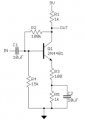
Transistors is not working/opening. How do i fix this?

dl324

Joined Mar 30, 2015
18,363
I probably used the wrong kind of terms in my schematic but the transistor comes after the relays
You shouldn't label the relay connection on the connector as GND because it's not GND. It's one side of the coil and the coil doesn't have a polarity unless it's a latching relay. You also have the transistors drawn upside down.
 

Thread Starter

Rensieboy223

Joined Feb 3, 2024
88
You shouldn't label the relay connection on the connector as GND because it's not GND. It's one side of the coil and the coil doesn't have a polarity unless it's a latching relay. You also have the transistors drawn upside down.
Thanks a lot guys!
If any of you have any books or information pages where i can learn more about the basics of electronics and drawing circuits following the right rules, let me know.
 

MisterBill2

Joined Jan 23, 2018
27,670
For starters, on the circuit shown, there is no connection to the emitter side of the base control circuit, and thus there would be no way that the transistor can be biased toward conduction. Aside from that, the labels on the blocks are backward from the polarity of the applied voltages. So that is rather confusing.
Besides that, we are only shown the portion of the circuit that you feel is all that we need to solve the problem. THAT is an effective way to turn folks off from having any interest in providing assistance.
With nothing connected to the base of the transistor and no return path for the base current there is no way the transistors can ever conduct.
 
Last edited:

Thread Starter

Rensieboy223

Joined Feb 3, 2024
88
For starters, on the circuit shown, there is no connection to the emitter side of the base control circuit, and thus there would be no way that the transistor can be biased toward conduction. Aside from that, the labels on the blocks are backward from the polarity of the applied voltages. So that is rather confusing.
Besides that, we are only shown the portion of the circuit that you feel is all that we need to solve the problem. THAT is an effective way to turn folks off from having any interest in providing assistance.
With nothing connected to the base of the transistor and no return path for the base current there is no way the transistors can ever conduct.
Yeah i know, sorry for the confusion but the problem is already solved, thanks
 

dl324

Joined Mar 30, 2015
18,363
If any of you have any books or information pages where i can learn more about the basics of electronics and drawing circuits following the right rules, let me know.
I don't have any single source I'd recommend. I can't remember how I learned to draw schematics. It's probably a combination of what I was taught in the electronics drafting class I was required to take and reading schematics drawn by others and incorporating things I liked into my style. You can learn from poorly drawn schematics, but the problem for you will be deciding what's good and bad.

I tried to find some documents from college professors, but I found that the several I looked at weren't very good (and all were in color which, to me, screams amateur).

I agree with most of the first answer to this post on StackExchange (as far as it went). https://electronics.stackexchange.c...es-and-guidelines-for-drawing-good-schematics

I don't like the preference to offset connection dots so "crosses" aren't made. The reasoning seems to be that if a dot is "lost" due to printing/copying, it's easier to determine what's connected. I've never had that problem. If I'm not certain of the intent, I just analyze the circuit to determine if a connection makes more sense. Personally, I think the jogs disrupt the flow and make the schematic more difficult to read. Fortunately, in my experience, this is the exception, not the norm.
1707321700851.png
 

MisterBill2

Joined Jan 23, 2018
27,670
I don't have any single source I'd recommend. I can't remember how I learned to draw schematics. It's probably a combination of what I was taught in the electronics drafting class I was required to take and reading schematics drawn by others and incorporating things I liked into my style. You can learn from poorly drawn schematics, but the problem for you will be deciding what's good and bad.

I tried to find some documents from college professors, but I found that the several I looked at weren't very good (and all were in color which, to me, screams amateur).

I agree with most of the first answer to this post on StackExchange (as far as it went). https://electronics.stackexchange.c...es-and-guidelines-for-drawing-good-schematics

I don't like the preference to offset connection dots so "crosses" aren't made. The reasoning seems to be that if a dot is "lost" due to printing/copying, it's easier to determine what's connected. I've never had that problem. If I'm not certain of the intent, I just analyze the circuit to determine if a connection makes more sense. Personally, I think the jogs disrupt the flow and make the schematic more difficult to read. Fortunately, in my experience, this is the exception, not the norm.
View attachment 314676
I certainly have suffered that problem. All it takes is one fax of a photocopy from a "D"sized print to put dots at every crossing. The alternative of using small arcs to indicate crossings is considered to "simply be too much work" for some lazy detailers. At least those employed where I was an engineer. But either method is acceptable to me.
But those concerns are also secondary as I see it
Far more important is general readability and adherence to some standards of signal or logic flow.
 

MaxHeadRoom

Joined Jul 18, 2013
30,691
If any of you have any books or information pages where i can learn more about the basics of electronics and drawing circuits following the right rules, let me know.
I would look at the schematic DWG package, free KiCad, it will show you the proper way to draw symbols and electronic circuits.
There is also an excellent Kicad forum.
 
Top