transistors bjt

Thread Starter

electronicsenjoyer089

Joined Feb 24, 2025
182
hello all,

I have been studying the bjt configurations lately and building the common circuits with them, like common emitter where i choose the gain that it needs to be given , common base where i saw that most important part is that i got a really low impedance in input ( but at this point it wont be thermally stable), i saw also the vbe multiplier, current mirror, differential amplifier.

Now what i wanted to understand what i could do to understand more? what circuits i could build? what tasks i could assign to myself in order to understand even more the transistor? or i should go ahead and study other subject in electronics? consider that my situation now is that i know what each circuit does, what could happen if u combine them together but like if u asked me to build a comparator or a complex thing i would have no idea how to start ( is that normal )

All of this to say: how i should proceed? i should keep studying transistors? thanks for all.
 

MrChips

Joined Oct 2, 2009
34,812
Build something simple, useful, and practical.

Knowing and understanding how transistor circuits work is useful.

Now move on to working with common ICs, such as LMC555 timer, op amps such as LM324, voltage regulators such as LM7805.
 

LvW

Joined Jun 13, 2013
2,027
I have been studying the bjt configurations lately and building the common circuits with them, like common emitter where i choose the gain that it needs to be given , common base where i saw that most important part is that i got a really low impedance in input ( but at this point it wont be thermally stable), i saw also the vbe multiplier, current mirror, differential amplifier.

Now what i wanted to understand what i could do to understand more? what circuits i could build? what tasks i could assign to myself in order to understand even more the transistor? or i should go ahead and study other subject in electronics? consider that my situation now is that i know what each circuit does, what could happen if u combine them together but like if u asked me to build a comparator or a complex thing i would have no idea how to start ( is that normal )

All of this to say: how i should proceed? i should keep studying transistors? thanks for all.
Before proceeding and "keep studying transistors" - do you really know how the bipolar transistor works?
Can you describe why and how the resistor Re in the emitter path works?
Did you use a quantity called "re"? Do you know about the physical meaning of this parameter?
Sorry for these questions - but from your text it is not clear to me if you just build the gain stages (based on well-known "rules of thumb") or if you have a good and deep understanding about the physics behind the circuits.
 

crutschow

Joined Mar 14, 2008
38,506
Do you understand the current-gain of a BJT, and its base-emitter characteristics?
Do you understand its transconductance in a common-emitter configuration?
Did you build an emitter-follower (common-collector) circuit?
 

dl324

Joined Mar 30, 2015
18,327
I have been studying the bjt configurations lately and building the common circuits with them, like common emitter where i choose the gain that it needs to be given , common base where i saw that most important part is that i got a really low impedance in input ( but at this point it wont be thermally stable), i saw also the vbe multiplier, current mirror, differential amplifier.
Do you know how the values used in the circuits were determined?

Do you understand where the circuits you mentioned can be used?

Do you know how to design such circuits from scratch?

You should also take some time to study how to write properly (capitalization, apostrophes, etc).
 

crutschow

Joined Mar 14, 2008
38,506
You should also take some time to study how to write properly (capitalization, apostrophes, etc).
Yes.
Text-speak/shortcuts has seriously eroded the writing of proper English in other contexts (e.g. a letter for a word, lack of capitals and punctuation, etc.).
It's especially annoying to me in technical discussions. :rolleyes:
 

Thread Starter

electronicsenjoyer089

Joined Feb 24, 2025
182
Before proceeding and "keep studying transistors" - do you really know how the bipolar transistor works?
Can you describe why and how the resistor Re in the emitter path works?
Did you use a quantity called "re"? Do you know about the physical meaning of this parameter?
Sorry for these questions - but from your text it is not clear to me if you just build the gain stages (based on well-known "rules of thumb") or if you have a good and deep understanding about the physics behind the circuits.
1)RE its used to stabilize the operating point ( bias stability ) , like the current gain can vary with temperature and from one transistor to another, without RE any change in vbe would cause IC current to change, but when u add this RE there is basically a feedback, if IC increases ( cus of temperature for example ) IE increases, if IE increases the drop on RE is larger which raises the emitter voltage, now since vbe= vb-ve, vb is fixed, an increase in ve will make vbe to get lower, so in this way ic decreases again providing this kinda of feedback
2)re is the internal resistance of the emitter base junction, it says how emitter current responds to small changes in base emitter voltage ( i dont know a lot i gotta admit, beside the fact that when building a common base u need to be really careful at that value , cus of impedance )
3) I think i got a bit of physics knowledge too behind them, but i really dont know beside building simple stages or combining them what to do, like i dont know how to treat a circuit like a real analog designer do, like the ones that are really experienced, like what happens if u add this resistor beetwen collector and base as feedback etc ( its like that i know the configurations, but if u change some things into the circuit i cant see instantly whats gonna happen )

I hope i was clear, and dont worry for ur questions, ur helping me so no problem :D
 

Thread Starter

electronicsenjoyer089

Joined Feb 24, 2025
182
Do you know how the values used in the circuits were determined?

Do you understand where the circuits you mentioned can be used?

Do you know how to design such circuits from scratch?

You should also take some time to study how to write properly (capitalization, apostrophes, etc).
ahah sorry man, i was at work.

I will try to write better and give me some time before sending a message or a post.
1) Yeah i know, but i always follow a "way" that i learnt ( there are reasons behind each choice, but i dont know if there could be other type to operate in order to get the same thing, i always follow same path
2) Well i look at Zin,zout,gain and this should tell me enough no? ( or atleast i do like that )
3) from scratch if i look at them yeah, i didnt memorize everything yet
 

LvW

Joined Jun 13, 2013
2,027
1)RE its used to stabilize the operating point ( bias stability ) , like the current gain can vary with temperature and from one transistor to another, without RE any change in vbe would cause IC current to change, but when u add this RE there is basically a feedback, if IC increases ( cus of temperature for example ) IE increases, if IE increases the drop on RE is larger which raises the emitter voltage, now since vbe= vb-ve, vb is fixed, an increase in ve will make vbe to get lower, so in this way ic decreases again providing this kinda of feedback
OK - correct. The keyword is negative current-controlled voltage feedback.

2)re is the internal resistance of the emitter base junction, it says how emitter current responds to small changes in base emitter voltage ( i dont know a lot i gotta admit, beside the fact that when building a common base u need to be really careful at that value , cus of impedance )
Perhaps the following helps to support your understanding: The quanity "re" is nothing else than the inverse transconductance gm=d(Ic)/d(Vbe) with re=1/gm.
This becomes logical looking at the simple gain expression (without feedback): A=-gm*Rc.
That means: The transconductance tells you how much the collector current Ic changes as a result of a small Vbe change. Hence, re is neither a resistance nor does it belong to the emitter.
The parameter gm is given by the slope of the Ic=f(Vbe) characteristics and directly proportional to the DC quiescent current:
gm=Ic/Vt).
(Personal note: I do not use "re" at all. I think, the corresponding small-signal equivalent BJT model is misleading because re is not a resistor at all. In the diagram it appears in series with the external resistor Re - and it looks as both could play the ame role, what is completely wrong)

3) I think i got a bit of physics knowledge too behind them, but i really dont know beside building simple stages or combining them what to do, like i dont know how to treat a circuit like a real analog designer do, like the ones that are really experienced, like what happens if u add this resistor beetwen collector and base as feedback etc ( its like that i know the configurations, but if u change some things into the circuit i cant see instantly whats gonna happen )
Explanation to the feedback resistor Rb between C and B:
Together with the base-emitter junction the resistor Rb forms a simple voltage divider. As a consequence, the divider voltage Vbe will be reduced when the current Ic increases (and the potential at the collector goes down).
 
Last edited:

crutschow

Joined Mar 14, 2008
38,506
A good way to easily experiment with transistors is to use a Spice analog simulator such as the free LTspice from Analog Devices, which several of us on this forum use. It allows you to easily look at all the voltages and currents in a circuit.
The learning curve may be a little step but there are example circuits, tutorials, and help from this forum to get you going.

Of course, after you get the simulated circuit working to your satisfaction, you should then breadboard it to verify its operation.

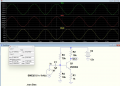
As an example, attached is an example LTspice simulation of a simple common-emitter amplifier with an approximate AC gain of 10, showing the selected input and output voltages, and the collector resistor current in the circuit, giving a simulated gain of 9.5.:

1748105316239.png
 
Last edited:
Probably biggest challenge with Bjts are oscillators. They are very hard to tune (perfectly), where usually every single component plays some role (have impact).
Every topology is for different purpose.
Some are good for low frequency (RC)(common emitter), some for high frequency (LC) (common collector, base).
Sometimes the feedback for amplitude stabilisation isn’t needed, sometimes is must, but all can be done with Bjts (without op-amps) , so that’s another option how to practice.

Example of variable inductor oscillator (95-235kHz) with 6V amplitude stabilisation I have build lately:
(LC tank is L1,C3)(L1 varies by pushing the core inside coil)
IMG_1677.jpeg
Video:
 
Last edited:
Check out Diode-Transistor-Logic (DTL) and Transistor-Transistor-Logic (TTL). Trying building some logic gates like AND and NOR using only discreet components like diodes and BJTs (no MOSFETs!). Pay attention to "fan-out" and "fan-in" when dealing with several inputs or outputs. Next check out CMOS logic and make note of important differences. Hint: MOSFETS draw almost no current and only while switching states.
 

Thread Starter

electronicsenjoyer089

Joined Feb 24, 2025
182
A good way to easily experiment with transistors is to use a Spice analog simulator such as the free LTspice from Analog Devices, which several of us on this forum use. It allows you to easily look at all the voltages and currents in a circuit.
The learning curve may be a little step but there are example circuits, tutorials, and help from this forum to get you going.

Of course, after you get the simulated circuit working to your satisfaction, you should then breadboard it to verify its operation.

As an example, attached is an example LTspice simulation of a simple common-emitter amplifier with an approximate AC gain of 10, showing the selected input and output voltages, and the collector resistor current in the circuit, giving a simulated gain of 9.5.:

View attachment 349842
Yeah, but after i make these circuits ( that i copy basically ) and i understand how they work, how can use that knowledge to use it to make more complex circuits? like i dont know how to make a stage that does a certain thing without copying something that already exists, or thats the normality?
 

Thread Starter

electronicsenjoyer089

Joined Feb 24, 2025
182
Probably biggest challenge with Bjts are oscillators. They are very hard to tune (perfectly), where usually every single component plays some role (have impact).
Every topology is for different purpose.
Some are good for low frequency (RC)(common emitter), some for high frequency (LC) (common collector, base).
Sometimes the feedback for amplitude stabilisation isn’t needed, sometimes is must, but all can be done with Bjts (without op-amps) , so that’s another option how to practice.

Example of variable inductor oscillator (95-235kHz) with 6V amplitude stabilisation I have build lately:
(LC tank is L1,C3)(L1 varies by pushing the core inside coil)
View attachment 349843
Video:
Oh really cool circuit, u made it from scratch? by combining stage or from where u took example
 
If you really understand how they work, then you should be able to modify the circuits to meet the new requirements.
Looking at other circuits that do similar things can help with that.

If you give an example, we can help with the process.
You should include an example. I understand what you mean conceptually but it's not obvious without a schematic of your own. A practical example might be consolidating a boolean expression like A + B + C = Y from 10 BJTs into 9 BJTs or better. Show how the expression remains unchanged but the cost of producing the circuit is reduced / optimised. This kind of lesson is suited to a seasoned engineer like yourself because you know most / all of the important things to look for. Much better than playing 20 questions.
 

Thread Starter

electronicsenjoyer089

Joined Feb 24, 2025
182
If you really understand how they work, then you should be able to modify the circuits to meet the new requirements.
Looking at other circuits that do similar things can help with that.

If you give an example, we can help with the process.
ok i give an example:
1) Lets say i wanna build a XNOR gate with transistors, how can i do that with knowing only how ''transistors works'' and basic configurations? like even if i know that i gotta copy a configuration that already exists and understand it no? but maybe someone more experienced knows how to build it from scratch, with knowing only what a XNOR gate needs to do

or its normal that u copy such circuits? and dont build anything really from scratch?
 
Top