Transistor Tester (PW July & August 1976)

Thread Starter

brianmk

Joined Dec 23, 2016
101
A while ago, I built a modified version of an old school Transistor Tester described in PW July and August 1976.
The design is almost 50 years old but it works as expected when measuring bipolar transistor HFE.
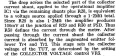
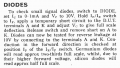
According to the description, it can also be used measure diode forward and reverse characteristics:-
1734334065999.png

This makes no sense to me at all!
Can anyone enlighten me?

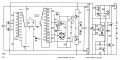
I have attached the schematic of the original design.
 

Attachments

Thread Starter

brianmk

Joined Dec 23, 2016
101
A while ago, I built a modified version of an old school Transistor Tester described in PW July and August 1976.
The design is almost 50 years old but it works as expected when measuring bipolar transistor HFE.
According to the description, it can also be used measure diode forward and reverse characteristics:-

View attachment 338068

This makes no sense to me at all!
Can anyone enlighten me?

I have attached the schematic of the original design.
The description makes no mention of the required setting for S1 (Base Current).
I assume it should be set to position 1 (Ices) for S2 (Ices,Ir / If) to have any effect.
With S2a in position 1 (If) we now have R13 (820 Ohms) connected to the fixed +12V supply.
This feeds into the DUT via R14 (33 Ohms). R13 + R14 in series = 853 Ohms.
S2b is also in position 1 (If).
That feeds into the Ic current shunt resistor chain at a fixed position (S3 position 9 = 1mA).
We now have R24 + R25 + R26 + R27 in series connected to Vc (which according to the description should be set to 10V).
The remaining resistors in the top of shunt chain add up to just under 1Meg. They feed into the op amp via R28 (200K).
So with the DUT A & K pins shorted we have 12V - 10V = 2V across a shunt resitance of 820 + 33 + 68 + 22 + 6.8 + 3.2 = 953 Ohms.
That equates to current of 2 / 953 = 2.1mA. The voltage across R24 + R25 + R26 + R27 (=100 Ohms) is 210mV.
The remaining top part of the shunt chain (1M) + R28 (200K) together with R29 (1.2M) divides 210mV by a factor of 2.
The op amp and meter gives FSD for 100mV across R30 (see description below).

1734340259104.png

I assume this part of the procedure is to simply set Vc to 10V rather than rely on VR3 calibration markings.
I guess to actually measure the reverse leakage current, one has to set S2 to position 2 (Ices,Ir) while leaving S1 at position 1 (Ices).
S3 can then be used to adjust the current range to get a reading on the meter.

I still haven't worked out how to measure diode conduction in the forward direction.
 

Thread Starter

brianmk

Joined Dec 23, 2016
101
The description makes no mention of the required setting for S1 (Base Current).
I assume it should be set to position 1 (Ices) for S2 (Ices,Ir / If) to have any effect.
With S2a in position 1 (If) we now have R13 (820 Ohms) connected to the fixed +12V supply.
This feeds into the DUT via R14 (33 Ohms). R13 + R14 in series = 853 Ohms.
S2b is also in position 1 (If).
That feeds into the Ic current shunt resistor chain at a fixed position (S3 position 9 = 1mA).
We now have R24 + R25 + R26 + R27 in series connected to Vc (which according to the description should be set to 10V).
The remaining resistors in the top of shunt chain add up to just under 1Meg. They feed into the op amp via R28 (200K).
So with the DUT A & K pins shorted we have 12V - 10V = 2V across a shunt resitance of 820 + 33 + 68 + 22 + 6.8 + 3.2 = 953 Ohms.
That equates to current of 2 / 953 = 2.1mA. The voltage across R24 + R25 + R26 + R27 (=100 Ohms) is 210mV.
The remaining top part of the shunt chain (1M) + R28 (200K) together with R29 (1.2M) divides 210mV by a factor of 2.
The op amp and meter gives FSD for 100mV across R30 (see description below).

View attachment 338074

I assume this part of the procedure is to simply set Vc to 10V rather than rely on VR3 calibration markings.
I guess to actually measure the reverse leakage current, one has to set S2 to position 2 (Ices,Ir) while leaving S1 at position 1 (Ices).
S3 can then be used to adjust the current range to get a reading on the meter.

I still haven't worked out how to measure diode conduction in the forward direction.
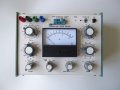
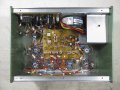
This is my slightly modified version. It includes provision for measuring transistor Vce and Vbe and the ability to measure HFE at higher collector currents up to 300mA. It uses a mains power supply rather than three 9V batteries.
 

Attachments

Last edited:

ericgibbs

Joined Jan 29, 2010
21,439
hi brian,
You have an interesting set of problems, which could take a while to get through.:)
I guess we will have to break down each step.

I still haven't worked out how to measure diode conduction in the forward direction.
EG57_ 2420.png

What result get did you see, when using the suggested method, with a Silicon Diode?

Is the front panel a shot of the original design, or is it your updated version?

E
 

Thread Starter

brianmk

Joined Dec 23, 2016
101
This is my slightly modified version. It includes provision for measuring transistor Vce and Vbe and the ability to measure HFE at higher collector currents up to 300mA. It uses a mains power supply rather than three 9V batteries.
One of the problems when attempting to measure diode reverse leakage current is that the high input impedance of the meter makes it succeptable to noise and mains pickup on the more sensitive ranges. I get a residual current reading of about 30nA with nothing connected. A 1N4004 has a specified reverse leakage current of 5uA. I have tried adding decoupling capacitors and playing around with the earthing configuration but have not yet managed to eliminate the unwanted pick up.

Using a 'scope on the op amp output, the residual meter reading appears to be caused by 50Hz pickup - possibly originating from the internal toroidal mains transformer. There are two separate 12V supplies. The 12V supply for the op amp is split to create +6V and -6V rails. It has to be left floating relative to the main 12V supply. I have tried adding decoupling capacitors to chassis ground from both supplies. It doesn't seem to help and in some cases it actually made things worse. I am going to try temporarily replacing the internal supplies with an external bench PSU.
That should remove any effects due to magnetic or capacitive coupling with the transformer or other internal power supply components.

Update: I found that using an external bench supply eliminates the mains pickup issue almost completely.
However, the problem returns if I plug the mains IEC connector into the internal power supply - even if it is not switched on.
That suggests an earthing issue rather than magnetic or capacitive coupling from the transformer.
Any ideas how I might be able to fix the problem?
Both sections of the twin 12V bench supply are isolated from mains earth.
I currently have one 0.047 uF disc cap between chassis and the junction of R14 and R15.
Another between chassis and the op amp negative rail (pin 4).
These were added to reduce pickup when measuring transistor HFE.
There is also C7 (0.022uF) that connects between the TUT emitter and chassis ground as shown on the original schematic.

If I connect the tester chassis ground to the bench PSU chassis ground there is little unwanted noise.
If I connect the tester chassis ground to my 'scope ground, again there is no issue.
It's only when I connect the IEC lead that I get the problem.
I checked the earth continuity on the mains leads - all looks good.
I tried a different IEC lead - no difference.
The tester, bench PSU and 'scope all plug into the same four way mains extension block.

Update:
I think may have found the noise problem...
The live from the IEC connector feeds into a panel fuse before the DPST power switch.
When I removed the mains fuse, the noise decreased by about half.
The mains wiring runs close to the 4mm banana sockets that connect into the sensitive part of the circuit.
I need to add some screening between the sockets and the mains wiring.
 
Last edited:

Thread Starter

brianmk

Joined Dec 23, 2016
101
hi brian,
You have an interesting set of problems, which could take a while to get through.:)
I guess we will have to break down each step.

I still haven't worked out how to measure diode conduction in the forward direction.
View attachment 338080

What result get did you see, when using the suggested method, with a Silicon Diode?

Is the front panel a shot of the original design, or is it your updated version?

E
The front panel photo is my version.

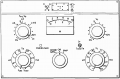
The original looks like this:-


1734345312095.png

Here are links to the original PW articles as PDF:-
https://www.worldradiohistory.com/UK/Practical-Wireless/70s/PW-1976-07.pdf
https://www.worldradiohistory.com/UK/Practical-Wireless/70s/PW-1976-08.pdf
 
Last edited:

Thread Starter

brianmk

Joined Dec 23, 2016
101
EG57_ 2420.png

I don't understand what that means.
Is it measuring the forward voltage drop at the fixed current I calculated as 2.1mA?
The meter measures current not voltage.
I am baffled.

Update: My comment above can't be right because the 2.1mA current only applies when the DUT terminals are shorted.
It doesn't take into account the forward voltage drop across the diode.
Is it using the change in current as a measure of the forward voltage?

My modified design includes the ability to directly measure transistor Vbe.
I could measure diode forward voltage drop in the same way simply by connecting the DUT between the base and emitter terminals.
The required current can be set using the Base current switch S1.
Despite this, I still want to understand how the original design works.
 
Last edited:

Thread Starter

brianmk

Joined Dec 23, 2016
101
The photo shows the new screen around the IEC mains socket, rocker switch and fuse.
There is now no pickup or noise on the meter when set to measure reverse leakage - even on the most sensitive range (100nA FSD).

I am still unsure how the diode forward voltage drop measurement (using the 'If') setting actually works. What is the meter measuring and what does the scale represent?
 

Attachments

Last edited:

Thread Starter

brianmk

Joined Dec 23, 2016
101
Now I have fixed the diode reverse leakage measurement (I hope), I have been looking at diode forward conduction.
If I follow the procedure given in the documentation, it kind of works - although there appears to be a calibration issue.
The internal analogue meter indicates a forward voltage drop of 0.44V.
If I measure the voltage across the diode with a DMM I get 0.56V.
The analogue meter reading is low by about 20%.
 

ericgibbs

Joined Jan 29, 2010
21,439
Of course, it matters, how else are you going to have a point of reference to compare the results of either of your test methods.
ie: you cannot be sure which of your testing methods, maybe, be giving the correct results.
 

Thread Starter

brianmk

Joined Dec 23, 2016
101
Of course, it matters, how else are you going to have a point of reference to compare the results of either of your test methods.
ie: you cannot be sure which of your testing methods, maybe, be giving the correct results.
I don't understand.
Surely the voltage across a diode only depends on the current flowing through it - or have I misunderstood Ohms law?

When I measure the voltage using a DMM, the diode is connected to the tester A and K terminals. The tester defines the current flowing through it.
 

Thread Starter

brianmk

Joined Dec 23, 2016
101
I do realise that diodes are non linear. I have been an engineer for over 50 years!
Even a non linear device will measure the same voltage across it when passing the same current!
 

ericgibbs

Joined Jan 29, 2010
21,439
Even a non linear device will measure the same voltage across it when passing the same current!
I have been an engineer for over 75 years.;)


how else are you going to have a point of reference to compare the results of either of your test methods.
ie: you cannot be sure which of your testing methods, maybe, be giving the correct results.

EG57_ 2436.png
 

Thread Starter

brianmk

Joined Dec 23, 2016
101
I still don't understand your argument.
The tester defines the fixed current throught the diode.
The voltage across it can be measured either using the internal analogue meter (doubtful) or I can measure it using an external high impedance DMM.
The external DMM (a Fluke which I trust) gives a voltage of 0.65V.
The internal meter indicates 0.44V.
Irrespective of the characteristics of the diode under test, the two measurements should agree.
 

ericgibbs

Joined Jan 29, 2010
21,439
hi brian,
I am trying to help, consider these points.
What voltage is applied across the diode when using your home made tester, and the measured current.?
What voltage is applied across the diode when using your DMM tester, and the measured current.?

Post your measurements
E
 
Top