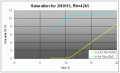
Thanks to steveb and Ron H for their patience, I think I see what's going on now.
For the purposes of the OP, I think the load-line graph of Ron H is the perfect answer for the assignment, and it does seem clear now that the answer expected is "saturated". Both dcepticon and teacher can be happy with that.
But back in the world of real transistors it's much more complex. After much thinking on the issue, it occurs to me that the question set can't be solved. For a start, beta won't be 50, it will be (assuming Vce(sat)=200mV) 9.8mA/230uA=42.6. I guess the assumption is that beta is 50 when there's a bit more headroom available from a higher Vcc supply, but that would imply a higher Vce, and beta is a function of Vce, as can be seen by the "constant" current section of Ron H's graph, which isn't that constant at all because the slope is non-zero. From the same graph it is clear that the collector current is only at 11.5 mA when Vce is about 4.5 V, so beta is only 50 at Vcc=14.5 V. As the OP transistor is biased so close to the knee then this can make a difference as to whether the transistor is actually saturated or not.
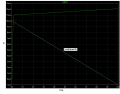
Here's a couple of graphs, sadly with a higher beta as my PSPICE has gone all crashy on me and I'm having to use LTSpice and I haven't worked out how to edit the models on that yet, but the rest of the circuit is the same, apart from the value of the base resistor, which I have tweaked to give a collector current of 11.5 mA at two values of Vcc: 20 V and 50 V.
So if we set the collector current for 11.5 mA when Vcc is 20 V then the transistor will have just started to go into saturation at Vcc = 10 V. But if we set the collector current to be 11.5 mA when Vcc is 50 V, it can be seen that Vce doesn't start saturating until Vcc = 8 V.
OK, I'll admit I'm being pedantic, I just think it's a little rude of teacher to set a question where the answer is both fuzzy and marginal. I'll shut up now
But back in the world of real transistors it's much more complex. After much thinking on the issue, it occurs to me that the question set can't be solved. For a start, beta won't be 50, it will be (assuming Vce(sat)=200mV) 9.8mA/230uA=42.6. I guess the assumption is that beta is 50 when there's a bit more headroom available from a higher Vcc supply, but that would imply a higher Vce, and beta is a function of Vce, as can be seen by the "constant" current section of Ron H's graph, which isn't that constant at all because the slope is non-zero.
Yes, you raise some good points here. The statement that beta is 50 would need to be assumed to be in the linear region. In a another thread, I once posted a derivation of beta (needed for a current control model) assuming the Ebers-Moll model which is a voltage control model that displays many important low-frequency features of the transistor. (see attached PDF).
Here we were discussing the most general form of beta for the cutoff region, linear region and saturation region. Then, I showed that the beta becomes constant in the linear region, and then showed beta is dependent on Vce in the saturation region.

 Facebook
 Google
 GitHub
 Linkedin

 23.7 KB Views: 32