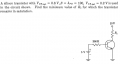
To maintain the transistor in saturation region

Status
Not open for further replies.

Thread Starter

Vihaan@123

Joined Oct 7, 2025
220
1771675622571.png
\[
\text{Equation for the base} \\
5V - I_B A* 200k Ohm - 0.8V =0 ;- eq1 \\
I_B = \frac{4.2V}{200K \Omega} A \\
I_B = 21\mu A \\
\text{Equation for the collector} \\
10V - I_C A * R_c \Omega - 0.2V = 0 - eq2 \\
I_C = \frac{9.8V}{R_c \Omega} ; \\
I_{B} = \frac{I_C}{\beta} \\
I_{B} = \frac{9.8V}{R_c \Omega*\beta} \\
R_c= \frac{9.8V}{\beta * I_B A} \\
R_c = \frac{9.8V }{100*21\mu A} \\
R_c = 4.6K\Omega \\

\text{Cross verification} \\
\text{Let} \\
R_c = 10K\Omega \\
I_C = \frac{10V}{10K\Omega} => I_C = 1 mA => I_B = \frac{1mA}{100} = 10\mu A;
\text{This is less than 21uA} \\
\text{Let} \\
R_c = 2K\Omega \\
I_C = \frac{10V}{2K\Omega} => I_C = 5mA => I_B = \frac{5mA}{100} = 50\mu A;
\text{This is greater than 21uA}
\]
I am little confused if the IB should be less than 21uA or more than 21uA, if it has to be more than 21uA then the Rc will have a maximum value not a minimum value.
 

MrChips

Joined Oct 2, 2009
34,628
If you decrease Rc, Ic will rise. This requires a higher IB to stay in saturation. Hence you are designing for the lowest Rc that will still maintain saturation.

(Note that beta is not constant and changes with Ic.)
 

ericgibbs

Joined Jan 29, 2010
21,390
I am little confused if the IB should be less than 21uA or more than 21uA, if it has to be more than 21uA then the Rc will have a maximum value not a minimum value.
hi V123,
You are not being asked that question ref 21uA ........ 'if max/min'
But what is the value of Collector resistor when Vce saturation occurs at Ib=21uA.
E
 

LvW

Joined Jun 13, 2013
1,995
I am little confused if the IB should be less than 21uA or more than 21uA, if it has to be more than 21uA then the Rc will have a maximum value not a minimum value.
You should not forget that the quantity "beta" is a small-signal parameter which may still be approximately applied at the transition between the active and the saturation mode, however, in no case when you are deeper in saturation.
 

LvW

Joined Jun 13, 2013
1,995
If 100 is the datasheet value of hfe, then it is likely to be much lower at Vce=0.2V
Shouldn`t we make a difference between hfe=beta=d(Ic)/d(Ib) and B=Ic/Ib ?
I think, this is important - in particular when we speak about saturation.
 

WBahn

Joined Mar 31, 2012
32,703
Shouldn`t we make a difference between hfe=beta=d(Ic)/d(Ib) and B=Ic/Ib ?
I think, this is important - in particular when we speak about saturation.
The problem gives 100 as both ß and hFE. But hFE (uppercase subscripts) is the DC current gain (Ic/Ib), while ß is another name for hfe (lower case subscripts), which is the small-signal gain. So it raises the question of whether the author of the problem is confused on this point (there's a lot of sloppiness out there and many people, even textbook authors -- many of whom have never actually designed a circuit in the real world -- don't realize that they are different parameters), or if they are just telling the student to use the same value for both.

Then there's the question of whether the author is expecting the student to use that value in saturation, or if they are throwing it out as a red herring and expecting the student to recognize that it is a parameter that applies to operation in the linear region and not saturation and is expecting them to use the typical forced beta value of 10 or there abouts.

Coursework problems do not exist in a vacuum and are given in the context of the course/text material. Without that context, it's hard to judge what the intent was (or whether it represents sloppiness or lack of awareness on the author's part).

If in doubt, the student should hedge their bets and state their assumptions and reasoning and do the calculation both ways. This demonstrates that they aren't just blindly throwing numbers at equations, but instead are thinking about the problem and are aware of these considerations.

The easiest and best, in my opinion, way of doing this is to work the problem symbolically right up to the end. Then do something like this in the write up:

Using the given hFE, we get the following value for Rcmin:

Rcmin = ....

However, hFE falls significantly as the transistor moves into saturation. This will result in lower collector current at this same base current, which would prevent the transistor from becoming saturated with this Rc, so a better choice would be to use the typical manufacturer's forced ß of 10, which yields:

Rcmin = ....

The true value of Rcmin (i.e., the actual "minimum" value of Rc that will place the transistor at this operating point) is likely somewhere between these two values.
 

WBahn

Joined Mar 31, 2012
32,703
View attachment 363774
\[
\text{Equation for the base} \\
5V - I_B A* 200k Ohm - 0.8V =0 ;- eq1 \\
I_B = \frac{4.2V}{200K \Omega} A \\
I_B = 21\mu A \\
\text{Equation for the collector} \\
10V - I_C A * R_c \Omega - 0.2V = 0 - eq2 \\
I_C = \frac{9.8V}{R_c \Omega} ; \\
I_{B} = \frac{I_C}{\beta} \\
I_{B} = \frac{9.8V}{R_c \Omega*\beta} \\
R_c= \frac{9.8V}{\beta * I_B A} \\
R_c = \frac{9.8V }{100*21\mu A} \\
R_c = 4.6K\Omega \\

\text{Cross verification} \\
\text{Let} \\
R_c = 10K\Omega \\
I_C = \frac{10V}{10K\Omega} => I_C = 1 mA => I_B = \frac{1mA}{100} = 10\mu A;
\text{This is less than 21uA} \\
\text{Let} \\
R_c = 2K\Omega \\
I_C = \frac{10V}{2K\Omega} => I_C = 5mA => I_B = \frac{5mA}{100} = 50\mu A;
\text{This is greater than 21uA}
\]
I am little confused if the IB should be less than 21uA or more than 21uA, if it has to be more than 21uA then the Rc will have a maximum value not a minimum value.
It's really good to see you making the effort to use units properly. I applaud you.

A few points to help you further in that regard:

Point #1 -- Disembodied units

In a lot of places you are throwing in disembodied units that don't belong there. Remember, symbolic quantities carry their units -- the units are part of the quantity they represent.

\(
5V - I_B A* 200k Ohm - 0.8V =0
\)

What is that "A' doing there? I_B already has units of current. So if I_B turns out to be 21 µA, your equation, as written, becomes

\(
5V - I_B A* 200k Ohm - 0.8V =0 \\
5V - 21\;\mu A A* 200k Ohm - 0.8V =0 \\
\)

Now your second term has units of µA·A which is (mA)². When multiplied by a 200 kΩ resistance, you would then end up with 4200 µA·A·kΩ, which is 4.2 V·A = 4.2 W, which is a unit of power, not voltage.

When you throw in that disembodied 'A', what you are really doing is multiplying that term by a current of 1 A out of the nowhere.

The fact that this is not messing up your units tracking is a sign that you aren't actually tracking your units, but just giving lip service to it.

Point #2 -- Case sensitivity

You use k and K interchangeably. They are not the same. 'k' is the SI prefix for a scaling multiplier of 1000, while 'K' is the SI unit for temperature (namely kelvin). This is why 'k' "violates" the general rule that scaling prefixes greater than 1 use upper case while prefixes less than 1 use lower case. Proper case use is important since the SI system has several places where it matters. For instance, 'f' for femto and F for farad, or 'a' or atto and A for ampere. Within just the scaling prefixes, you have 'm' for milli and 'M' for mega, which is a difference of nine orders of magnitude, yet many people use them interchangeably, but 100 mHz is NOT the same thing as 100 MHz. The sole place where the same symbol is used for different things is 'm', which could mean milli or it could mean meter. This is unfortunate, but the crafters of SI had to live in the real world where most things had already been long established via a hodgepodge evolution over the course of centuries.

Note that because of this, 'm' is a potential trouble maker. Is mN a millinewton, or a meter·newton? For this reason, 'm' as a unit (meter) should never go first in a compound unit. If it's not a compound unit, then there is no ambiguity because there must always be a unit (bare prefixes are not allowed). So 'mm' is unambiguously millimeter.

Also, compound scaling prefixes are not allowed, though we do see them, particular mmF for microfarad (it should be interpreted a millimeter·farad), and µµF for picofarad (it's not valid, period). But these are old style and frowned upon.

Point #3 -- Spacing

A scaling prefix is fundamentally part of a quantity's unit and should not be separated from it by a space. Thus is is 'kΩ' and not 'k Ω'.

Also, per the SI style guidelines, the units of a quantity ARE separated from the numerical portion by a space, so it is '200 kΩ' and not '200kΩ' and certainly not '200k Ω'.

This was done for readability as the human brain can more easily parse numerical and text components if they are physically separated. But it can make expressions a bit harder to read because we also tend to use physical separation to imply operator grouping (whether we should or not). For instance:

R = 10 kΩ
1/R = 1/10 kΩ

This is strictly speaking correct, but it is also indistinguishable from 0.1 kΩ. Of course, if you make this mistake, it will mess up the units if they are being properly tracked.

Instead, write it as

1/R = 1/(10 kΩ)


EDIT: Fix typo in LaTeX equation
 
Last edited:

Thread Starter

Vihaan@123

Joined Oct 7, 2025
220
A few points to help you further in that regard:

Point #1 -- Disembodied units

In a lot of places you are throwing in disembodied units that don't belong there. Remember, symbolic quantities carry their units -- the units are part of the quantity they represent.
The fact that this is not messing up your units tracking is a sign that you aren't actually tracking your units, but just giving lip service to it.
It has become a really very important tool in my analysis, and you have addressed the pain points i had, thank you for that, i can add them in my future work.
 

WBahn

Joined Mar 31, 2012
32,703
It has become a really very important tool in my analysis, and you have addressed the pain points i had, thank you for that, i can add them in my future work.
Glad to hear you are seeing the benefit.

Here's a very comprehensive guide that is about as authoritative as it gets on this topic.

NIST Guide to the SI

With particular regards to what we've been discussing here are Chapters 6, 7, and 8.
 

MrAl

Joined Jun 17, 2014
13,667
View attachment 363774
\[
\text{Equation for the base} \\
5V - I_B A* 200k Ohm - 0.8V =0 ;- eq1 \\
I_B = \frac{4.2V}{200K \Omega} A \\
I_B = 21\mu A \\
\text{Equation for the collector} \\
10V - I_C A * R_c \Omega - 0.2V = 0 - eq2 \\
I_C = \frac{9.8V}{R_c \Omega} ; \\
I_{B} = \frac{I_C}{\beta} \\
I_{B} = \frac{9.8V}{R_c \Omega*\beta} \\
R_c= \frac{9.8V}{\beta * I_B A} \\
R_c = \frac{9.8V }{100*21\mu A} \\
R_c = 4.6K\Omega \\

\text{Cross verification} \\
\text{Let} \\
R_c = 10K\Omega \\
I_C = \frac{10V}{10K\Omega} => I_C = 1 mA => I_B = \frac{1mA}{100} = 10\mu A;
\text{This is less than 21uA} \\
\text{Let} \\
R_c = 2K\Omega \\
I_C = \frac{10V}{2K\Omega} => I_C = 5mA => I_B = \frac{5mA}{100} = 50\mu A;
\text{This is greater than 21uA}
\]
I am little confused if the IB should be less than 21uA or more than 21uA, if it has to be more than 21uA then the Rc will have a maximum value not a minimum value.
Hi,

As you have probably gathered by now, some people use Beta=10 for bipolar transistor saturation cases. It's like a heuristic for saturation. It can be different, but when we don't know what it is we often just use 10.

Also, now you see that 21ua is for the base current, and you know that the base current times the Beta is equal to the collector current in these calculations. This means that with 21ua into the base you calculate the collector current, and since that is the maximum collector current, you can calculate the resistor value, which also depends on the source of 10v and the saturation voltage of 0.2v .

One of the issues that comes up with these homework problems is what Beta do we use for the saturation problems. This comes up because a Beta of 100 is usually not for saturation. Many transistors have a value of 100 but in saturation it is presumed to be much lower, like 10. So what value do we want to use?

In these kinds of cases really the only thing you can do is look at past exercises and see if you can find a precedent. If the instructor or book gave you other problems that involved saturation and they explained that the Beta for saturation goes down, then you probably want to use a value of 10. If they never explained that though, then you might want to stick with the value of 100. The value of 100 would be taking the value they gave you as the literal value to use simply because they defined the Beta already. The question only arises because experienced people know that saturation is a special case, but beginners may not be expected to know this yet.
Alternately, you can calculate it both ways and give the two results conditionally.

When you have questions about min and max values it sometimes helps to calculate a few different values using different input values, such as a different collector resistor, then see if you can decide what to do from there. For example, see what you can figure out using values of 4k, 5k and 6k for the collector resistor. Calculate the voltage drop knowing the collector current.
 

crutschow

Joined Mar 14, 2008
38,316
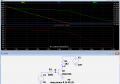
For your interest, below is the LTspice sim of the circuit using a typical transistor with a nominal current gain of about 170 for a changing collector load resistance (horizontal axis):
The transistor goes into saturation when the collector voltage (yellow trace) becomes lower than the base voltage (blue trace) at a collector resistance of about 2.7kΩ.
Note the change in current gain (red trace) with collector current.

1771772465099.png
 

Thread Starter

Vihaan@123

Joined Oct 7, 2025
220
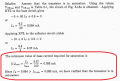
Thank you all for the clarifications, I am trying to absorb what is told, an example from the same textbook with similar problem

1771734832112.png
 
Last edited:

WBahn

Joined Mar 31, 2012
32,703
Thank you all for the clarifications, I am trying to absorb what is told, an example from the same textbook with similar problem

View attachment 363807
Thanks for posting this as it provides some useful context.

For the purposes of the original problem, the author is clearly expecting you to use hFE=100 even in saturation. So you want to be sure to do that just to make the grader happy.

But it really leaves open the question of WHY the author thinks that this is a reasonable thing to do. Do they really believe that? Are they just trying to keep things simple at this point in the journey, which is at a very introductory level? The latter might well be possible as early models are often piecewise linear resulting in abrupt transitions between regions that, while easy to do the math for, are very unrealistic (though, having said that, they are often more than good enough for real-world work).

The clue might be in looking in the text, possibly further on, to see if they eventually address the fact that hFE drops significantly as the transistor saturates.
 

LvW

Joined Jun 13, 2013
1,995
As you have probably gathered by now, some people use Beta=10 for bipolar transistor saturation cases. It's like a heuristic for saturation. It can be different, but when we don't know what it is we often just use 10.
Also, now you see that 21ua is for the base current, and you know that the base current times the Beta is equal to the collector current in these calculations. This means that with 21ua into the base you calculate the collector current, and since that is the maximum collector current, you can calculate the resistor value, which also depends on the source of 10v and the saturation voltage of 0.2v .
Hi again,
Sorry to say, but the highlighted statement is - in my view - somewhat misleading.
This would assume that - even in saturation - there would be a (quasi-)linear relationship between Ib and Ic.
But this is , of course, no the case - the current Ic is in saturation!!

(1) The classical procedure is as follows (Vcc and Rc given):
We determine the collector current Ic,sat which brings the product Ic,sat*Rc to a value which allows saturation (with Vbc>Vbe equivalent to Vce<Vbe) .
Now - because we do not know the corresponding base current Ib (because there is NO known relationship to Ic) we often are using - as a rule of thumb - a value of Ib=Ic,sat/10 for further calculations.
Using this (or a similar) value for Ib, we find a suitable value for the series resistor Rs between signal voltage Vs and the base node.
The product Ib*Rs must allow a sufficient safety margin to bring/keep the transistor into saturation: (Vs-Ib*Rs)=Vbe>Vbe,sat.
Because, in reality, Ib will be somewhat smaller than estimated (due to the safety margin) , the remaining voltage Vbe will be able to allow saturation

(2) If the resistor Rc is the only unknown variable, we are looking for the current Ic,sat that makes the product Ic,sat*Rc large enough to reach saturation.
Now let us assume that this current Ic,sat is associated with a base current Ib that can satisfy the required inequality Vs-Ib*Rs=Vbe>Vbe,sat - even under unfavorable conditions (with a safety factor we set: Ib=Ic,sat/10). For a known current Ib, this consideration then yields the current Ic,sat and thus also the minimum value for the resistance Rc (10 V - Ic,sat*Rc < 0.2V)
 
Last edited:

MrAl

Joined Jun 17, 2014
13,667
Hi again,
Sorry to say, but the highlighted statement is - in my view - somewhat misleading.
This would assume that - even in saturation - there would be a (quasi-)linear relationship between Ib and Ic.
But this is , of course, no the case - the current Ic is in saturation!!
I do not see what you mean. It seems that you are looking at this one way while I am looking at it from a different perspective.

Is the following statement true or false:
"The collector current is always equal to the Beta times the base emitter current".

How many times have we seen Ic=Ib*Beta? It must have been a lot, yet sometimes we see less iC than other times. So what is going on here?

What is going on is the action of the collector base diode is reducing the overall Beta as the collector voltage falls and starts to make the transistor enter what we call CE saturation. Thus, we actually have TWO (or more) different Beta's to consider. We have the major Beta spec of the transistor, which could be 100 or so, and we have the decreased Beta which comes from the forward biasing of the collector base diode.
For perfectly linear operation, we usually use the spec of 100, but for saturation we often (but not always) use a value of 10.

Now I ask the question again:
Is the following statement true or false:
"The collector current is always equal to the Beta times the base emitter current".

In the case of linear operation this is true, and in the case of saturation it is also roughly true but it's more of a constraint than a direct calculation.
If we have 10ua into the base and the Beta is 100, we get Ib*Beta=1ma. That's more or less linear operation.
If we drop the Beta to 10, we have only 100ua collector current. We then have to tests that using the collector resistor to see if the drop gets us down to a voltage that is typical of a saturation voltage, like around 0.2 to around 0.7v. This does not mean that the 100ua has to actually flow in the collector. It just has to provide a voltage drop that is enough to get the transistor to look like it will behave as it would in saturation.
The point being, we still have to multiply Ib*Beta even with the reduced Beta in order to do this test.

So the answer to the question is YES for linear operation, and YES for in saturation, except in saturation it's more of a test than a calculation of the actual collector current.

Two examples:
1. The above 100ua calculation. We have a 10v power supply voltage, 10k collector resistor, and Beta=10 and Ib=10ua.
Ic=Ib*Beta=100ua.
100ua times 10k equals 1v.
10v-1v=9v CE, transistor is not in saturation.
2. Same calculation, now Rc=20k.
100ua times 20k equals 5v.
10v-2v=8v CE, transistor not in saturation.
3. Same calculation, now Rc=50k.
100ua times 50k equals 5v.
10v-5v=5v CE, transistor not in saturation.
4. Same calculation, Rc=100k.
100ua times 100k equals 10v.
10v-10v=0v CE, transistor is in saturation.
5. Formula:
vCE=Vcc-Rc*Ic, transistor is in saturation if:
vCE<=VHigh
where VHigh is the assumed higher saturation voltage limit.
If we set VHigh=0.7v, then since:
0<=0.7
we assume the transistor is in saturation.

In real life though, it depends on the conduction of the CB diode. If the CB diode is forward biased, then we say it has entered saturation. When the CB diode conducts in the forward direction, it makes the apparent Beta less than the linear mode Beta, but it's still usually called the "Beta".
We don't usually do this except in spice because the calculations quickly become unwieldly even for just one transistor, so we come up with approximations or rules of thumb that can help speed up the analysis. If the calculation requires very accurate calculations, then we must use the more advanced models.

I think the only difference between views is one is a direct calculation, the other is a constraint negotiation. They both still involve calculations though.

We also have to realize that NONE of this may be true (any of these simplified views) if we have special cases like high-speed switching, low operating voltages, etc. Spice models are usually best, followed by actual prototype construction and bench testing.
 
Last edited:
Status
Not open for further replies.
Top