Transistor question

Thread Starter

chaosdestro0

Joined Apr 30, 2011
10
I am having difficulty understanding how you would find the voltage across R2.
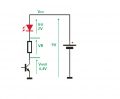
Let's say I had this circuit, with Vout as 4.4v and a voltage drop across the diode at 2v. From the mark scheme, it says do 9-2-4.4. I am not sure why this does this, can anyone explain?
 

Thread Starter

chaosdestro0

Joined Apr 30, 2011
10
Do you know II Kirchhoff's law (KVL)??
For your circuit KVL must hold


Vcc = Vout + VR + Vd = 9V
VR = Vcc - Vd - Vout
Wait, so why does the voltage from the v out of the transistor not add to the 9v?
I have done work on it but without additional sources.
 

Jony130

Joined Feb 17, 2009
5,598
Well, I don't understand you question.
Can you specify your question.
Your circuit has "external 9V additional sources".
 

ErnieM

Joined Apr 24, 2011
8,415
Wait, so why does the voltage from the v out of the transistor not add to the 9v?
Because they are of opposite polarity. Look at the arrows drawn for you.

If you put two 1.5 volt batteries in series, same polarity, they add, you see 3V across both.

If you put two 1.5 volt batteries in series, but opposite polarity, they subtract, and you see about 0V across both.
 

jegues

Joined Sep 13, 2010
733
Wait, so why does the voltage from the v out of the transistor not add to the 9v?
I have done work on it but without additional sources.
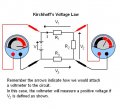
If you are confused about the arrows, it basically indicates how one would attach a voltmeter to the circuit.

See the figure attached.
 

Attachments

Thread Starter

chaosdestro0

Joined Apr 30, 2011
10
Because they are of opposite polarity. Look at the arrows drawn for you.

If you put two 1.5 volt batteries in series, same polarity, they add, you see 3V across both.

If you put two 1.5 volt batteries in series, but opposite polarity, they subtract, and you see about 0V across both.
Now I see it, Cheers :).
 
Top